

Motor wattage is easy to compare and easy to overvalue. Product listings often place the largest power number near the top, encouraging parents to treat watts like a simple ranking. In practice, a children’s dirt bike needs the right combination of motor output, controller tuning, gearing, traction, vehicle weight and speed control. A huge peak number does not help if the child cannot start smoothly or if the bike is too heavy to hold up. This guide explains what common power levels can realistically mean and how to choose without buying more than the rider needs.
Rated power, peak power and marketing numbers
Manufacturers may publish continuous, rated or peak output, and those figures are not interchangeable. Continuous or nominal power describes what a motor can sustain under defined conditions. Peak power may be available only briefly during acceleration or climbing. Some listings do not clearly say which number they use. That makes direct comparison difficult. Parents should ask how the bike performs in each speed mode, what rider load it supports and whether the published number is nominal or peak before assuming two products with the same wattage will feel alike.
What lower-power bikes do well
Motors in the roughly 250W to 350W range can work for small riders on smooth, level surfaces at modest speeds. They may be light, quiet and unintimidating. The tradeoff appears when the surface changes. Thick grass, soft soil, a heavier child or even a mild hill can reduce speed quickly and create additional heat. This category is best viewed as a bridge from ride-on toys or electric balance bikes rather than a universal trail solution. Good brakes and controlled response are still necessary even at lower power.
The practical middle range
Around 500W to 850W, designers have more flexibility to provide firm starts, maintain speed on grass and handle moderate off-road resistance. This range can suit children who already balance and pedal confidently but are learning throttle control. An 850W brushless motor, for example, can offer usable torque without placing the bike in an adult-performance category. The controller should still soften initial response and provide lower modes. A motor capable of more work is helpful only when the rider can access that capability gradually.
When 1000W or more makes sense
A 1000W label may be reasonable for a larger youth bike, a heavier rider or more demanding terrain, but it is not automatically an upgrade for every child. Higher output can produce stronger acceleration, increase top speed or require a heavier frame and battery. Those changes can reduce confidence if the child cannot plant their feet or recover the bike at a stop. Parents should separate future-use aspirations from present control. It is better to outgrow a manageable first bike than to avoid riding because an oversized machine feels intimidating.
Gearing and controller tuning change the feel
Two motors with identical wattage can behave very differently. Shorter gearing may create stronger low-speed pull and a lower top speed, while taller gearing can trade some climbing response for speed. Controller programming determines how quickly current reaches the motor when the throttle moves. Progressive mapping makes the first portion of throttle travel calmer. Abrupt mapping can make even a modest motor difficult for a new rider. Test smooth starts and walking-pace control, not only maximum speed.
Brushless efficiency and maintenance
Brushless motors are common on better youth electric dirt bikes because they avoid physical brushes that wear inside the motor. They can run efficiently, respond consistently and require less motor maintenance than brushed designs. That does not mean every brushless system is equal; controller quality, sealing, cooling and drivetrain setup still matter. Parents should keep the chain adjusted, maintain tire pressure and avoid overloading the bike. A well-maintained mid-power system often performs better than a larger motor working through a neglected drivetrain.
How parents should compare the options
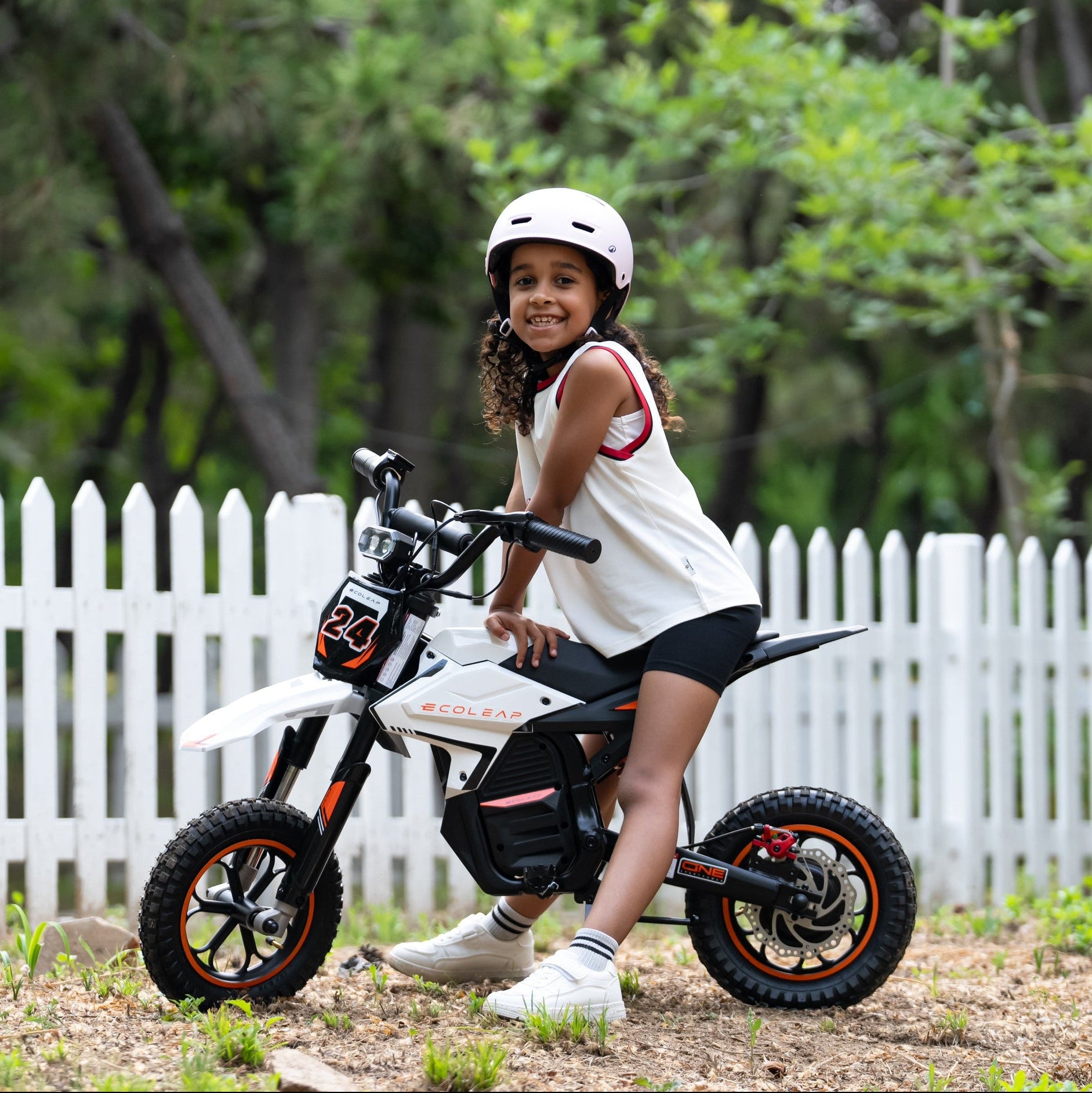
Specifications are useful only when they are interpreted together. Rider weight, inseam, hand strength, experience and riding surface can change how the same bike feels. A child who can balance confidently but is new to a twist throttle may need a different setup from a child who has already spent a season on an electric balance bike. Parents should evaluate whether the rider can place at least the balls of both feet down, reach both brake controls without stretching and hold the bike upright at a stop.
Also consider where the bike will actually be used. Flat packed dirt places less demand on the power system than grass, soft soil or repeated climbs. A bike that looks adequate in a specification table may work harder in a heavy backyard surface. Conversely, buying far more capability than the child can control can make learning slower. The best first setup gives the rider enough performance for the intended terrain while preserving a calm, predictable response.
A practical test before buying
If possible, have the child sit on a bike of similar dimensions while wearing normal riding boots. Check reach to the handlebar, brake levers and foot pegs. Ask the child to lean the bike slightly and recover it. Review how speed modes are selected, whether a parent can limit performance and how easily the battery can be charged. Confirm replacement parts, warranty coverage and the availability of tires, brake pads, chains or belts before treating a low purchase price as the full cost.
For online purchases, compare published seat height, vehicle weight, maximum rider load, wheel size, battery specification and speed settings. Age ranges are broad marketing guides, not a substitute for fit. Two children of the same age can differ greatly in height, confidence and coordination. A conservative setup that the child can control usually produces more useful riding time than a larger machine bought mainly for future growth.
Safety and supervision
Every test ride should begin in the lowest suitable mode on flat, open private property. Use a properly fitted certified helmet, eye protection, gloves, long sleeves, long pants, knee and elbow protection and over-the-ankle footwear. An adult should inspect the tires, brakes, throttle, steering, chain or belt, fasteners and battery before riding. Children should practice smooth starts, straight-line braking and wide turns before adding hills or loose terrain.
Electric dirt bikes are off-road vehicles and local access rules vary. Confirm that the property permits the exact vehicle and youth rider. Speed, range and climbing performance change with rider weight, temperature, surface, tire pressure and riding style. Manufacturer estimates are useful for comparison, but they should not be treated as guaranteed results for every family.
Frequently asked questions
Is 850W too much for a six-year-old?
Age alone cannot answer this. Consider height, weight, balance skill, throttle experience, speed settings and adult supervision. Start in the lowest mode on flat ground.
Will more watts make the bike climb every hill?
No. Rider weight, gradient, surface, gearing, tire traction, battery charge and controller limits all affect climbing.
Why do some lower-watt bikes feel faster?
They may be lighter, geared differently or programmed with a more aggressive throttle. Published wattage does not define the complete riding experience.
What motor does the K2 use?
The Ecoleap K2 uses an 850W brushless motor. Its three speed settings allow parents to introduce the available performance in stages rather than giving a beginner the maximum immediately.
Use a performance checklist instead of chasing watts
During a supervised test, evaluate walking-speed control, acceleration from a normal start, braking distance, response on the intended surface and how quickly speed falls on a mild incline. Listen for drivetrain strain and check whether the system becomes unusually hot. These observations reveal more than an isolated wattage claim because they show how the motor, controller, gearing, battery and tires work together under the child’s actual load.
Parents should also compare the lowest speed mode and throttle mapping. A bike with useful mid-range power and a calm first mode can support learning and later terrain better than a weak bike that is quickly overwhelmed or a powerful one that surges. Keep the focus on repeatable control, not a single dramatic acceleration run.
Final recommendation
Choose enough motor to prevent the intended terrain from constantly overwhelming the bike, then prioritize smooth delivery and adjustable limits. For mixed backyard riding, the middle range can offer a sensible balance of traction, growth room and control. The safest choice is not the lowest or highest wattage; it is the bike the child can fit, stop and operate consistently.
Families comparing beginner models can also review the Ecoleap K2 kids electric dirt bike and our kids electric dirt bike buyer’s guide.
Safety note: Always follow the product manual, use complete protective gear and ride only in permitted off-road areas under responsible adult supervision.


Share:
What Tire Size Is Best for a Kids Dirt Bike?
Kids Electric Dirt Bike Battery Care: Charging, Storage and Lifespan