


Lithium vs. Lead-Acid Batteries in Kids’ Electric Dirt Bikes: What’s the Difference?
When choosing a kids’ electric dirt bike, parents often focus on speed, motor power, and price. However, the battery type can have just as much impact on the bike’s weight, range, performance, and everyday usability.
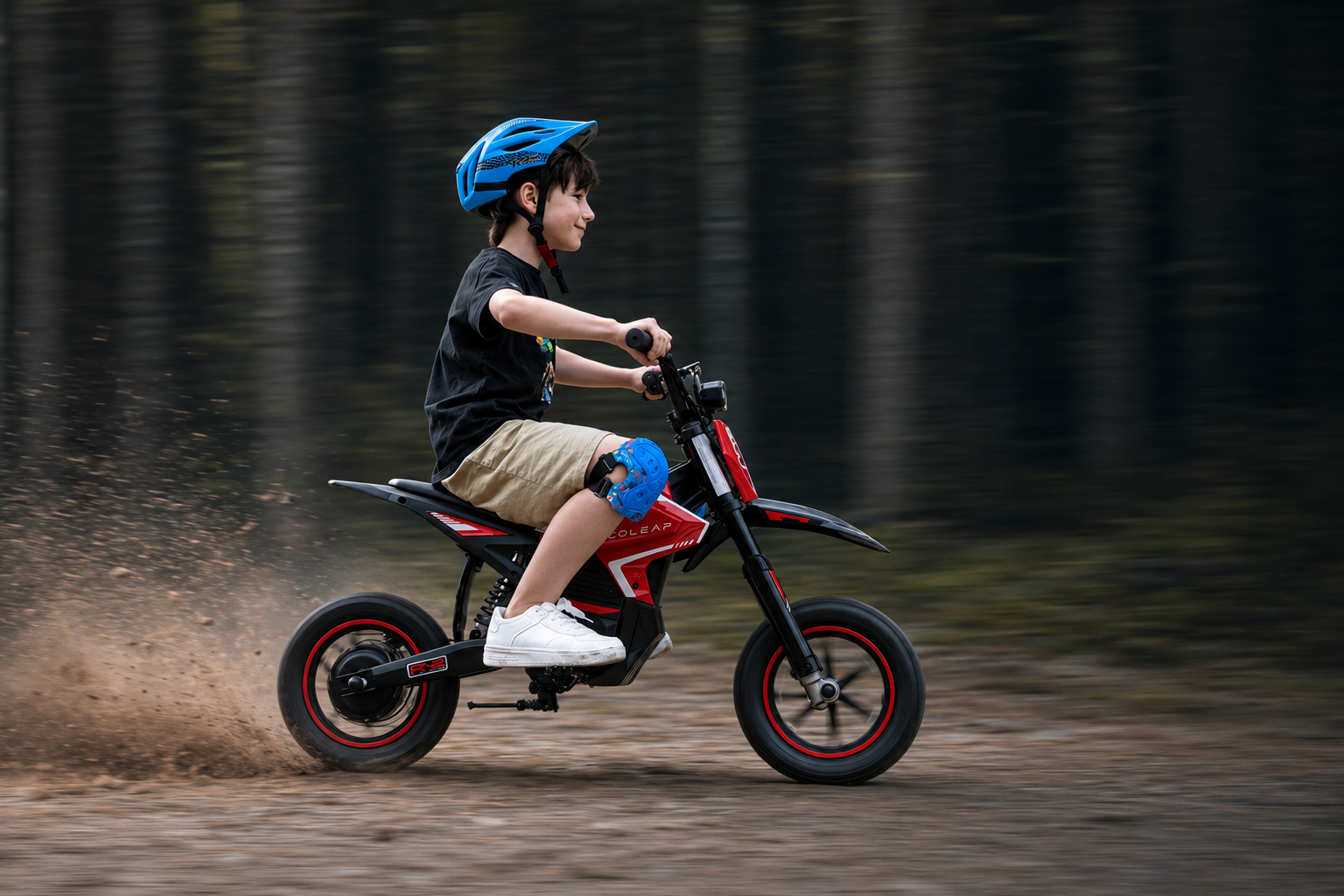
Most affordable kids’ electric bikes use sealed lead-acid batteries, while more advanced models—including the Ecoleap K2—use lithium-ion batteries.
So, what is the difference, and why does it matter for young riders?
Lithium vs. Lead-Acid Batteries at a Glance
| Feature | Lithium-Ion Battery | Lead-Acid Battery |
|---|---|---|
| Weight | Lighter for the same capacity | Heavier and bulkier |
| Energy density | Stores more energy in less space | Requires more weight for similar capacity |
| Riding range | Typically longer | Usually designed for shorter riding sessions |
| Power delivery | More consistent as the battery drains | Performance may weaken noticeably at lower charge |
| Charging efficiency | Generally higher | Usually takes longer to recharge |
| Battery lifespan | Typically longer with proper care | More sensitive to deep discharge |
| Storage | Lower self-discharge | Can lose capacity if stored without regular charging |
| Upfront cost | Higher | Lower |
| Battery management | Usually includes a BMS | Simpler battery system |
1. Less Battery Weight Means Easier Handling
Weight matters more on a children’s dirt bike than on an adult vehicle. Young riders have less strength, so a heavy battery can affect:
- Low-speed balance
- Steering and cornering
- Confidence when starting and stopping
- The ability to lift or reposition the bike
- Handling on grass, dirt, and uneven terrain
Lithium batteries store more energy without the bulk of traditional lead-acid batteries. This helps provide longer rides while keeping the bike more manageable for young riders—and easier for parents to transport.
More Energy Without the Extra Battery Weight
2. More Range From a Compact Battery
Lithium-ion batteries have a much higher energy density, allowing manufacturers to fit more usable capacity into the limited space of a kids’ dirt bike.
The K2’s 36V 7.8Ah battery stores approximately:
This allows the K2 to offer up to 18 miles of range under favorable conditions. By comparison, many lead-acid kids’ bikes describe their range in minutes rather than miles.
For example, the lead-acid-powered Razor MX350 is rated for up to approximately 30 minutes of continuous use in its high-speed mode or 60 minutes in low-speed mode. These figures should not be compared directly with the K2’s mileage because testing conditions, speed, terrain, and rider weight may differ.
The practical benefit is simple:
More Time Riding. Less Time Waiting.
3. More Consistent Power During the Ride
As a lead-acid battery loses charge, voltage can drop more noticeably. Riders may experience:
- Slower acceleration
- Reduced hill-climbing performance
- A bike that feels increasingly weak near the end of a ride
Lithium batteries generally maintain a more stable voltage through most of the discharge cycle. This can help provide smoother and more predictable performance from the beginning of the ride until the battery becomes low.
Consistent Power From Start to Finish
This does not mean performance remains completely unchanged at every battery level, but lithium power is generally more consistent than lead-acid power.
4. Better for a Full Day of On-and-Off Fun
Children rarely ride continuously for several hours. A typical day may include:
- A morning riding session
- A break for lunch
- Another ride in the afternoon
- Short rides throughout a family gathering or camping trip
A higher-capacity lithium battery is well suited to this pattern of riding. With up to 18 miles of range, the K2 can support multiple riding sessions for many families.
Charge Once. Enjoy a Full Day of On-and-Off Fun.
Actual range will vary with speed mode, rider weight, terrain, temperature, tire pressure, and riding style.
5. Easier Long-Term Ownership
Lead-acid batteries are particularly sensitive to being stored in a discharged state. If they are not recharged regularly—especially during winter storage—they may lose capacity permanently.
Lithium batteries also require proper care, but they generally offer:
- Lower self-discharge
- Less frequent maintenance during storage
- Better suitability for occasional family use
- A longer service life when correctly charged and stored
Battery life still depends on cell quality, charging habits, temperature, and storage conditions. Any specific lifespan claim should be supported by actual battery testing.
What About Battery Safety?
Lithium batteries should not simply be described as “safer” than lead-acid batteries. Poor-quality lithium cells, incompatible chargers, or inadequate battery-management systems can create serious risks.
Parents should look for:
- A reliable battery-management system
- Overcharge, over-discharge, overcurrent, and short-circuit protection
- A charger specifically matched to the battery
- Verifiable battery and electrical-system certifications
- Clear charging and storage instructions
Always use the original charger and never charge a damaged, wet, unusually hot, or swollen battery.
Why the K2 Uses Lithium Power
The Ecoleap K2 is equipped with a 36V 7.8Ah lithium battery designed to provide up to 18 miles of range with less battery bulk and more consistent performance.
That means more than an impressive number on a specification sheet. It means young riders can spend more time practicing, exploring, and building confidence—and families can spend less time waiting between rides.
Share:
Why the Aipas S1 AMP Is Primarily Designed for Adult Riders