

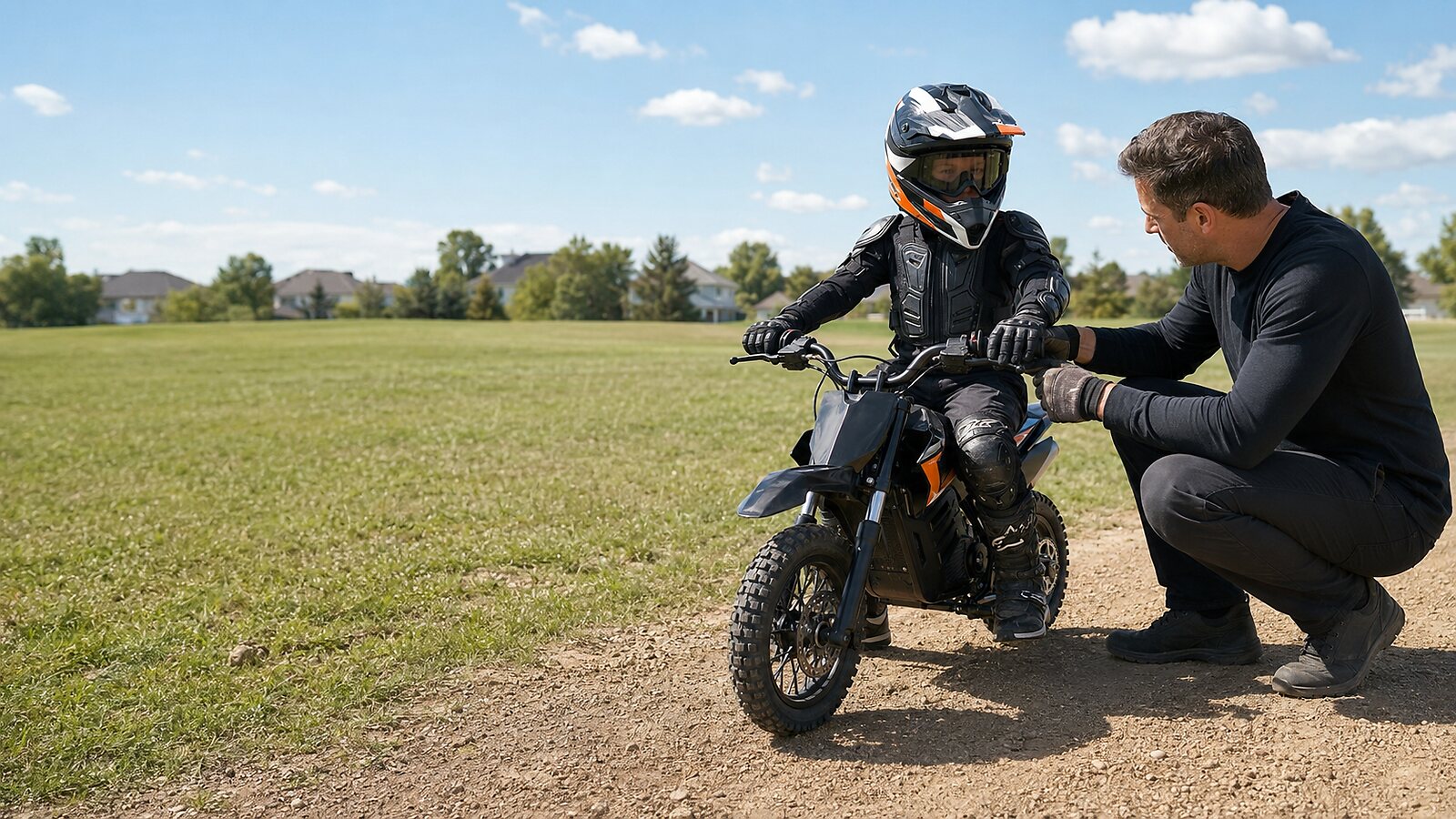
Choosing the best first dirt bike for a 6-year-old is less about finding the highest power or fastest top speed and more about finding a bike the child can control with confidence. At this age, two children with the same birthday may have completely different balance skills, height, hand strength and comfort with speed. The right first bike should fit the rider now, offer a genuinely manageable training mode and leave enough room to progress without feeling heavy or intimidating.

What should parents look for in a first dirt bike for a 6-year-old?
A useful buying decision comes down to five questions:
- Fit: Can the child mount, sit, reach the handlebars and support the bike without panic?
- Balance: Can the child ride a pedal bike independently and look ahead while turning?
- Controls: Can small hands reach and operate the brake? Does the child understand that releasing the throttle comes before braking?
- Speed management: Can a parent begin with a restricted speed instead of exposing the rider to the bike's full performance on day one?
- Terrain: Is the bike equipped for the grass, packed dirt or gravel where it will actually be used?
Maximum speed and motor output matter, but they should come later in the decision. A bike that looks impressive on a specification sheet can be a poor first bike if the child cannot confidently stop, turn or hold it upright.
Age is a starting point—not a sizing system
Six-year-olds vary widely in height, inseam, coordination and temperament. One child may have spent years on a balance bike and bicycle, while another is just learning to balance on two wheels. That is why an age label should be treated as an initial filter rather than a final recommendation.
For a beginner, secure ground contact builds confidence. The child does not necessarily need to sit completely flat-footed in every situation, but should be able to stabilize the bike during mounting, stopping and a minor lean. If the bike tips and the rider immediately feels trapped by its weight, it is probably too large or too heavy for a comfortable first experience.
A simple at-home fit check
- Have the child wear the same shoes or boots used for riding.
- Measure inseam from the floor to the crotch while standing naturally.
- Compare that measurement with the bike's real seat height and seat width.
- Let the child sit on the actual bike whenever possible; a wide seat can make a listed seat height feel taller.
- Check that elbows remain slightly bent and the child can turn the handlebar without leaning forward excessively.
- Confirm the child can reach the brake lever and apply useful pressure with a small hand.
Do not buy a much larger bike simply because it may last for more years. A bike that is intimidating now can delay learning and reduce confidence, which defeats the purpose of buying room to grow.
Is your 6-year-old actually ready for a motorized dirt bike?
Readiness is better measured by behavior than by birthday. Before using a powered bike, a child should consistently demonstrate most of the following:
- Rides a two-wheel bicycle independently without training wheels.
- Starts, turns and stops while looking ahead rather than down at the front wheel.
- Follows short instructions even when excited.
- Understands that releasing the throttle reduces power.
- Can squeeze the brake without removing the whole hand from the handlebar.
- Can stop at a marked point rather than only when an adult shouts.
- Does not freeze and continue holding the throttle when nervous.
- Accepts wearing a helmet and protective equipment every ride.
If the child cannot yet balance independently, struggles to follow stop commands or becomes frightened when the bike leans, continue practicing on a balance bike or pedal bicycle first. There is no advantage in rushing. Confidence and control are more valuable than reaching a powered-bike milestone at a particular age.
Electric or gas dirt bike for a 6-year-old?
Both can teach useful riding skills, but they create different learning environments. A small gas dirt bike introduces engine noise, heat, fuel, vibration and additional operating procedures. A children's electric dirt bike starts quietly, requires no fuel mixing and can make short practice sessions easier for a family to manage.
| Consideration | Kids electric dirt bike | Small gas dirt bike |
|---|---|---|
| Starting | Simple electric power-on procedure | May require fuel, starting procedure and warm-up |
| Noise and vibration | Generally quieter with little motor vibration | More sound, vibration and heat |
| Speed progression | Selectable speed modes may support staged learning | Depends on model and any throttle-limiting system |
| Daily upkeep | Charge battery; inspect tires, brakes and fasteners | Includes fuel and engine-related maintenance plus normal chassis checks |
| Best use | Frequent, manageable backyard or private-property practice where permitted | Families specifically preparing for gas-bike or motocross riding |
Electric does not automatically mean harmless. A children's electric bike is still a motorized off-road vehicle. Proper fit, protective equipment, adult supervision and a controlled riding area remain essential.
Ecoleap K1 vs. K2 for a 6-year-old
The better choice depends on the child's current size and experience. K1 is the more approachable option for a smaller, lighter or cautious beginner. K2 is the progression-oriented choice for a rider who already has two-wheel confidence and fits the bike correctly.
| Parent question | K1 may fit better when… | K2 may fit better when… |
|---|---|---|
| Riding background | The child is new to powered riding or still cautious on two wheels | The child already rides a bicycle confidently and follows riding instructions |
| Size and confidence | A lighter, easier-to-manage introduction is the priority | The rider fits the larger platform and can hold it upright independently |
| Learning goal | Build basic throttle, braking and balance skills | Continue from basic control toward varied terrain and higher skill levels |
| Room to progress | Controlled first experiences matter more than future performance | Three speed modes provide a staged path as ability improves |
Parents should verify the current product dimensions, recommended rider range and weight limits before ordering. If a child falls between the two models, choose the bike the child can control today rather than the bike that promises the most future speed.
Why the K2 brushless motor matters for beginners
The K2 uses a brushless motor. This is more than a technical label. A brushless design eliminates the carbon brushes found in a traditional brushed motor, removing a wear component and generally supporting quieter operation and lower routine motor maintenance.
For a young rider, the practical value is the riding environment. Less mechanical noise can make the first session feel less intimidating and makes it easier for the child to hear a supervising adult. A smooth electric powertrain also lets the parent focus the lesson on looking ahead, throttle release, turning and braking rather than engine noise or shifting procedures.
The K2 is listed with 850W peak power. Peak power describes short-duration capability, not continuous output, and it should not be interpreted as the speed a beginner must use. The important beginner feature is the ability to restrict the bike to an appropriate mode while preserving enough capability for future progression.
Why a lithium battery improves the ownership experience
The K2's lithium battery helps make electric dirt-bike ownership more practical for families. Compared with older lead-acid battery systems commonly found in entry-level ride-on products, lithium batteries generally offer higher energy density. That means useful energy can be stored without the same battery weight burden.
For parents, the benefits are easier charging routines, no fuel storage and a bike that can be used for short practice sessions without preparing a gas engine. For the rider, reducing unnecessary mass helps the overall package feel more manageable, although the complete bike's weight and fit still matter more than battery chemistry alone.
Lithium battery care parents should know
- Use only the charger supplied or approved for the bike.
- Charge in a dry, ventilated location away from flammable materials.
- Inspect the battery, connector and charger before use.
- Do not charge a visibly damaged, swollen or unusually hot battery.
- Allow the bike to cool after riding before charging.
- Follow the manual's storage instructions during long periods without use.
- Keep charging equipment out of children's control.
Actual riding time varies with rider weight, speed mode, surface, hills, temperature, tire pressure and riding style. Parents should treat any range figure as an estimate rather than a guaranteed session length.
Why three speed modes are more useful than one high top speed
For a first dirt bike, the most meaningful performance feature is not the maximum speed—it is whether the bike can match the child's present ability. The K2's three selectable speed modes give parents a clearer progression path instead of asking a beginner to manage full performance immediately.
Mode 1: learn the controls
Use the lowest mode for mounting, smooth starts, straight lines and predictable stopping. Mark a start line and stop box with cones. The child should repeatedly release the throttle and brake inside the box without verbal reminders before moving on.
Mode 2: connect skills
After starts and stops become automatic, the middle mode can support wider turns, figure-eight practice and gentle changes in surface. The goal is not to chase speed. It is to maintain a stable line, look through the turn and slow down before entering it.
Mode 3: unlock only after consistent judgment
The highest mode should be reserved for a rider who can anticipate obstacles, reduce speed voluntarily, stop on command and recover calmly from small mistakes. Reaching a certain number of rides is not enough. Advancement should be based on repeatable control.
Tires, suspension and brakes matter on real terrain
A bike that feels fine on smooth pavement may behave very differently on grass or loose dirt. Wider knobby pneumatic tires help provide traction and absorb small surface irregularities. The K2's 12 × 2.75-inch tires provide a broader contact patch than narrow ride-on tires, while front and rear suspension help manage bumps on appropriate beginner terrain.
Braking deserves equal attention. A child should be able to reach the lever comfortably and apply the brake without losing handlebar control. Before every ride, an adult should check brake response, tire pressure, wheel condition, chain or drive components as applicable, and visible fasteners. Equipment cannot compensate for a riding area that is too steep, crowded or unpredictable.
A four-week first-riding plan
Week 1: stationary controls and straight lines
- Walk around the bike and identify the power control, throttle and brake.
- Practice mounting and dismounting with the power off.
- Have the child say “release, then brake” before each stop.
- Use the lowest mode in a flat, open area.
- End the session while the child is still confident; 10–15 focused minutes can be enough.
Week 2: accurate stops and wide turns
- Create a visible stop box with cones.
- Practice stopping from the same distance several times.
- Add large circles in both directions.
- Teach the child to look where they want to go rather than at the front tire.
Week 3: figure eights and surface changes
- Combine left and right turns into a wide figure eight.
- Introduce packed dirt or short grass only after dry, flat practice is consistent.
- Keep the rider in the lowest suitable mode if the new surface adds difficulty.
Week 4: supervised progression
- Consider the next mode only if the rider stops voluntarily and follows commands.
- Add gentle terrain variation one element at a time.
- Do not combine more speed, a new surface and obstacles in the same session.
If the child falls and becomes frightened, pause the session. Check for injury, then let confidence return at the child's pace. Forcing another attempt immediately can turn a minor fall into long-term reluctance.
Common buying mistakes
Buying for the child to “grow into”
Extra seat height and weight are not free future value. If the rider cannot stabilize the bike now, the larger model may slow learning.
Choosing by peak watts alone
Peak output does not tell you how manageable the bike feels in its lowest mode, how well it fits or how the controls suit small hands.
Testing on grass or a hill first
Grass adds rolling resistance and can hide holes; hills magnify throttle and braking mistakes. Begin on a flat, open, predictable surface.
Increasing speed after one good ride
One successful session may reflect ideal conditions. Look for consistent starts, turns and stops over multiple rides before progressing.
Skipping protective equipment because the bike is electric
Electric power does not remove fall or collision risk. A properly fitted helmet, eye protection where appropriate, gloves, long sleeves, long pants, over-the-ankle footwear, knee protection and elbow protection are sensible baseline equipment.
Frequently asked questions
What is the best dirt bike for a 6-year-old beginner?
The best choice is a bike the child can physically fit and control in a restricted speed mode. K1 may suit a smaller or cautious first-time rider, while K2 may suit a confident bicycle rider who fits the larger bike and is ready for a three-stage progression path.
Should a 6-year-old start on K1 or K2?
Choose K1 when low weight and easy first control are the priorities. Consider K2 when the child already balances confidently, reaches the controls, can hold the bike upright and will benefit from its brushless motor, lithium battery and three selectable speed modes.
Should both feet touch the ground?
For a first motorized bike, reliable ground contact can increase confidence. Exact fit depends on inseam, seat width, footwear and experience, but the rider should be able to stabilize the bike during a normal stop without panic.
How fast should a 6-year-old ride?
There is no universal correct speed. Start in the lowest available mode and increase only after the rider consistently starts, turns, releases the throttle and stops without repeated reminders.
Is a brushless motor better for a kids' dirt bike?
A brushless motor avoids brush wear and generally offers quieter operation and lower routine motor maintenance. Those are practical family benefits, but fit, speed control, brake reach and supervision remain more important to beginner safety.
Is a lithium battery better than lead acid?
Lithium batteries generally provide higher energy density and lower battery mass for a given amount of stored energy. They still require correct charging, inspection and storage according to the manufacturer's instructions.
Are three speed modes necessary?
They are not the only way to manage a beginner bike, but they are highly useful. Separate modes let parents match performance to the rider's current ability and create a clear progression process.
Can a 6-year-old ride on grass?
Only after basic control is established on a flat, predictable surface. Dry, short grass may be appropriate with adult supervision, but it increases resistance and can conceal holes or slippery areas.
When is a child ready to move up a speed mode?
Move up only when the rider repeatedly stops at a chosen point, slows before turns, looks ahead, follows commands and remains calm when something unexpected happens.
Final recommendation
For most parents, the best first dirt bike for a 6-year-old is the smallest bike that fits correctly, supplies enough traction for the intended terrain and provides a controlled path for learning. K1 is the more conservative starting point for a smaller or less experienced child. K2 is the stronger progression option for a child who already has solid bicycle skills and fits it properly, with a brushless motor for quieter low-maintenance operation, a lithium battery for practical family use and three speed modes that allow ability—not excitement—to determine when performance increases.
See the Ecoleap K1, see the Ecoleap K2, or compare more factors in our kids' electric dirt bike buyer's guide.
Safety note: Rider readiness varies. Product speed, power delivery and range can change with rider weight, terrain, temperature, tire pressure and riding mode. Children should ride only in permitted off-road areas under responsible adult supervision. Always follow the product manual, local rules and applicable age requirements.


Share:
Best Dirt Bike Before a Yamaha PW50
Razor Dirt Rocket Age and Size Guide: MX125, MX350, MX500 and MX650