

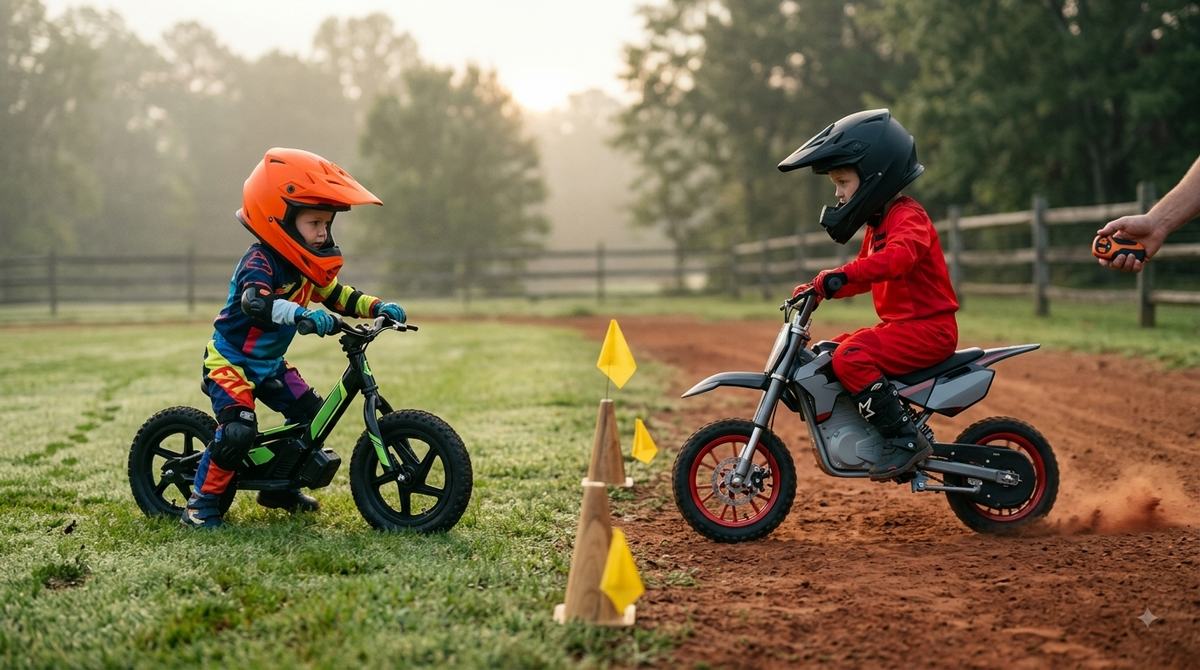
A Yamaha PW50 is one of the best-known first gas dirt bikes, but “first dirt bike” does not always mean “first powered two-wheeler.” For a child who is still learning balance, throttle control, braking and boundaries, a smaller speed-selectable electric dirt bike can make the step toward a PW50 more gradual and easier to supervise.

Why some children benefit from a bike before the PW50
The PW50 is designed as an entry-level motorcycle. Its automatic transmission and adjustable throttle stop remove the need to shift gears, and its low 18.7-inch seat helps many small riders reach the ground. Even so, it is still a 49cc two-stroke motorcycle with fuel, engine heat, exhaust noise and approximately 90 pounds of wet weight. Those characteristics are normal for a gas dirt bike, but they add demands for a child who has never controlled a powered two-wheeler.
A pre-PW50 stage is not about delaying progress. It is about separating skills so the child does not have to learn everything at once. On a quieter, lower-speed electric bike, a parent can focus first on:
- Looking ahead instead of down at the front tire
- Rolling the throttle off immediately when uncertain
- Braking smoothly without grabbing the lever in panic
- Keeping both feet on the pegs once moving
- Turning within a marked boundary
- Stopping at a specific cone or on a verbal command
Once these behaviors become automatic, the transition to a gas bike is less about learning basic control and more about adapting to a heavier machine, different power delivery, noise and vibration.
PW50 vs. a pre-PW50 electric bike: different jobs
| Consideration | Pre-PW50 electric bike | Yamaha PW50 |
|---|---|---|
| Primary purpose | Learn basic powered two-wheel control | Begin gas dirt-bike riding |
| Power source | Rechargeable battery | 49cc two-stroke engine |
| Speed progression | Selectable modes can create clear learning stages | Adjustable throttle stop limits throttle opening |
| Rider feedback | Quiet, low vibration; easier to hear coaching | Introduces engine sound, vibration and heat |
| Routine | Charge, inspect and ride | Fuel, oil system and motorcycle inspections |
| Best fit | New riders who still need repetition at lower speeds | Riders already showing consistent control and rule-following |
Neither category is automatically “better.” The right choice depends on the child’s size, coordination, confidence and ability to follow instructions. A skilled young rider may be ready for a PW50 immediately; another child of the same age may learn faster and more safely with an electric stepping stone.
Why the Ecoleap K2 works as a bridge to a PW50
The Ecoleap K2 is not a small gas motorcycle, and it does not try to reproduce every characteristic of a PW50. Its value is that it lets a young rider practice the transferable skills first, with controls that parents can introduce progressively.
1. A brushless motor delivers smoother, quieter practice
The K2 uses a brushless electric motor with up to 850W peak output. “Peak” describes the maximum short-duration output available under certain conditions; it should not be confused with continuous rated power. For a beginner, the more important point is how an electric brushless system feels during practice.
There are no motor brushes rubbing against a commutator, so there are fewer wear components inside the motor than in a brushed design. Brushless motors are also typically quieter and more efficient. On the training field, lower noise has a practical benefit: the child can hear “roll off,” “eyes up” or “stop at the cone” without an idling two-stroke engine between parent and rider.
The motor starts only when the throttle is used. That reduces some of the sensory load for a nervous beginner and allows the parent to repeat short drills without managing engine idle, exhaust or hot engine surfaces. It does not eliminate the need for supervision—the bike can still accelerate quickly if the rider twists the throttle abruptly—but it creates a calmer learning environment.
2. A lithium battery keeps the routine simple
The K2 uses a rechargeable lithium battery rather than a lead-acid battery or gasoline engine. Lithium chemistry generally offers better energy density, meaning useful energy can be stored without the bulk associated with older lead-acid packs. For families, the visible benefit is a straightforward routine: charge with the supplied charger, inspect the bike, and begin the session.
Electric riding also avoids fuel storage, carburetor-related starting routines and exhaust fumes. That convenience matters because beginners improve through frequent, short sessions—not only occasional long rides. A parent is more likely to set up a 15-minute stop-and-turn practice when preparation is simple.
Battery care still matters. Use the specified charger, charge in a dry and ventilated location, inspect the pack and cable before use, and follow the owner’s manual for storage. Range varies with rider weight, terrain, temperature, speed mode and repeated acceleration, so parents should plan sessions by remaining battery level rather than treating an advertised estimate as a guarantee.
3. Three speed modes turn progress into clear stages
The K2’s three selectable speed modes are the most relevant feature for a pre-PW50 training plan. A parent can keep the bike in the lowest mode while the child learns starts and stops, move to the middle mode for wider turns and standing posture, and reserve the highest mode until the rider consistently responds to instructions.
This is different from simply telling a child to “go slowly.” A beginner does not yet have refined wrist control, especially when startled. Limiting the available speed reduces the consequence of an accidental large throttle input while the correct habit is being formed. The next mode should be earned through repeatable behavior, not chosen because the rider asks to go faster.
A practical three-stage training plan
Stage 1: Walking-speed control
Use the lowest speed mode on flat, open private property. Set out two cones in a straight line. The child should start smoothly, place both feet on the pegs, ride to the second cone and stop in a marked box. Keep each session short and end before fatigue causes sloppy control.
Advance only when the rider can:
- Start without jerking the handlebar
- Roll off the throttle before applying the brake
- Stop inside the box five times in a row
- Stop immediately when the supervising adult gives the agreed signal
Stage 2: Turns, scanning and uneven ground
In the middle speed mode, build a wide oval or figure-eight course. Teach the rider to turn the head and look toward the exit. Introduce mild grass or smooth packed dirt only after flat-ground stopping is reliable. Avoid steep slopes, traffic, water, loose rock and crowded riding areas.
This stage should develop decision-making: slowing before a turn, choosing a line and leaving enough space to stop. Speed is not the objective.
Stage 3: Consistency and PW50 preparation
Use the highest mode only in a suitable area and only after the first two stages are routine. Practice longer runs, controlled deceleration and stopping after a distraction. Discuss the differences the child will encounter on a PW50: additional weight, engine noise, vibration, heat, fuel-related procedures and a throttle limiter that works differently from selectable electric speed modes.
A child is ready to test a PW50 when safe responses remain consistent even when excited—not only during one perfect lap.
How to know whether the bike fits
Age recommendations are only a starting point. Children of the same age can differ significantly in height, inseam, hand strength, coordination and judgment. For the K2, use the current recommended rider-height guidance of approximately 44–52 inches, then confirm physical control in person whenever possible.
- The child should reach the handlebars without locking the elbows.
- Hands should operate the throttle and brake without shifting off the grips.
- At least the balls of both feet should reach securely when seated; new riders often benefit from more contact.
- The rider should lift the bike from a minor lean with adult guidance.
- Knees should not be forced excessively high or interfere with steering.
Do not buy a much larger bike only for future growth. A bike that fits later can undermine confidence and control today.
When it may be better to go directly to a PW50
A pre-PW50 electric bike is helpful, but it is not mandatory. Going directly to a PW50 may be reasonable when the child already rides a two-wheel bicycle confidently, uses hand brakes correctly, follows boundaries without repeated reminders, fits the PW50 ergonomically and will always ride in an appropriate off-road area with experienced adult supervision.
If the family’s goal is organized mini-moto or motocross training, a knowledgeable coach or dealer should evaluate the rider. The PW50 introduces real motorcycle operation, while an electric starter bike focuses more narrowly on foundational control.
Common mistakes parents should avoid
- Choosing by age alone: Fit, coordination and judgment matter more than a birthday.
- Starting in the fastest mode: Speed can hide poor technique and increase panic responses.
- Moving up after one successful ride: Require the same safe behavior across multiple sessions.
- Using protective gear as a substitute for supervision: Gear reduces risk but does not make an unsuitable area safe.
- Practicing near vehicles or pedestrians: Beginners need a controlled area with generous runoff space.
- Ignoring fatigue: Tired hands and reduced attention often appear before the child admits being tired.
- Assuming electric means harmless: An electric dirt bike is still a powered vehicle and must be treated accordingly.
Pre-ride parent checklist
- Use a properly fitted, certified off-road helmet plus eye protection, gloves, long sleeves, long pants, over-the-ankle boots, knee protection and elbow protection.
- Inspect tires, brakes, throttle return, fasteners, cables and battery condition.
- Confirm the selected speed mode before the rider gets on.
- Review one stop signal and one riding boundary.
- Keep other children outside the practice area.
- Ride only on permitted private property or designated off-road areas.
- Check the owner’s manual and local regulations before use.
Frequently asked questions
What is the best age to start preparing for a PW50?
There is no universal age. Some children develop two-wheel balance and rule-following early, while others need more time. Evaluate fit, braking ability, throttle discipline and judgment rather than relying on age alone.
Is a balance bike enough preparation?
A balance bike is excellent for steering and two-wheel balance, but it does not teach powered acceleration, throttle-off response or motorcycle-style stopping. A bicycle with hand brakes and then a speed-limited electric bike can fill those gaps.
Is the K2 a replacement for the Yamaha PW50?
Not necessarily. The K2 and PW50 serve different stages and preferences. The K2 offers quiet electric operation, three speed modes and a simple charging routine. The PW50 is a gasoline-powered entry motorcycle that introduces the sound, feel and operation of a two-stroke dirt bike.
Why does a brushless motor matter for a young rider?
The biggest day-to-day benefits are quiet operation, smooth response and fewer internal wear parts than a brushed motor. Quiet practice also makes parent-to-child communication easier.
Does a lithium battery make the K2 faster?
Battery chemistry alone does not determine top speed. Speed and acceleration depend on the complete motor, controller, gearing, voltage, rider and conditions. Lithium primarily supports a lighter, rechargeable electric system and a simpler ownership routine than lead-acid or gas-powered alternatives.
When should parents unlock the next speed mode?
Only after the child repeatedly starts smoothly, keeps eyes up, follows boundaries and stops on command in the current mode. Progress should be based on control, not confidence alone.
How long should the pre-PW50 stage last?
It might be several sessions or an entire riding season. There is no benefit to rushing. The child should show safe habits across different days and conditions before moving to a heavier or more complex motorcycle.
Final recommendation
The best dirt bike before a PW50 is not simply the smallest or slowest model. It is the bike that fits the child and gives parents a structured way to introduce one skill at a time. For a rider who is not yet ready for the weight and sensory demands of a gas motorcycle, the Ecoleap K2 offers a useful bridge through its brushless motor, rechargeable lithium battery and three-stage speed control.
Start low, practice often and let consistent control—not pressure to upgrade—decide when the PW50 becomes the appropriate next step.
Compare your options
See the Ecoleap K2, compare it with the smaller Ecoleap K1, or read our kids’ electric dirt bike buyer’s guide.
Safety note: Dirt bikes are powered vehicles and riding involves risk. Rider readiness and product performance vary with fit, weight, terrain, temperature, riding mode and experience. Children should ride only in permitted off-road areas with appropriate protective equipment and continuous responsible-adult supervision.


Share:
Razor Dirt Rocket MX350 Upgrade: Is the Ecoleap K2 the Right Next Step?
Best First Dirt Bike for a 6-Year-Old: Parent Buying Guide