

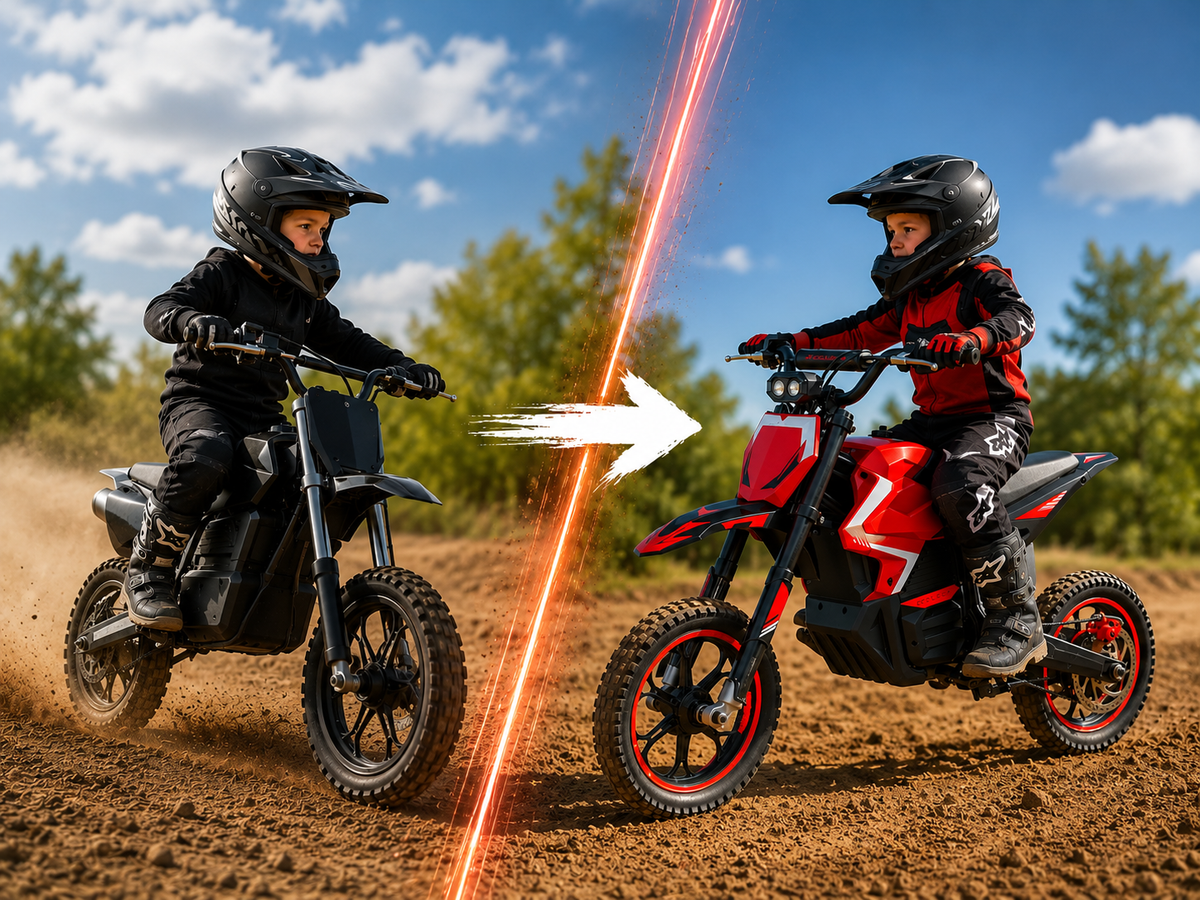
If your child likes the Razor Dirt Rocket MX350 but is beginning to ask for stronger performance, better control on grass, and more room to grow, the Ecoleap K2 is worth considering as the next step.
Calling the K2 an “upgraded MX350” does not mean the MX350 is a bad bike. Razor’s small Dirt Rocket remains a familiar and relatively simple introduction to electric dirt-bike-style riding. The better question is whether its 24V lead-acid battery, chain drive, rigid steel fork, and 10/14 mph speed settings will continue to meet your child’s needs—or whether it is time for a lighter, lithium-powered bike with suspension and a wider performance range.
The K2 answers that second need. It uses a 36V 7.8Ah lithium battery, a 400W sustained/850W peak brushless hub motor, 10/15/20 mph selectable modes, front and rear suspension, 12 × 2.75-inch tires, and a chainless drive system. Those upgrades affect acceleration, terrain capability, maintenance, and how long the bike can remain useful as skills improve.

Razor Dirt Rocket MX350 vs. Ecoleap K2: quick comparison
| Specification | Razor MX350 | Ecoleap K2 | Upgrade significance |
|---|---|---|---|
| Current listed price | $349.99 MSRP | $499 | K2 costs more but adds a different battery, motor, suspension and control platform. |
| Speed modes | 10 / 14 mph | 10 / 15 / 20 mph | K2 adds a middle step and a higher ceiling for developing riders. |
| Motor | High-torque chain-driven rear-wheel drive | 400W sustained / 850W peak brushless hub motor | K2 publishes output and eliminates the chain. |
| Battery | 24V sealed lead-acid | 36V 7.8Ah lithium, 280.8Wh | Lithium offers higher energy density and contributes to lower bike weight. |
| Claimed ride time/range | Up to 60 minutes low; 30 minutes high | Up to 18 miles | Different test formats; neither should be compared as a guaranteed result. |
| Weight | 48.26 lb | 41.9 lb | K2 is about 6.4 lb lighter despite offering more performance. |
| Wheels/tires | 12-inch spoked pneumatic wheels | 12 × 2.75-inch off-road tires | K2 emphasizes a wider footprint for grass and loose surfaces. |
| Suspension | Rigid double-crown steel fork; no rear shock listed | Oil-spring telescopic fork and rear spring shock | K2 is better equipped for bumps and uneven ground. |
| Brake | Hand-operated rear brake | Rear mechanical disc brake | Both rely on one rear brake; K2 uses an adjustable disc system. |
| Fit guidance | Age 8+ low / 13+ high | Recommended rider height 44–52 in | Height and physical control are more useful than age alone. |
Specifications and prices reflect the current U.S. manufacturer pages at the time of writing. Retail inventory and older model years may differ. Speed, range and runtime vary with rider weight, terrain, temperature, tire pressure, riding style and battery condition.
What the Razor MX350 still does well
The MX350 deserves credit for making electric dirt-bike-style riding accessible. Its current two-mode controller limits speed to 10 mph in Low and 14 mph in High. That is a meaningful improvement over older descriptions that treated the MX350 as a single-speed bike. For a child learning on flat, open ground, Low mode gives parents a practical starting point.
The Razor also uses familiar bicycle-style controls: a twist-grip throttle and a hand-operated rear brake. Its 12-inch pneumatic wheels, metal foot pegs, kickstand and motocross-inspired frame make it feel more substantial than a plastic ride-on toy. Razor lists the current model for ages 8+ in Low and 13+ in High, with a maximum rider weight of 140 lb.
Families may prefer the MX350 when the priority is a lower purchase price, recognizable brand, light recreational use and a conservative 14 mph ceiling. A child who is completely new to throttle control does not automatically need more power.
Why the K2 can be the better MX350 upgrade
1. More useful power for grass and gradual slopes
The K2 uses a 36V brushless hub motor rated at 400W sustained and 850W peak. Sustained output describes the motor’s regular operating level; peak output is short-duration power available when the bike is starting, accelerating or meeting extra resistance.
That distinction matters on grass. Soft ground creates much more rolling resistance than pavement, and a bike that feels lively on a driveway can lose speed quickly in a yard. The K2’s higher-voltage system, published motor output and lighter overall weight give it a stronger power-to-weight foundation for ordinary grass, packed dirt and modest inclines.
This is not a claim that every child should climb steep hills. Grade, surface, rider weight and battery charge all change performance. The upgrade is that K2 has more reserve for normal off-road resistance without becoming an adult-size, multi-kilowatt electric motorcycle.
2. Lithium battery instead of two lead-acid batteries
The MX350 uses two 12V sealed lead-acid batteries for a 24V system. Lead-acid technology is inexpensive and well understood, but it is heavy for the energy it stores. It also tends to feel weaker as voltage falls, especially when the battery ages or sits discharged.
K2 uses a 36V 7.8Ah lithium battery with 280.8Wh of nominal energy. Lithium provides greater energy density, so the bike can carry useful energy without the same battery weight penalty. That helps explain why K2 weighs about 41.9 lb—roughly 6.4 lb less than the MX350—even though K2 has front and rear suspension and a stronger performance ceiling.
For a child, those pounds matter at walking speed. A lighter bike is easier to roll from the garage, steady during a tight turn and catch before a small lean becomes a full drop. Parents also benefit when loading the bike into a vehicle.
K2 lists a 5–6 hour charge time and up to 18 miles of range. Razor lists runtime rather than distance: up to 60 minutes in Low and 30 minutes in High. These are different measurements, so parents should not convert one into the other. Real results depend heavily on speed, stops, hills, surface, rider weight and temperature.
3. Three speed modes create a longer learning path
Top speed alone is a poor reason to upgrade a child’s bike. The better reason is controlled progression.
The MX350 provides 10 and 14 mph settings. K2 provides 10, 15 and 20 mph modes. A child moving from the Razor does not need to jump directly to 20 mph. The rider can begin K2 at the familiar 10 mph limit, prove consistent braking and turning, then progress to 15 mph. The final 20 mph mode remains an earned step for a capable rider in a suitable off-road area.
This three-stage structure gives K2 a broader useful window. Parents do not have to choose between a bike that will quickly feel slow and a high-power model that is inappropriate on day one. However, because K2’s lowest mode is still 10 mph, it is not a substitute for a slower balance bike when a child lacks basic two-wheel control.
4. Real suspension changes control, not just comfort
Razor describes the MX350’s fork as a double-crown steel design, but its current specification does not list functional front or rear suspension. On smooth ground that simplicity is acceptable. On roots, shallow ruts and bumpy grass, the rider absorbs more of the impact through the arms and legs.
K2 pairs a telescopic oil-spring front fork with a rear spring shock. Suspension helps the tires follow uneven ground and reduces the amount of sudden movement transferred to the rider. The practical benefit is not simply a softer ride: better tire contact can make steering and braking feel more predictable on a backyard trail.
Suspension does not make K2 a motocross race bike. Jumps, extreme terrain and public roads remain outside its intended use. It is an upgrade for ordinary off-road play, not permission to skip skill development.
5. Wider tires for loose and soft surfaces
Both bikes use 12-inch wheels, but K2 specifies 12 × 2.75-inch tires front and rear. The extra width creates a larger contact patch and can improve confidence on grass, packed dirt and light gravel. Tire pressure still matters: too much pressure can reduce compliance and traction, while too little can make steering vague or risk tire damage.
The same wheel diameter also means K2 remains a compact kids’ platform. Families get more grip and suspension without moving to the much larger, roughly 94 lb class represented by a Razor MX500.
6. No chain to lubricate, tension or put back on
The MX350 uses a chain-driven rear wheel. Chain drive is common and can work well, but it creates recurring ownership tasks: checking tension, lubricating the chain, watching sprocket wear and correcting alignment. Dirt and grass can accelerate that routine.
K2 places the brushless motor in the rear wheel, eliminating the external drive chain. There is no chain to drop, catch clothing, stretch or require periodic lubrication. Families still need to inspect brakes, tires, spokes, fasteners and cables, but the drivetrain has fewer exposed service points.
For parents who want the child to ride more often without turning every weekend into a small maintenance session, this is one of K2’s most practical upgrades.
Size and fit: do not choose by speed alone
K2’s recommended rider height is 44–52 inches, and its listed seat height is 20.67 inches. Razor gives age guidance rather than a rider-height range. Neither number replaces a physical fit check.
Before choosing K2, confirm that the child can:
- Hold the bike upright without immediately needing an adult.
- Reach the brake lever comfortably and apply it with useful force.
- Turn the handlebar fully without the arms locking straight.
- Place enough of both feet down to recover from a slow lean.
- Roll the bike, park it and use the kickstand with control.
- Understand that releasing the throttle comes before squeezing the brake.
A child may fit the MX350 but not yet be ready for K2’s 15 or 20 mph modes. Conversely, an experienced child near the top of K2’s height range may find the Razor’s 14 mph ceiling and rigid chassis limiting. Readiness is a combination of fit, strength, judgment and riding experience—not a birthday.
Is the K2 worth the extra $149?
At current listed prices, K2 is about $149 more than the MX350. The added cost is not just payment for 6 mph of extra maximum speed. It buys a 36V lithium system, a brushless hub motor with published output, a lighter complete bike, a third speed mode, front and rear suspension, wider tires, a rear mechanical disc brake, a headlight and a chainless drivetrain.
If a child will only ride occasionally on flat pavement and the family wants the lowest purchase cost, the MX350 may remain the rational choice. If the bike will be used frequently on grass and dirt, or the child already rides confidently and needs room to improve, the K2’s hardware can justify the difference.
Ownership cost also matters. Lead-acid batteries are often inexpensive to replace but are heavier and sensitive to being stored discharged. Lithium packs cost more, yet their energy density and day-to-day performance are better suited to frequent use. A chain requires inexpensive but recurring maintenance; a hub motor removes those tasks. Neither bike is maintenance-free, but the work is different.
Who should stay with the Razor MX350?
- A first-time rider who is still learning basic throttle and braking coordination.
- A family that wants a firm 14 mph maximum and does not need a higher growth mode.
- A child riding mainly on flat, dry and relatively smooth ground.
- A buyer prioritizing lower initial cost over lithium battery technology and suspension.
- A family comfortable checking and maintaining a chain.
Who is ready to upgrade to the K2?
- A child who can already start, turn and stop the MX350 without repeated reminders.
- A rider who can release the throttle immediately when surprised.
- A child who finds the MX350 slow or harsh on grass and small bumps.
- A family that wants 10 mph for familiar practice, 15 mph for development and 20 mph only after skills are proven.
- A rider within the K2’s 44–52-inch recommended height range who can independently steady the 41.9 lb bike.
- Parents who prefer lithium power, suspension and lower chain-related maintenance.
A safe transition plan from MX350 to K2
Moving to K2 should feel like a controlled continuation, not a first-day speed test.
- Start with the power off. Check seated reach, foot contact, brake reach and the child’s ability to push and turn the bike.
- Select 10 mph mode. Use a flat, dry, open area with no cars, pedestrians, pets, walls or hidden holes.
- Repeat start-and-stop drills. The rider should close the throttle and stop at a marked line five times without overshooting.
- Add wide turns and figure eights. Watch for target fixation, panic grabs and feet remaining off the pegs.
- Introduce grass only after control is consistent. Grass changes steering resistance and braking distance.
- Unlock 15 mph based on skill, not boredom. The child should look ahead, brake smoothly and follow boundaries without reminders.
- Treat 20 mph as advanced mode. Use it only with direct supervision, full protective equipment and enough legal off-road space.
A properly fitted full-face helmet, eye protection, gloves, long sleeves, long pants, knee and elbow protection, and over-the-ankle footwear should be standard. Check local rules and ride only on private property or permitted off-road areas.
Frequently asked questions
Is the Ecoleap K2 faster than the Razor MX350?
Yes. The current MX350 is rated for up to 10 mph in Low and 14 mph in High. K2 offers 10, 15 and 20 mph modes. The useful upgrade is the staged progression, not simply the 20 mph maximum.
Is K2 safer because it has three speed modes?
No speed system replaces fit, judgment or supervision. Three modes give parents more control over progression, but K2’s lowest setting is still 10 mph. A child who cannot reliably balance, release the throttle and brake should use a slower learning platform first.
Which bike is better on grass?
K2 is better equipped for grass through its 400W sustained/850W peak brushless system, lighter complete weight, 2.75-inch-wide tires and front/rear suspension. Wet grass, steep slopes and hidden holes remain unsafe for beginners.
Does the Razor MX350 have two speed modes?
The current U.S. Razor page lists 10 mph Low and 14 mph High settings. Older inventory, manuals or secondhand versions may differ, so verify the model label and instructions for the exact bike being purchased.
Which battery is easier to live with?
K2’s lithium battery offers better energy density and supports a lighter bike. The MX350’s sealed lead-acid system is simple but heavier and should not be stored discharged. Always use the manufacturer-supplied charger and follow the relevant manual.
Does K2 need chain maintenance?
No. Its rear hub motor drives the wheel directly, so there is no external drive chain to lubricate, tension or reinstall. Brakes, tires, spokes, cables and fasteners still require regular inspection.
Can a child move directly from an MX350 to K2’s 20 mph setting?
That is not recommended. Begin at 10 mph, confirm repeatable control, then progress to 15 mph. The 20 mph setting should be earned only after the child consistently demonstrates braking, turning, awareness and respect for riding boundaries.
Bottom line: K2 is the next-step upgrade, not the automatic first choice
The Razor Dirt Rocket MX350 remains a credible entry-level bike: it is familiar, relatively affordable and now offers two speed settings. For smooth recreational riding and a child who is still learning, those qualities have real value.
The Ecoleap K2 becomes the stronger choice when the rider is ready for more than the MX350 can provide. It is lighter, uses a lithium battery and brushless hub motor, adds working front and rear suspension, offers wider off-road tires, removes chain maintenance and provides a three-stage 10/15/20 mph learning path.
That makes K2 a meaningful Razor MX350 upgrade for a child who already has two-wheel control and wants to progress on grass, dirt and light trails. The decision should still begin with fit and readiness. More capability is valuable only when the rider can use it responsibly.
Still comparing Razor models? Read our Razor MX125 vs. MX350 guide or the complete Razor Dirt Bike model comparison.
Safety note: Manufacturer age and height ranges are starting points, not guarantees of readiness. Use direct adult supervision, appropriate protective gear and a legal, controlled off-road riding area. Never ride on public roads.


Share:
Kids Dirt Bike Height Chart: How to Find the Right Fit
Best Dirt Bike Before a Yamaha PW50