

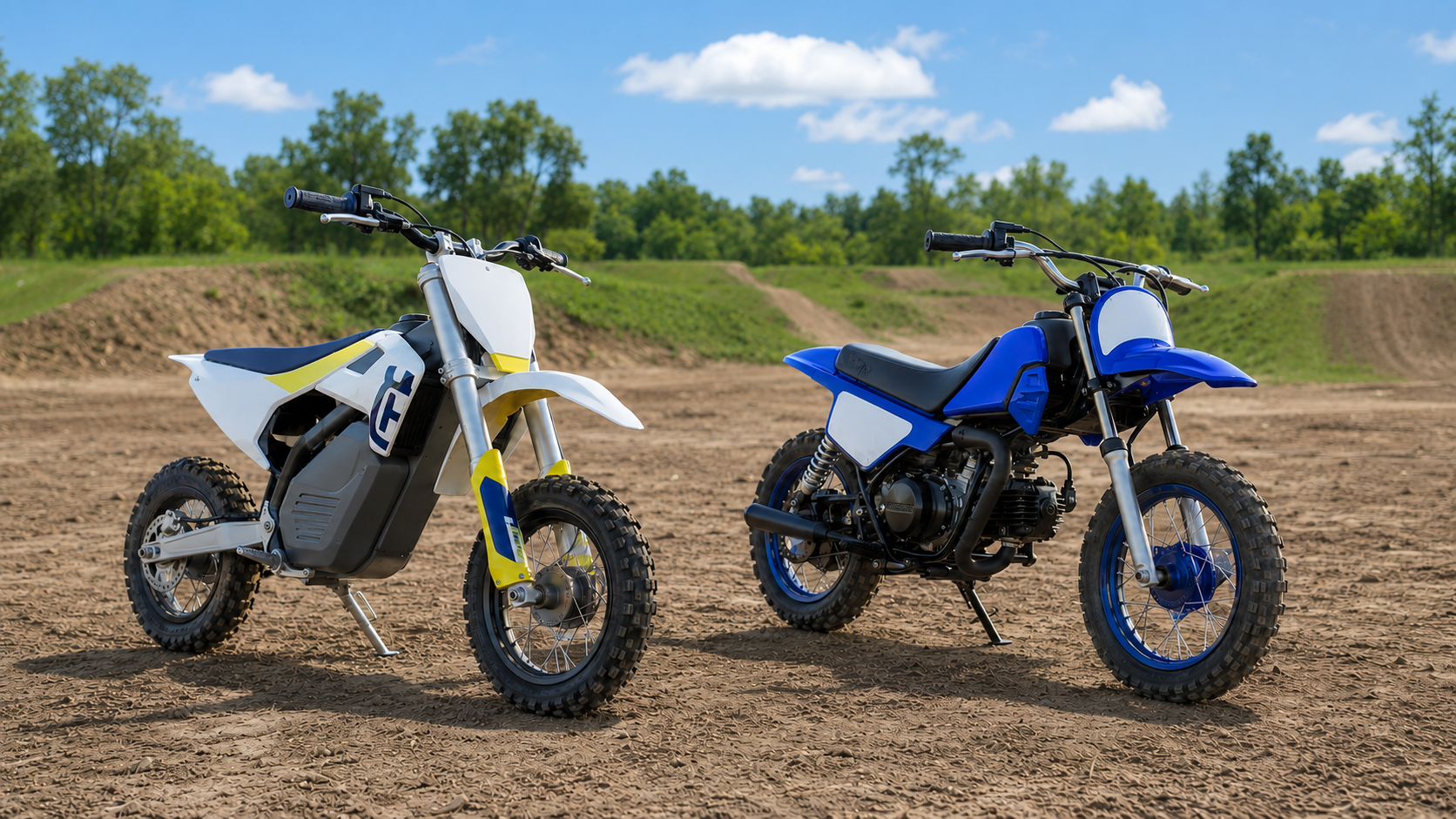
Parents often ask whether a child should begin on a lightweight electric bike, move straight to a Husqvarna EE 2, or learn traditional motorcycle controls on a Yamaha PW50. The honest answer is that age alone cannot decide it.
Two children of the same age can need completely different bikes. One may already ride a pedal bike confidently, understand braking, and stay calm after a fall. Another may still be developing balance, struggle to support a heavier machine, or feel intimidated by noise and sudden acceleration.
The best first dirt bike is the one your child can confidently hold up, start, stop, turn, and control today—not the one with the biggest motor or the longest advertised age range.
This parent-focused guide uses the Husqvarna EE 2 and Yamaha PW50 as two useful reference points, then explains where smaller electric options such as the Ecoleap K1 and progressive models such as the Ecoleap K2 can fit into a child's learning path.
Husqvarna EE 2 vs Yamaha PW50: Two Different Ways to Start
The EE 2 and PW50 are both designed for young riders, but they solve different problems. The Husqvarna is an electric minicycle with adjustable ergonomics and multiple power modes. The Yamaha is a long-established 49cc gas motorcycle with an automatic transmission and adjustable throttle control.
| Parent consideration | Husqvarna EE 2 | Yamaha PW50 |
|---|---|---|
| Power system | Electric hub motor and removable lithium-ion battery | 49cc air-cooled two-stroke engine |
| Learning emphasis | Quiet, staged electric progression and motocross-style controls | Traditional gas-bike experience with automatic transmission |
| Speed management | Three selectable power modes | Adjustable throttle stop |
| Starting routine | Simple electric startup | Gas-bike starting and operating routine |
| Noise and local practice | Relatively quiet | Two-stroke engine sound may limit where practice is appropriate |
| Best fit | Families wanting a premium electric stepping stone | Families committed to the traditional gas-bike or racing path |
This is not a declaration that one bike is universally safer or better. Fit, rider ability, supervision, terrain, and setup matter more than the badge on the plastics.
Age Is Only the First Filter
Age recommendations help narrow a shopping list, but they do not tell you whether your child can manage a particular motorcycle. Parent discussions repeatedly return to the same lesson: physical fit and demonstrated control matter more than a birthday.
Before buying, evaluate four areas:
- Physical fit: Can the child reach the controls and stabilize the bike at a stop?
- Two-wheel balance: Can the child already ride a balance bike or pedal bike without training wheels?
- Brake and throttle control: Can the child release the throttle and apply the brake on command?
- Emotional readiness: Does the child want to ride, listen consistently, and recover calmly from small mistakes?
A confident bicycle rider may progress quickly even if younger. An older child can still struggle if the motorcycle is too tall, too heavy, or too abrupt.
The Six-Point Readiness Test
1. Balance without adult support
A powered bike adds throttle, braking, and route decisions. Basic balance should not still require all of the child's attention. If the child cannot coast and steer a bicycle independently, continue building that foundation first.
2. Hold the bike up while stopped
The rider does not always need both feet completely flat. However, they should be able to stop, place a foot or both feet down, and keep the bike from immediately falling to one side. Requiring an adult to catch every stop is a sign that the platform may be too tall or heavy.
3. Reach the brake with small hands
Brake reach is easy to overlook in a specification table. Ask the child to hold the grip normally and squeeze the lever without rotating the entire hand away from the throttle. A powerful brake is not useful if the rider cannot comfortably operate it.
4. Release the throttle when nervous
Young beginners can tense up and accidentally continue twisting the throttle. Before introducing corners or uneven ground, practice a simple response until it becomes automatic: release, brake, feet down.
5. Follow boundaries consistently
The rider should stop when asked, remain inside the practice area, and wait for permission before starting again. Excitement that repeatedly overrides instructions is a reason to delay faster riding.
6. Ask to ride
A child who is interested but not emotionally ready should not be forced. Confidence is not a soft extra; it directly affects whether the rider looks ahead, turns naturally, and reacts correctly after a mistake.
Why Buying “Room to Grow” Can Backfire
Parents understandably want several years of use from an expensive dirt bike. But buying substantially too large can slow learning rather than extend value.
An oversized or overly heavy bike can make a child:
- Afraid to lean into turns
- Dependent on an adult at every stop
- Reluctant to practice repeated starts and stops
- Unable to reposition the bike after a tip-over
- More focused on avoiding a fall than learning control
A correctly sized bike gives the rider independence. The child can stop, restart, and recover from small errors without feeling trapped by the machine. Compare rider height and inseam with seat height, but also consider overall weight, center of gravity, control reach, and previous bicycle experience.
Weight May Matter More Than Top Speed
Maximum speed attracts attention, but low-speed handling often determines whether the first day goes well. A heavier machine carries more momentum and requires more strength to stabilize. When it tips, a small rider may not be able to lift or reposition it.
A lighter electric platform can make early practice less intimidating because it is easier to push, balance, maneuver at walking pace, and recover after a mistake. That does not mean the lightest bike automatically wins. Suspension, tires, brakes, build quality, and correct sizing still matter.
What the Husqvarna EE 2 Offers
The Husqvarna EE 2 sits between an electric balance bike and a larger youth motocross motorcycle. Its strongest beginner-relevant feature is not peak power; it is the ability to change the bike as the rider develops.
- Three power modes let parents start conservatively and unlock performance gradually.
- Adjustable seat height helps match the machine to different rider sizes.
- Electric operation removes engine noise and several gas-bike starting tasks.
- Hydraulic disc brakes, suspension, and motocross-style ergonomics make it a serious learning platform rather than a toy.
- A rollover sensor is designed to cut drive if the bike falls over.
That premium hardware can be valuable for a committed young rider, but it does not eliminate the need for proper fit. A child who cannot support the EE 2 independently may learn faster on something lower and more manageable first.
What the Yamaha PW50 Offers
The Yamaha PW50 has introduced generations of children to gas-powered riding. Its fully automatic transmission removes shifting from the first lesson, while the throttle stop allows an adult to restrict throttle opening and increase it as skills improve.
The PW50 makes particular sense when:
- The family intends to follow a traditional gas-bike or motocross pathway
- The child already fits and supports the bike confidently
- Access to suitable riding areas makes engine noise acceptable
- The parent wants the child to learn a real gas-motorcycle routine
- Local racing or riding groups favor conventional motorcycles
It is not automatically the right first step simply because it has a long reputation. A child who is intimidated by the weight, sound, or operating routine may benefit from a lighter electric stage before moving to the PW50.
Where Ecoleap K1 and K2 Fit
Not every family needs a premium race-oriented electric minicycle, and not every child is ready for a gas motorcycle. The Ecoleap K1 and K2 provide two additional entry points based on rider size and experience.
| Rider profile | More suitable starting point |
|---|---|
| Still learning two-wheel balance | Balance bike or pedal bike first |
| Smaller rider building basic confidence | Ecoleap K1 or another low, manageable platform |
| Confident bicycle rider who physically fits the bike | Ecoleap K2 with staged speed training |
| Committed rider ready for premium electric motocross hardware | Husqvarna EE 2 |
| Child ready for gas-bike operation and family pursuing that path | Yamaha PW50 |
The K2 should not be recommended automatically to every child of a certain age. It is for a rider who already has basic two-wheel balance and can physically manage the bike.
Why the K2’s Brushless Motor Matters
For a beginner, predictable response matters more than a large number on a specification sheet. An abrupt, nearly on-or-off throttle can surprise a child and encourage poor control habits.
The K2's brushless motor offers practical family-use advantages:
- Quieter operation than a gas engine
- Fewer wear components than a brushed motor
- Lower routine motor maintenance
- Efficient use of battery power
- Consistent response through repeated practice sessions
No motor technology makes a bike automatically safe. The value is that a quieter, lower-maintenance drive system can let the child focus on balance, vision, braking, and line choice.
Why a Lithium Battery Improves the Learning Experience
Battery chemistry changes more than range. Compared with a traditional sealed lead-acid pack, a lithium battery generally offers a better power-to-weight ratio and more consistent voltage through the ride.
For a young rider, that can mean less unnecessary battery weight and a bike that feels more predictable from the beginning of practice to the end. For parents, it means simpler regular use without fuel handling.
Always use the supplied charger and follow the manufacturer's storage instructions. Never charge a damaged battery, charger, or wiring system, and do not leave charging equipment unattended.
Three Speed Modes Should Be Treated as a Training System
The K2's three speed modes are not simply three ways to go faster. Their real value is letting parents match performance to demonstrated ability.
Stage 1: Start, release, brake
Use the lowest mode in a flat, open area. Practice smooth starts, straight-line riding, throttle release, controlled braking, and placing the feet down after stopping. The child should repeat these skills without panic or constant reminders.
Stage 2: Turn and regulate speed
Move to the middle mode only after the basic controls feel automatic. Practice wide left and right turns, looking through the corner, holding partial throttle, slowing before turns, and riding over mild terrain changes.
Stage 3: Make independent decisions
The highest mode should remain unavailable until the rider slows voluntarily, chooses safe lines, and stops without adult intervention. Faster mode is not a reward for one successful ride. It is unlocked after consistent control.
Electric Dirt Bike or Gas Bike?
| Beginner consideration | Electric dirt bike | Gas dirt bike |
|---|---|---|
| Startup | Usually simple and immediate | Adds a starting and warm-up routine |
| Noise | Relatively quiet | Louder engine sound |
| Maintenance | No fuel or carburetor work | More engine-related care |
| Early skill focus | Balance, throttle, steering, and braking | Adds gas-bike operation |
| Traditional racing progression | Useful skill foundation | Directly relevant to many established classes |
Electric and gas bikes are not enemies. A child can develop excellent fundamentals on electric power and move to a PW50 later. Another child may fit the PW50 well and thrive on it immediately. The right sequence depends on the rider and the family's goal.
A Practical Progression From Balance Bike to PW50
- Balance bike
- Pedal bicycle without training wheels
- Low-speed electric bike
- Multi-speed electric dirt bike
- Husqvarna EE 2, Yamaha PW50, or another appropriately sized next-step motorcycle
Children do not need to complete each stage at a particular age. Some move quickly; others need months. Advancement should be based on repeatable skills.
A rider may be ready for a PW50 or EE 2 when they can:
- Support the machine independently
- Start and stop without assistance
- Use the throttle progressively
- Brake before entering a turn
- Look ahead instead of down at the front wheel
- Recover calmly after a small error
- Follow riding boundaries every time
- Ask to ride rather than being pressured
What About Dirt Bike Training Wheels?
Training wheels are controversial. They may help a very young child become familiar with throttle and brake controls, but they can also delay true two-wheel balance. On uneven terrain, they may alter how the bike leans or interacts with obstacles.
For most children, learning balance first on a balance bike or pedal bike creates the stronger foundation. If training wheels are used, treat them as a temporary familiarization tool on flat ground at very low speed—not a substitute for balance training.
How to Reduce the Risk of Whiskey Throttle
“Whiskey throttle” describes a frightened rider accidentally continuing or increasing throttle input. Parents can reduce the risk by making one sequence automatic: release, brake, feet down.
- Begin in the lowest available mode or most restricted throttle setting
- Use a wide, flat practice area
- Keep the first sessions short
- Confirm the brake lever fits the child's hand
- Do not run beside the bike while holding it once powered practice begins
- Do not raise speed after a single successful lap
- Stop when the child becomes tired, distracted, or frustrated
Confidence Is Part of Bike Fit
A child who feels secure usually learns faster than one who is constantly afraid of dropping the motorcycle. If a rider falls and does not want to continue, check for injury, explain what happened calmly, and let the child decide when to try again.
Progress can mean one smooth start, one controlled stop, or one confident turn. Those small wins are more useful than reaching maximum speed. The first dirt bike should make the child want to ride again.
Parent Buying Checklist
- The child already has basic two-wheel balance
- Seat height matches height and inseam
- The child can support the bike while stopped
- Handlebars and controls are within comfortable reach
- The brake lever works for small hands
- The lowest setting is genuinely manageable
- Throttle response is predictable
- The bike is not unnecessarily heavy
- Replacement parts and support are available
- The child has a certified helmet, eye protection, gloves, boots, and protective clothing
- The family has a safe and legal place to ride
Frequently Asked Questions
Is the Husqvarna EE 2 better than the Yamaha PW50?
Not for every child. The EE 2 suits families wanting quiet electric operation, selectable power modes, and premium off-road hardware. The PW50 suits riders who fit it well and families intentionally entering the traditional gas-bike pathway.
Should a child start on electric before a PW50?
It can be a very effective route, especially when the child needs to develop balance, throttle release, and braking confidence without engine noise. It is not mandatory if the child already fits and controls the PW50 confidently.
Is the K2 suitable for every six-year-old?
No. Age is only a starting point. The rider should have two-wheel balance, fit the bike physically, reach the brake, and hold the bike upright independently.
Why are three speed modes useful?
They let a parent match performance to current ability and create measurable training stages. Higher modes should be unlocked only after the rider consistently demonstrates control.
When should a child move from K1 to K2?
Move up when the rider has outgrown the smaller platform physically and can start, turn, slow, and stop consistently—not simply after a birthday.
When is a child ready for a PW50?
When the child fits the machine, supports it at a stop, understands throttle release and braking, follows boundaries, and wants to learn the gas-bike routine.
The Bottom Line
The Husqvarna EE 2 and Yamaha PW50 represent two credible but different first-motorcycle paths. The EE 2 emphasizes premium electric progression. The PW50 introduces the traditional gas-bike world in a beginner-oriented package. The Ecoleap K1 and K2 can provide earlier or more accessible steps depending on rider size and experience.
Do not choose by age, peak power, or the number of years you hope the bike will last. Choose the motorcycle your child can master now. A rider who can confidently hold up, stop, restart, and control a correctly sized bike will build skills faster than a child struggling to grow into an impressive machine.
Fit first. Control second. Speed later.
Sources for model details: Husqvarna electric motorcycles and Yamaha PW50. Specifications and availability can change by model year and market; confirm current details with the manufacturer before purchasing.


Share:
Razor Dirt Rocket Age and Size Guide: MX125, MX350, MX500 and MX650
STACYC 12eDRIVE vs. Razor MX125: Balance Bike or Mini Dirt Bike?