

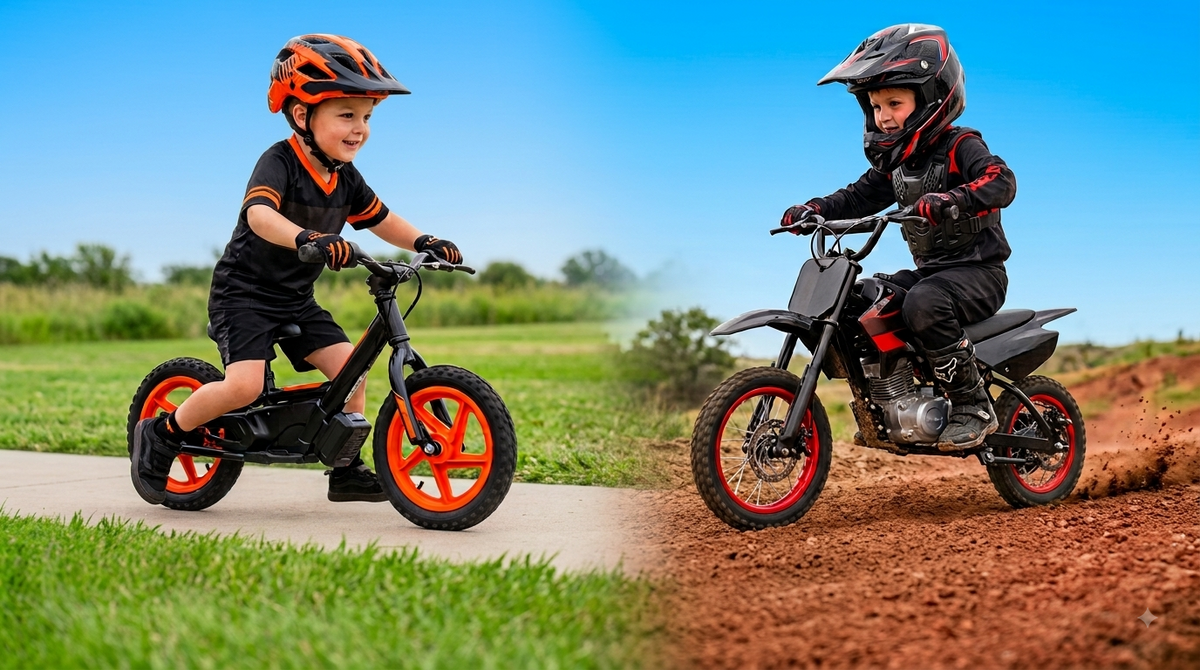
The STACYC 12eDRIVE and Razor MX125 are often compared because both have 12-inch wheels, hand controls and modest top speeds. However, they are designed around two different ways of learning.
The STACYC 12eDRIVE is a powered balance bike. It lets a child begin by pushing, coasting and balancing with the motor off, then add throttle in stages. The Razor MX125 is a small electric ride-on with dirt-bike bodywork, a seated riding position, foot pegs and a motorcycle-style twist throttle.
Short answer: choose the STACYC 12eDRIVE when the main goal is to develop two-wheel balance and throttle control on a light platform. Choose the Razor MX125 when the child already balances confidently and wants a lower-cost, low-speed mini dirt-bike experience. Neither model is automatically right based on age alone.

STACYC 12eDRIVE vs. Razor MX125 at a glance
| Comparison | STACYC 12eDRIVE | Razor MX125 |
|---|---|---|
| Primary format | Powered electric balance bike | Mini electric dirt-bike-style ride-on |
| Official age guidance | Ages 3–5, subject to fit and ability | Ages 5+ in low mode; 7+ in high mode |
| Recommended rider limit | Under 75 lb | Up to 110 lb |
| Bike weight | 17 lb with battery | About 29.8 lb on Razor’s global specification page |
| Seat and fit guidance | 15-inch listed seat height; 16–19-inch inseam guidance on the current product page | Check the child’s reach and ability to support the complete bike; age and weight limits do not guarantee fit |
| Speed settings | Three modes: approximately 5, 7 and 9 mph | Two settings: up to 5 mph and 8 mph |
| Battery | Quick-connect 20V max lithium-ion pack | 12V sealed lead-acid battery |
| Published runtime | 30–60 minutes, depending on terrain and rider | Up to 80 minutes in low mode or 40 minutes in high mode |
| Brake | Enclosed rear drum brake | Hand-operated rear brake |
| Learning emphasis | Balance, coasting, standing, braking and progressive throttle control | Seated riding, foot-peg position, twist throttle and mini dirt-bike familiarity |
Specifications reflect manufacturer information available at the time of writing. Runtime varies with rider weight, surface, hills, temperature, tire pressure and riding style. Always verify the exact product page and manual before purchasing.
Why this comparison is more than a spec contest
A parent can look at the similar top speeds and assume these bikes will produce a similar learning experience. They do not.
On a balance-bike platform, the rider’s feet remain an active part of learning. A beginner can push the bike, lift both feet for a short coast and put them down again when balance is lost. This gives the child a familiar recovery method before power is introduced.
On the MX125, the rider sits in a more motorcycle-like position and places both feet on folding pegs while moving. The controls and bodywork make the experience feel closer to a small dirt bike, but the child has less opportunity to use the bike as a conventional push-and-coast balance trainer.
The better question is therefore not “Which one is faster?” It is “Which skill does my child need to learn next?”
How the STACYC 12eDRIVE teaches riding
STACYC’s strongest feature is the order in which skills can be introduced. A child can learn the platform in several steps instead of processing balance, throttle and braking at the same time.
Step 1: Push and coast without power
With the motor off, the child can use the 12eDRIVE much like a balance bike. The early goal is not speed. It is learning to look forward, keep the handlebars calm, lift the feet and coast without immediately tipping to one side.
This stage is particularly valuable for a child with little or no bicycle experience. If the rider cannot coast and stop calmly without power, adding a throttle usually creates more confusion rather than faster progress.
Step 2: Add the lowest power mode
Once the rider can coast and operate the rear brake, the low mode introduces throttle at a pace close to a brisk balance-bike speed. The child learns that the throttle is not an on/off command: it can be opened gently, held steady and released before braking.
Step 3: Progress through three speed modes
The approximately 5, 7 and 9 mph modes create smaller steps than a single full-speed setting. Parents can keep the bike in training mode until starts, stops and wide turns become repeatable, then unlock more speed only when the rider demonstrates control.
The three modes are not simply three entertainment settings. Used correctly, they form a learning system:
- Low mode: start, coast, release the throttle, brake and put both feet down.
- Medium mode: maintain partial throttle, make wide turns and slow down before the corner.
- High mode: ride independently only after the child can judge space, surface and stopping distance.
Why 17 lb matters
A 17 lb bike is easier for a small rider to hold upright, push back to the practice area and catch when it begins to lean. The lower mass also makes repeated low-speed drills less tiring.
This is one of the biggest practical differences from the MX125. Weight affects confidence every time the child stops, turns tightly or makes a mistake. Maximum rider capacity does not tell you how manageable the bike itself will feel.
What the Razor MX125 does differently
The MX125 is Razor’s smallest Dirt Rocket. It uses steel motocross-style geometry, plastic fairings, a crossbar-reinforced handlebar, folding foot pegs, a retractable kickstand and 12-inch pneumatic tires. For a child who wants something that looks and feels more like a miniature motorcycle, this presentation can be a major part of the appeal.
A more dirt-bike-like riding position
The seated position and foot pegs teach a different body relationship from a balance bike. The rider learns to keep the feet on the pegs while moving, use a twist throttle and stop with a hand-operated rear brake.
That can make the MX125 feel like a logical next step for a child who already rides a bicycle or powered balance bike confidently. It is less ideal as the tool for learning basic balance from zero.
Two speed settings, not a fully variable training system
The current MX125 provides a low setting of up to 5 mph and a high setting of up to 8 mph. The low/high switch is useful because an adult can reduce the maximum speed for a novice.
However, a parent should still evaluate how smoothly the child uses the twist throttle. A limited top speed reduces the consequence of an error, but it does not automatically teach progressive throttle input. Practice releasing the throttle before squeezing the brake.
Mini dirt-bike appearance does not equal full dirt-bike suspension
The MX125 has authentic-looking fairings and knobby pneumatic tires, but the official specification lists a steel fork rather than a suspension fork and does not list rear suspension. It should not be confused with a larger, suspension-equipped youth dirt bike.
Razor’s owner guidance is the safer reference for terrain selection: use a controlled private area and avoid traffic, wet surfaces, loose debris, sharp bumps and aggressive riding. The MX125 can provide off-road-style fun, but it is not intended for jumps, rough trails or steep technical terrain.
Fit: use inseam and control, not the age label alone
Manufacturer age ranges help narrow the search, but children of the same age can differ greatly in height, strength, coordination and emotional readiness.
For the STACYC 12eDRIVE, the current product page recommends a 16–19-inch inseam and says the child should be able to touch the ground with a slight bend in the knees. This is more useful than the 3–5 age range because it describes how the bike should actually fit.
Before choosing either model, check whether the child can:
- Stand over or sit on the bike without feeling trapped by its height.
- Reach the handlebar without locking the elbows or leaning excessively forward.
- Operate the brake lever without rotating the entire hand off the grip.
- Hold the bike upright when stopped.
- Turn the handlebar fully without losing balance.
- Push or reposition the bike without an adult carrying it every time.
- Understand and repeat the instruction: “Release throttle, brake, feet down.”
A higher maximum rider-weight rating does not mean a bike fits a broader range of children. A small rider can be far below the weight limit and still be unable to reach the controls or support the bike.
Weight and confidence: the difference parents feel immediately
The STACYC is officially listed at 17 lb with its battery. Razor’s global specification lists the MX125 at approximately 29.8 lb. A difference of roughly 13 lb is significant when the rider is small.
The heavier MX125 can feel more planted once moving, but it takes more effort to catch at a stop, turn around at walking speed and recover after a tip-over. For a confident child who already handles a bicycle well, that may be manageable. For a hesitant beginner, it can become the reason the bike stays in the garage.
Do not buy an oversized or unnecessarily heavy bike solely so the child can “grow into it.” A first powered two-wheeler should create independence. The rider should be able to start, stop and recover from small mistakes without waiting for an adult to lift the bike.
Speed: 9 mph vs. 8 mph is not the deciding factor
The STACYC reaches approximately 9 mph in its high mode, while the MX125 reaches up to 8 mph in high mode. That one-mile-per-hour difference should not determine the purchase.
For beginners, low-speed behavior matters more:
- Can an adult select a genuinely manageable training mode?
- Can the child open the throttle without a sudden panic response?
- Does the rider release the throttle before braking?
- Can the child make a controlled stop repeatedly?
- Is the practice area wide enough for the child’s current stopping distance?
The STACYC offers three stages and begins as a non-powered balance bike. The MX125 offers two maximum-speed settings and a motorcycle-style riding format. Those differences matter more than their similar top-speed numbers.
Lithium-ion vs. sealed lead-acid battery
Battery chemistry shapes the ownership experience as well as the bike’s weight.
STACYC quick-connect lithium-ion battery
The 12eDRIVE uses a compact, quick-connect 20V max lithium-ion battery. The pack can be removed and swapped, allowing a family with an additional compatible battery to continue riding while another pack charges. STACYC publishes an estimated 30–60 minutes of runtime and a 30–60 minute charge time for the current product listing.
The removable pack also makes it easier to store the battery in an appropriate temperature-controlled location. Owners should still use only the specified charger and follow the manufacturer’s charging and storage instructions.
Razor 12V sealed lead-acid battery
The MX125 uses a rechargeable 12V sealed lead-acid battery. Razor publishes up to 80 minutes of continuous use in low mode and up to 40 minutes in high mode.
The longer low-mode runtime is attractive, but the battery contributes to a heavier complete bike and requires a different ownership routine. Follow the manual’s charging instructions carefully, switch the bike off after riding and avoid storing it in a deeply discharged state.
Published runtime numbers are not directly comparable laboratory results. Rider weight, temperature, surface, hills, tire pressure and stop-start riding can change actual runtime substantially.
Brakes and small hands
Both bikes use a hand-operated rear brake, but parents should test lever reach rather than checking only whether a brake exists.
Ask the child to keep the palm and thumb securely around the grip, then pull the lever with the fingers. If the child must release most of the grip or rotate the wrist dramatically, the control may not be a good fit.
Before powered riding, practice braking while walking beside the bike. Then practice short powered starts followed by a stop marker. The rider should learn to release the throttle first, squeeze the brake progressively and put both feet down only as the bike comes to a stop.
Which bike is better on grass, dirt and hills?
Both models use pneumatic tires, but neither should be evaluated only by the word “off-road.” Surface conditions change the amount of power, traction and braking distance required.
The STACYC’s light weight makes it easy to maneuver on short grass and smooth packed dirt, while its balance-bike layout helps a child recover with the feet. The MX125’s knobby tires and dirt-bike geometry provide the appearance and seated feel many children want.
Neither model is a substitute for a suspension-equipped youth dirt bike on rough trails. Avoid mud, deep sand, loose gravel, wet grass, sharp bumps, jumps and steep hills. Start on flat, dry and open ground. Introduce only one new challenge at a time after the child has mastered starts, turns and stops.
Maintenance and day-to-day ownership
STACYC 12eDRIVE
- Check tire pressure and tread before riding.
- Inspect the BMX-style chain, freewheel and guards.
- Confirm the rear drum brake works before every session.
- Keep the removable battery connector clean and dry.
- Use the correct STACYC battery and charger.
Razor MX125
- Check tire pressure, rear brake operation and chain-guard condition.
- Inspect the chain drive and keep body panels and guards secured.
- Turn the power switch off after each ride.
- Charge the sealed lead-acid battery according to the current manual.
- Do not modify the electrical system, speed control or original frame configuration.
The MX125’s lower purchase price does not eliminate maintenance. The STACYC’s higher price does not eliminate the need for inspections. Both are powered vehicles and should receive a pre-ride check.
A safer first-week training plan
Session 1: fit and controls
With the power off, confirm reach, brake operation and the child’s ability to hold the bike upright. Identify the power switch and teach the stop sequence: release throttle, brake, feet down.
Session 2: balance before throttle
On the STACYC, practice pushing and coasting in non-powered mode. On the MX125, the child should already demonstrate independent two-wheel balance on a bicycle or balance bike before powered practice.
Session 3: short starts and stops
Select the lowest mode. Place two markers a short distance apart. The child starts at the first marker and stops before the second. Repeat until throttle release and braking happen without panic.
Session 4: wide turns
Add large left and right circles. Teach the child to look through the turn rather than at the front wheel. Keep the session short enough that fatigue does not degrade control.
Session 5 and beyond: gradual progression
Increase speed only when the rider starts smoothly, turns both directions, stops on command and respects the practice boundary consistently. A higher mode should be unlocked by demonstrated skill—not used as a reward after one good ride.
Which one should you buy?
| Your child’s situation | Better starting direction | Why |
|---|---|---|
| Still learning to coast on two wheels | STACYC 12eDRIVE | Can begin in non-powered push-and-coast mode |
| Small rider who struggles to hold heavier bikes upright | STACYC 12eDRIVE | 17 lb listed weight is easier to catch and reposition |
| Needs small steps between training speeds | STACYC 12eDRIVE | Three approximately 5/7/9 mph modes |
| Already rides a bicycle confidently and wants mini-motorcycle styling | Razor MX125 | Seated geometry, fairings, foot pegs and twist throttle |
| Family wants a lower-cost powered introduction | Razor MX125 | Its official MSRP is substantially lower than the STACYC list price |
| Needs suspension for rough terrain or more room to progress | Evaluate a larger next-stage bike | Neither model provides a full suspension-equipped youth dirt-bike platform |
What comes after the STACYC 12eDRIVE or Razor MX125?
Both bikes occupy an early stage of the learning path. Children can outgrow the fit, the low speed or the terrain capability even if they remain below the published maximum rider weight.
A common progression is:
- Conventional balance bike
- Powered balance bike such as the STACYC 12eDRIVE
- Low-speed mini dirt-bike-style ride such as the Razor MX125
- A larger electric youth dirt bike with progressive speed control and suspension
- An appropriately sized gas bike or higher-performance electric dirt bike when the rider is ready
The exact order is not mandatory. A confident bicycle rider may skip a powered balance bike, while a younger or cautious child may spend a long time developing skills at the first two stages.
Families looking for the next stage can also compare the Ecoleap K1 kids electric dirt bike. It is intended for riders who need more dirt-bike structure and progression than an entry balance-bike platform provides. Check the child’s height, inseam, control reach and current riding ability before moving up.
Frequently asked questions
Is the STACYC 12eDRIVE a real dirt bike?
It is best described as an electric balance bike designed to develop riding skills. It has powered modes, footrests, pneumatic tires and a rear brake, but its low frame, light weight and push-and-coast learning method distinguish it from a conventional mini dirt bike.
Is the Razor MX125 a balance bike?
No. The MX125 uses a seated dirt-bike-style frame, foot pegs, fairings, a twist throttle and a chain-driven rear wheel. A child should already possess basic two-wheel balance before learning to ride it under power.
Which bike is lighter?
The STACYC 12eDRIVE is officially listed at 17 lb with its battery. Razor’s global MX125 specification lists approximately 29.8 lb. The lighter STACYC is generally easier for a small child to catch, push and reposition.
Which bike is faster?
Their published maximum speeds are close: approximately 9 mph for the STACYC 12eDRIVE and up to 8 mph for the MX125. The more important difference is the learning format and number of speed stages.
Which has better battery technology?
The STACYC uses a quick-connect lithium-ion battery, while the MX125 uses a 12V sealed lead-acid battery. The STACYC pack is lighter and removable; the Razor publishes longer continuous runtime in low mode. Actual runtime depends on riding conditions.
Can a three-year-old ride the Razor MX125?
Razor’s current US guidance is ages 5+ in low mode and 7+ in high mode. A three-year-old should not be placed on the MX125 merely because the child is under its weight limit. Follow manufacturer guidance and evaluate physical fit, maturity and riding skill.
Can a five-year-old use the STACYC high mode immediately?
Age alone does not justify high mode. Begin without power or in the lowest mode and increase speed only when the rider can control starts, turns, throttle release and braking consistently.
Does the Razor MX125 have suspension?
The current official specification lists a steel fork and does not list rear suspension. Its pneumatic tires absorb small surface irregularities, but it should not be presented as a full-suspension dirt bike.
Which is better for learning before a PW50?
For a child who still needs to master balance, the STACYC’s non-powered mode and low weight create a clearer first step. The MX125 provides more motorcycle-like bodywork and foot-peg positioning, but neither fully reproduces the weight, controls or behavior of a Yamaha PW50. Move up only when the child can confidently support, start, stop and control the next bike.
What protective gear does a beginner need?
Use a properly fitted, certified helmet, eye protection, gloves, long sleeves, long pants, over-the-ankle footwear and appropriate knee and elbow protection. Gear does not replace adult supervision, a pre-ride inspection or a controlled legal riding area.
Bottom line
The STACYC 12eDRIVE and Razor MX125 are not two versions of the same product.
The STACYC 12eDRIVE is the stronger balance-first learning tool. Its 17 lb weight, non-powered mode, three progressive speed settings and removable lithium-ion battery make it easier to introduce skills one at a time.
The Razor MX125 is the stronger budget mini dirt-bike-style experience. It offers fairings, foot pegs, a seated position, two speed settings and a twist throttle at a substantially lower price, but it is heavier and should not be mistaken for a suspension-equipped trail bike.
Choose the STACYC when the rider still needs to develop balance and confidence. Choose the MX125 when the child already balances independently, fits the bike correctly and mainly wants the feel and appearance of a small dirt bike. If the rider needs suspension, stronger terrain capability or more progression, evaluate a properly sized next-stage youth bike instead of expecting either entry model to do everything.
Safety note: Manufacturer age ranges are only a starting point. Confirm the child’s inseam, reach, brake operation, ability to support the bike and maturity to follow instructions. Ride only in a legal, controlled area with adult supervision and appropriate protective equipment.


Share:
Husky EE2 or PW 50? Which bike is better for kids
Razor MX350 vs. MX400: What Is the Difference?