

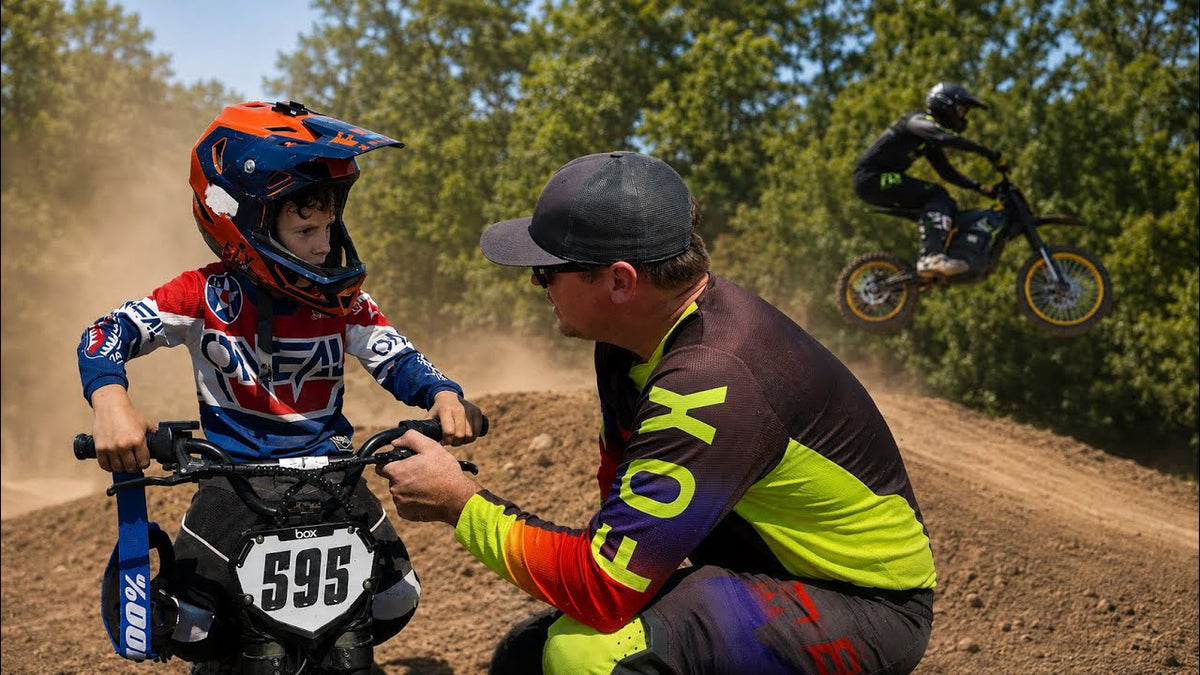
A KTM dirt bike can be an exciting goal, but “KTM next” is not a training plan. Young riders need a sequence that separates balance, throttle, braking, body position and terrain judgment. Ecoleap K2 can serve as the practice platform before a more race-focused bike.
Start with the destination—not the brand
KTM offers youth bikes at different sizes and performance levels. The correct destination depends on the child’s inseam, weight, experience and riding purpose. A family preparing for organized motocross has different needs from a family riding a backyard loop. Confirm the exact current model’s seat height, weight, controls and minimum power setting before choosing it.
Stage 1: make 10 mph boring
Use K2’s lowest mode until starts and stops no longer require coaching. Build a straight lane with a start box and stop box. The rider should launch smoothly, hold a steady pace, close the throttle and brake progressively. Add an unpredictable but safe verbal stop signal.
Stage 2: connect vision and turning
Create a wide oval and figure eight. Teach the child to look through the turn, slow before entering and apply power only when the exit is visible. Both directions matter; many young riders hide a weak side by always circling the same way.
Stage 3: use the suspension
On a permitted beginner area, introduce shallow ripples, packed-dirt ruts and mild slopes. The goal is not jumping. It is learning to stand lightly on the pegs, keep elbows relaxed and let the front and rear suspension work under the bike.
Stage 4: progress to 15 mph
Unlock the middle mode only when the child passes the same drills repeatedly. The higher mode should not change their habits: eyes stay up, throttle remains progressive and braking begins early. If technique collapses, return to 10 mph.
Stage 5: test destination-bike readiness
| Question | Pass standard |
|---|---|
| Fit | Controls are reachable and feet can support the bike |
| Strength | Child walks and steadies a comparable-weight bike while off |
| Throttle | No panic grip; immediate roll-off on command |
| Braking | Controlled stops on flat ground and mild slope |
| Body position | Stands over bumps without pulling on the bars |
| Judgment | Slows before blind or rough sections |
| Behavior | Accepts rules, gear and session limits |
What K2 contributes
The 400W sustained/850W peak brushless hub motor, 36V lithium battery and three speed modes make repeatable practice simple. Chainless drive reduces one maintenance variable, while the foot pegs, suspension, rear disc brake and knobby tires teach more dirt-specific skills than a rigid balance bike.
What still must be learned on the KTM
Every destination bike has different weight distribution, throttle mapping, braking feel and controls. A child who graduates from K2 still needs a fresh low-speed introduction. Do not treat prior speed as permission to use the new bike’s full output.
Safety still depends on fit, terrain and supervision
No speed mode or motor type makes a youth dirt bike automatically safe. Use a properly fitted certified full-face helmet, goggles, gloves, long sleeves, long pants, knee and elbow protection and over-the-ankle boots. Ride only on private property or permitted off-road areas, away from traffic, water, drop-offs and bystanders. An adult should inspect the brakes, tires, controls, fasteners and riding area before each session.
Final advice
The fastest route to a KTM is not the earliest purchase. It is a rider who arrives with repeatable fundamentals and confidence. Use K2 to make control automatic, then choose the KTM model that fits the child and intended riding—not the model with the most impressive specification.
Model specifications, prices and recommendations can change. Confirm the current manufacturer product page and owner’s manual before buying. Community comments cited here are individual parent experiences, not controlled product tests.
How to make the transition decision in real life
Model names describe machines, not readiness. Before choosing the next bike, write down what the child can do now, what the next bike will demand and where practice will happen. The gap between those lists is the real transition. A child who rides fast in a straight line may still need work on slow balance, planned braking and responding calmly when a line changes.
Use three kinds of evidence: physical fit with the power off, repeated control drills at the lowest setting, and the child’s emotional response after small mistakes. A birthday, a friend’s bike or one successful ride should not overrule those observations. The goal is a step that creates frequent independent practice rather than a machine the child can use only with constant adult rescue.
Stage 1: prove fit before riding
With K2 switched off, the child should hold it upright, walk forward, back up, turn the bars and stop a small lean. Confirm comfortable reach to the grips and brake. This stage prevents the motor from hiding a chassis mismatch.
Stage 2: master the 10 mph mode
Use a flat enclosed area and work only on start markers, straight tracking, full throttle release and stop boxes. Ten miles per hour is still powered riding; it should not be treated as walking pace or as automatically suitable for every beginner.
Stage 3: build low-speed steering
Set wide cones for circles and figure eights. Ask the rider to look through each turn, keep elbows relaxed and avoid dragging a foot. Tighten the pattern only after both directions look equally controlled.
Stage 4: introduce real dirt gradually
Move from a predictable surface to packed dirt or grass before using loose soil, ruts or slopes. Keep the same speed mode during the first terrain change so the child learns traction without also learning stronger response.
Stage 5: earn the 15 mph mode
The middle setting should follow accurate stops, consistent foot placement and automatic roll-off behavior. Run the same familiar course first. If accuracy falls sharply, return to 10 mph and strengthen the missing skill.
Stage 6: learn body position
Practice standing briefly over small smooth bumps, weighting the outside peg in broad turns and keeping the head up. The objective is not jumping; it is teaching the child to let the bike move underneath a stable body.
Stage 7: use 20 mph only as a test of judgment
Highest mode belongs after the rider slows voluntarily before turns, respects boundaries and responds immediately to adult signals. Speed is not the graduation requirement. Good decisions at speed are.
Stage 8: reassess for the exact KTM
Compare the child’s inseam, reach, strength and demonstrated habits with the current specifications and minimum settings of the KTM under consideration. KTM dirt bike models differ substantially, so a brand-level recommendation is not enough.
A practical practice plan
Use a repeating four-station course: start line, large turn, small smooth bump and stop box. Score smoothness and accuracy rather than lap time. When a mode or surface changes, return to the same course. This gives the parent and child a fair comparison and exposes whether stronger response causes late braking or rushed steering.
Keep sessions short, use visible cones or markers and change only one variable at a time. For example, retain the same speed setting when introducing loose dirt, or keep the same flat surface when moving to a higher mode. This makes improvement easier to see and helps the child understand exactly what changed.
Frequently asked questions
How long should the K2-to-KTM transition take?
There is no fixed schedule. Some riders need a season, others longer or shorter. Move by observed behavior, physical growth and terrain needs rather than a promised number of weeks.
Must a child use K2’s highest mode before upgrading?
Not necessarily. The relevant question is whether the child has mastered the skills and fits the next machine. However, difficulty controlling K2 at familiar speeds is a clear reason not to add more capability.
What if the child wants to race?
Seek qualified youth coaching and confirm local class rules. A race goal can shape the route, but it does not remove the need for fit, protective gear, controlled practice and progressive settings.
Final parent checklist
- The child can mount, hold and walk the bike with power off.
- Brake reach and hand strength are adequate.
- Throttle release happens automatically when confused.
- Turns and stops are repeatable in both directions.
- The available terrain matches the bike and current skill.
- Protective gear fits correctly and an adult supervises every session.
Move forward when these behaviors are boringly consistent. If one item remains unreliable, practice it on the current bike or choose a smaller intermediate step. That is not falling behind; it is how a rider arrives at the next motorcycle with useful habits intact.
Review the plan after every three rides
Do not wait until the child outgrows the bike to reassess. Every three sessions, compare stop accuracy, turn smoothness, foot placement and response to adult signals with the previous notes. If performance remains stable, introduce one small challenge. If it declines, repeat the familiar course. This simple review keeps the KTM goal connected to measurable habits rather than impatience.


Share:
Backyard Dirt Bike Riding Guide for Kids
MotoTec 36V Kids Dirt Bike Review: Is It a Good First Electric Dirt Bike?