

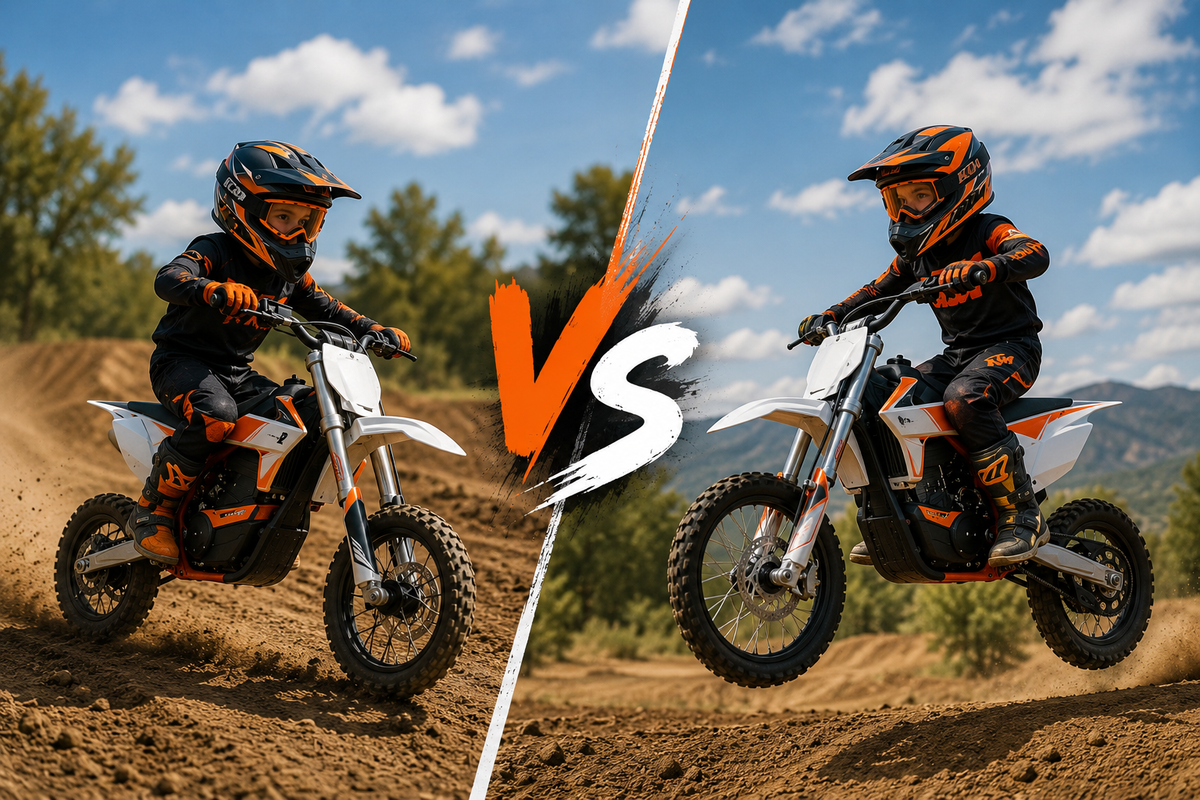
The KTM SX-E 2 and KTM SX-E 5 both carry the same orange race-bike styling, but they are built for very different stages of a child’s riding development. The SX-E 2 is a low, compact bridge between a powered balance bike and a true motorcycle. The SX-E 5 is a full youth motocross platform with substantially more power, height, suspension travel and setup responsibility.
For most families, the correct choice is not determined by age alone and certainly not by which model has the higher specification. It comes down to whether the child can physically fit the bike, manage its mass at walking speed, reach both brake levers, use the throttle without panic and ride the terrain the motorcycle was designed for.
Quick answer: choose the SX-E 2 for a small rider who has basic balance skills but is still learning motorcycle starts, stops, turns and standing posture. Consider the SX-E 5 only when the rider fits a roughly 25–27-inch seat-height range, already controls a motorcycle without constant coaching and needs genuine motocross suspension and performance. A child can outgrow the SX-E 2’s size before being ready for the SX-E 5’s capability, so an intermediate step may be the smarter route.
Model-year note before comparing specifications
KTM specifications change by model year and market. At the time of this comparison, KTM’s United States website lists the 2025 SX-E 2 and the newer 2027 SX-E 5. The table below therefore compares those currently listed U.S. versions rather than combining figures from older SX-E 5 generations. Always confirm the exact model-year label, owner’s manual and dealer specification before buying a new or used bike.
KTM SX-E 2 vs SX-E 5 specifications
| Specification | 2025 KTM SX-E 2 | 2027 KTM SX-E 5 |
|---|---|---|
| Primary role | Bridge from powered balance bike to motorcycle | Beginner-to-competitive youth motocross platform |
| Motor | Maintenance-free hub motor | Water-cooled 48 V BLDC motor with outer rotor |
| Maximum power | 1.8 kW | 5 kW at 3,900 rpm |
| Rated output | 0.75 kW | 2 kW at 3,200 rpm |
| Seat height | 18.5 in standard; adjustable to 19.6 in | Approximately 24.9–26.8 in adjustable |
| Wheels | 10 in front and rear | 12 in front and 10 in rear |
| Front suspension | Non-adjustable hydraulic fork, 90 mm travel | Fully adjustable WP XACT 35 air fork, 205 mm travel |
| Rear suspension | Preload-adjustable hydraulic monoshock, 70 mm travel | Fully adjustable WP XACT monoshock, 193 mm travel |
| Brakes | Front and rear hydraulic discs, 140 mm | Front and rear hydraulic discs, 160 mm |
| Battery concept | Quick-change 9.4 Ah lithium-ion power-tool-style pack | 907 Wh KTM lithium-ion PowerPack |
| Claimed riding time | Up to 100 minutes, depending on use | More than two hours for a beginner or about 30 minutes at full race pace, depending on conditions |
| Charging | About 35 min to 80%; under 60 min to 100% | About 45 min to 80%; 70 min to 100% |
| Drivetrain | Direct hub drive; no chain or sprockets | Motor with chain final drive |
| Safety controls | Rollover sensor and wrist-lanyard kill switch | Rollover sensor and lockable ride modes |
| U.S. base MSRP when checked | $2,249 plus freight | $5,799 plus freight |
These numbers explain why the SX-E 5 should not be treated as simply a faster SX-E 2. It has nearly three times the listed maximum motor power, more than double the suspension travel and a seat that starts more than five inches higher. The rider must manage a larger chassis long before the higher modes become relevant.
Fit comes before power
The SX-E 2’s 18.5-inch standard seat height is designed to help a small rider place both feet confidently on the ground. The bodywork, shock position, fork position and footrest carrier provide room to adjust the bike as the child grows. That adjustability is useful, but it does not turn the SX-E 2 into a tall mini motocross bike. Its compact cockpit and two 10-inch wheels remain intended for a small body.
The SX-E 5 begins in a different physical category. Its adjustable seat-height window is approximately 24.9 to 26.8 inches, and its longer wheelbase, higher ground clearance and 12-inch front wheel create a much larger rider triangle. A child who is comfortable on a 19-inch seat may still be unable to touch down securely, reach the bars without stretching or move forward over the front wheel on the SX-E 5.
Do not use standing height alone. Measure the child’s barefoot inseam, then test the bike while the child is wearing riding boots. Boots change ankle movement, seat foam compresses, suspension settles under the rider and seat width affects how far the legs must spread. A paper seat-height number cannot capture all of those variables.
Five fit tests at the dealer
- Stable stop: the child can hold the bike upright without an adult supporting the handlebar or rear fender.
- Control reach: both hands stay on the grips while the child comfortably reaches and pulls each brake lever.
- Steering range: the bars can turn from side to side without the rider’s knees, arms or torso being forced out of position.
- Walking control: with the motorcycle switched off, the rider can paddle it forward, stop it and make a tight turn.
- Recovery: from a controlled lean, the child can arrest the bike before it falls and understands when to step away instead of fighting excessive weight.
If the rider fails these tests, a low power mode does not solve the problem. Software can reduce acceleration, but it cannot shorten the frame, lower the center of mass enough or improve a child’s leverage at a stop.
The SX-E 2 teaches first-motorcycle skills
The SX-E 2 is most valuable when a child already balances and steers confidently but still needs to learn how a motorcycle behaves. Compared with a powered balance bike, it adds a motorcycle-style riding position, footrests, front and rear hydraulic brakes, real suspension and more substantial chassis feedback.
Its 1.8 kW hub motor also removes the chain and sprockets found on a traditional mini motocross drivetrain. That reduces routine chain adjustment and eliminates an exposed final-drive component near the rear wheel. A rollover sensor cuts power after a fall, while the wrist lanyard can stop the motor if the rider separates from the bike.
The multifunction throttle requires a deliberate activation movement and provides haptic feedback when the bike becomes ready. These features support learning, but parents should still teach a consistent sequence: bike upright, eyes forward, one or two fingers prepared for the brakes, smooth throttle opening and immediate roll-off when the rider becomes uncertain.
The SX-E 2 is not a toy. KTM lists it at 59.5 lb, which is far heavier than many powered balance bikes. A child who can ride a 15–20 lb balance bike at full speed is not automatically ready to control nearly 60 lb through slow turns, stops and small falls.
The SX-E 5 is a real youth motocross machine
The SX-E 5 is designed as an electric alternative to a 50 cc competition motorcycle. Its 5 kW water-cooled motor, chromoly frame, 12/10-inch wheels, chain final drive, long-travel WP suspension and larger 160 mm hydraulic brakes are intended for track speeds, braking bumps, ruts, jumps and repeated hard use.
KTM provides six ride modes, ranging from gentler characteristics for developing riders to full performance for experienced racers. The selected mode can be locked with a dongle under the seat, helping prevent a child from changing to a more powerful setting without permission. This is a useful parent control, but it should be viewed as a progression tool—not as a way to make an oversized race chassis appropriate for an unprepared beginner.
The suspension is another major distinction. The SX-E 5’s WP XACT 35 air fork has 205 mm of travel and can be adjusted for rider weight. The rear WP XACT shock provides 193 mm of travel and is also adjustable. Correct pressure, sag and damping help the motorcycle stay balanced under braking and over impacts. Incorrect setup can make the front push, the rear kick or the chassis ride too low in its stroke. Families moving to an SX-E 5 should be prepared to learn suspension setup or work with a knowledgeable dealer or coach.
Why maximum power does not answer the buying question
Parents often compare 1.8 kW with 5 kW and assume the child should move up once the smaller bike feels slow. That skips the most important part of progression. Speed tolerance is only one skill; race-bike readiness includes braking judgment, body position, line choice, traction management and decision-making when something goes wrong.
A rider is not ready for the SX-E 5 merely because they can hold the SX-E 2 throttle open on a straight. Look for whether the child rolls off before a turn without being told, brakes while the bike is upright, looks through the corner, stands with knees and elbows flexed, absorbs bumps without pulling the throttle accidentally and stops immediately when a boundary is called.
The best evidence is repeatability. One clean lap is encouraging; ten controlled laps without reminders show a skill is becoming automatic. Fatigue matters as well. If technique disappears near the end of a session, the next bike may amplify the problem.
Battery and charging are different ownership experiences
The SX-E 2 uses a quick-change 9.4 Ah lithium-ion pack. KTM states up to 100 minutes of riding time, and the 500 W charger can bring the pack to roughly 80% in 35 minutes and to full charge in under an hour. The removable, tool-style format makes a spare pack a practical way to extend a family practice session.
The 2027 SX-E 5 stores 907 Wh in a robust aluminum-cased KTM PowerPack with an integrated battery-management system. KTM estimates more than two hours for a beginner or about 30 minutes at full racing intensity, depending on terrain and conditions. Its 900 W charger reaches approximately 80% in 45 minutes and 100% in 70 minutes.
Runtime claims are not directly comparable because rider weight, mode, speed, temperature, elevation change, surface and riding style all affect energy use. Slow drills can last far longer than deep soil, repeated acceleration or race laps. Plan a session around the child’s concentration and physical fatigue rather than trying to empty the battery every time.
Use only the specified charger, allow a hot battery to cool before charging, inspect connectors and casing after a crash and follow the owner’s manual for storage charge and temperature. The higher-energy SX-E 5 pack also makes dealer support and correct battery handling more consequential.
Brakes, wheels and terrain
Both bikes use front and rear hydraulic disc brakes, which allows children to learn coordinated braking from the start. The SX-E 2’s 140 mm discs and adjustable levers suit small hands and its intended speed. The SX-E 5 moves to 160 mm discs to match the larger, faster chassis.
The SX-E 2’s equal 10-inch wheels keep the seat low and make direction changes easy on a smooth training area, hard-packed dirt and small beginner features. The SX-E 5’s 12-inch front wheel rolls over braking bumps, ruts and square edges more effectively, while the 10-inch rear preserves the proportions of a 50 cc-class motocross bike.
Terrain should match the motorcycle. A groomed beginner loop can help an SX-E 2 rider repeat basic controls. The SX-E 5 becomes worthwhile when the family has access to a legal motocross practice area where its suspension, ground clearance and race-oriented geometry can actually be used. Buying race capability for a small flat backyard may add cost and difficulty without improving the learning experience.
Choose the KTM SX-E 2 when
- The child fits the 18.5–19.6-inch adjustable seat range.
- They already balance and steer but have limited motorcycle experience.
- Starts, stops, wide turns and brake coordination are still being learned.
- A low, compact chassis is more important than long-travel race suspension.
- The family values a quick-change battery and chain-free hub drive.
- Practice will occur mainly on a controlled beginner loop rather than a full motocross track.
Choose the KTM SX-E 5 when
- The rider genuinely fits the 24.9–26.8-inch adjustable seat range in full gear.
- They can hold, walk and turn the motorcycle without adult support.
- Throttle roll-off, braking before corners and standing posture are already automatic.
- The child has experience with ruts, bumps, traction changes and small jumps under qualified supervision.
- The family needs six-mode progression and real 50 cc-class motocross performance.
- Parents are prepared to manage suspension settings, chain inspection, tires, brake wear, transport and track access.
Signs the SX-E 5 upgrade is premature
- An adult must hold the bike upright while the child starts or stops.
- The rider can touch only one toe down and becomes anxious at low speed.
- The child relies on speed for balance and avoids tight turns.
- They frequently freeze on the throttle or need verbal reminders to roll off.
- Braking happens late, abruptly or while the handlebar is sharply turned.
- Standing over bumps causes accidental throttle input.
- The family does not have a suitable legal riding area or protective equipment.
- The main reason for upgrading is age, appearance or maximum mode rather than a demonstrated skill need.
What if the child is between the two bikes?
This is a common situation because there is a large gap between the two platforms. A child may be too tall for the SX-E 2’s cockpit but still lack the inseam, strength or track experience for the SX-E 5. Do not solve that gap by buying the larger KTM and keeping it permanently in the lowest mode.
For a recreational rider, an intermediate children’s electric dirt bike can provide more room and speed progression without immediately adding a competition chassis. Families can compare the Ecoleap K1 for a smaller learning step or the Ecoleap K2 for a larger child who already has two-wheel fundamentals. The objective is not to follow a brand ladder; it is to keep vehicle size, minimum controllable speed and rider skill aligned.
Track-focused families may also evaluate an intermediate race model in the relevant year and market. Whatever the route, repeat the fit and control tests on the actual motorcycle rather than assuming the next model number is the next correct size.
A practical progression test before moving up
Before scheduling a test ride on the SX-E 5, ask the child to demonstrate the following on the current bike over several sessions:
- Start smoothly ten times without a throttle surge.
- Stop inside a marked box from different approach speeds.
- Ride tight left and right circles while looking through the turn.
- Complete a cone slalom without dabbing a foot or cutting the throttle abruptly.
- Stand over a rough section with neutral wrists and steady throttle.
- Slow before every corner without a parent calling instructions.
- Respond instantly to a stop signal.
- Recognize fatigue and voluntarily take a break.
If these skills are inconsistent, continue training on the current motorcycle. A smaller familiar bike lets the child concentrate on technique; a larger high-performance motorcycle consumes attention simply through its size and response.
Frequently asked questions
Is the SX-E 5 simply the next bike after the SX-E 2?
No. There is a significant physical and performance gap. Some children can move directly when they fit the larger chassis and have developed strong motorcycle skills, but many need an intermediate step.
Can a complete beginner use the SX-E 5 in the lowest mode?
KTM provides low modes for progression, but mode selection cannot correct poor physical fit or lack of balance, braking and throttle control. A beginner must still pass the static fit tests and train in a controlled environment.
Which bike is easier to maintain?
The SX-E 2’s hub motor eliminates the chain and sprockets, reducing final-drive maintenance. The SX-E 5 is still simpler than a combustion race bike in several respects, but its chain, race suspension, tires, brakes and higher-performance chassis require regular inspection and setup.
Which bike has better suspension?
The SX-E 5 has far more capable and adjustable WP suspension. That is an advantage for motocross impacts and rider-specific setup, not necessarily for a small beginner on smooth ground. The best suspension is the system correctly sized and configured for the rider and terrain.
How long do the batteries last during a session?
KTM claims up to 100 minutes for the SX-E 2. For the 2027 SX-E 5, KTM states more than two hours for beginner use or roughly 30 minutes at full racing pace. Real runtime varies substantially with mode, rider, terrain, temperature and riding intensity.
Does the quieter electric drivetrain make either bike safe for public roads?
No. These are off-road motorcycles. Use them only where operation is permitted, follow local rules and provide full protective equipment and adult supervision.
What protective gear should a child wear?
At minimum, use a correctly fitted youth off-road helmet, goggles, gloves, over-the-ankle motocross boots, knee protection, elbow protection and durable riding clothing. For track riding, add appropriate body protection and follow the facility’s rules.
Bottom line
The KTM SX-E 2 is the better fit for a small child moving beyond a powered balance bike and learning true motorcycle controls. Its low adjustable seat, compact 10-inch chassis, chain-free hub drive, hydraulic brakes and quick-change battery make repeated beginner drills more approachable.
The KTM SX-E 5 is the right choice for a physically larger and technically prepared junior who needs a genuine electric motocross machine. Its 5 kW motor, six modes, 12/10-inch wheels, long-travel adjustable WP suspension and large PowerPack provide real competition capability—but also require more rider discipline, setup knowledge, appropriate terrain and family commitment.
Choose the motorcycle the child can control today while still having a sensible path to grow. If the SX-E 2 is cramped but the SX-E 5 still needs adult support at a stop, the answer is not to force the jump. Use an intermediate size, keep building automatic skills and test the larger bike again when fit and behavior—not age or enthusiasm—say the rider is ready.


Share:
When Should Kids Start Riding Dirt Bikes?
Electric vs Gas Dirt Bike for Kids: A Parent’s Comparison