

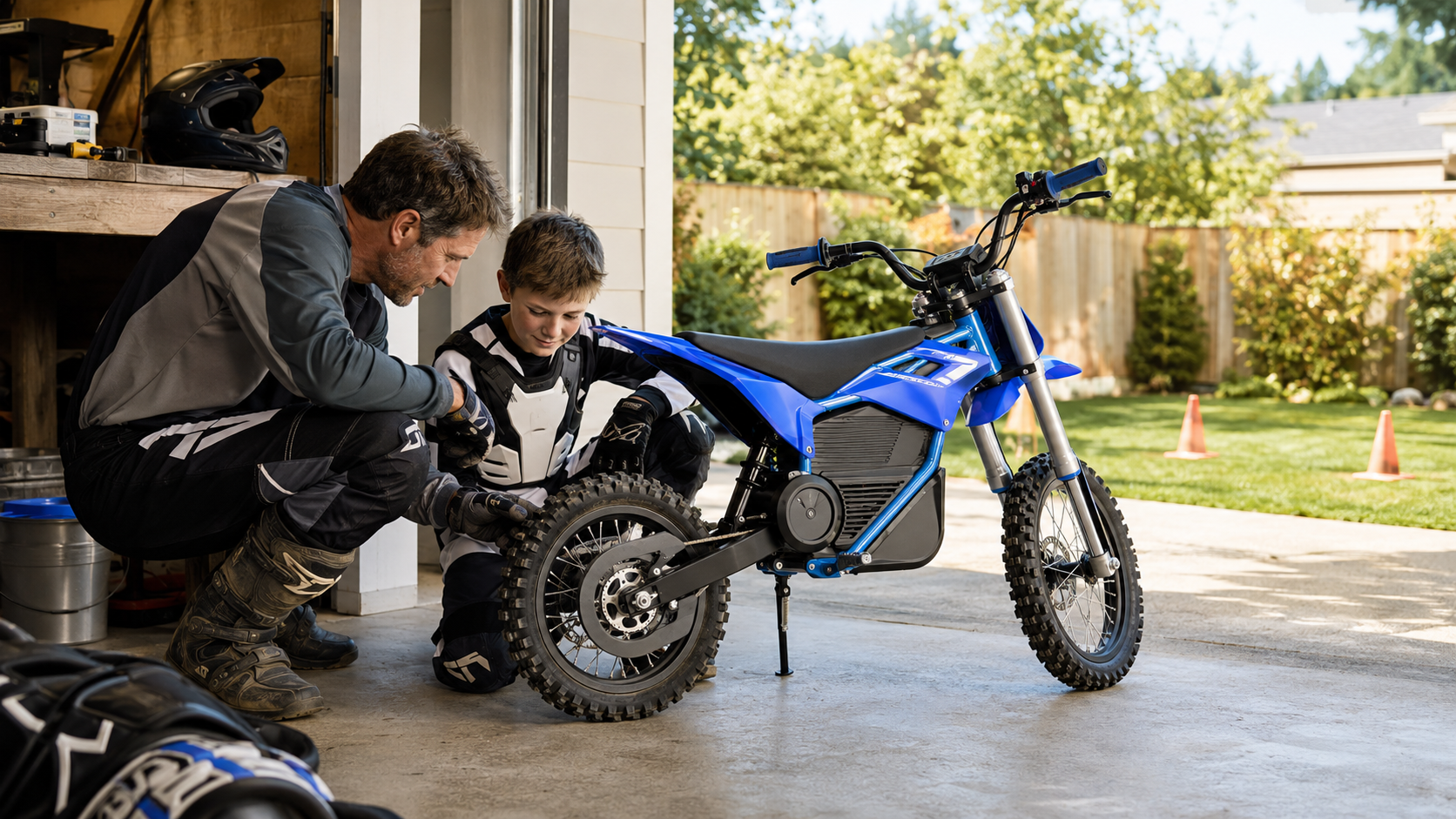
When parents compare electric kids dirt bikes, motor wattage usually gets most of the attention. Product pages advertise 250W, 500W, 850W or even 1,000W, which makes it easy to assume that the largest number automatically means the best bike.
Wattage tells only part of the story. Two motors with similar ratings can feel very different because one uses brushes while the other uses electronic commutation. Motor design affects efficiency, heat, noise, maintenance, service life and how consistently the bike delivers power.
For a young rider, those differences matter. A first kids dirt bike should not simply be fast. It should provide predictable power that helps the child learn smooth starts, controlled turns and confident stops. This guide explains why a brushless motor is usually the better choice for a regularly ridden electric dirt bike for kids—and when a lower-cost brushed motor may still make sense.
Quick Answer: Why Is a Brushless Motor Better?
A brushless motor generally converts more battery energy into motion, produces less internal friction and requires less routine internal maintenance. It also tends to run more quietly and maintain more consistent performance during repeated riding.
- Higher electrical efficiency
- Less internal friction and heat
- No carbon brushes to wear out
- Quieter operation
- Longer potential service life
- More consistent power delivery
- Better compatibility with precise electronic speed control
The tradeoff is cost. Brushless systems require an electronic controller and are normally more expensive to manufacture. A brushed motor can still be adequate for an inexpensive ride-on used occasionally at low speed. For a kids dirt bike intended for regular practice and long-term skill development, however, brushless technology usually offers better overall value.
How Does a Brushed Motor Work?
A brushed DC motor uses physical carbon brushes to transfer electrical current to a rotating component called the commutator. As the motor spins, the brushes remain in contact with the commutator and repeatedly switch the current that keeps the rotor turning.
The design is simple, established and inexpensive. Brushed motors can produce useful starting torque without a highly sophisticated controller, which is why they remain common in entry-level kids dirt bikes, electric scooters, ride-on toys and older power tools.
The limitation is physical contact. Every time the motor operates, the brushes rub against the commutator. That contact produces friction, heat, electrical arcing and gradual wear. As the brushes and commutator age, the motor can become noisier, less efficient or less consistent. Eventually, the brushes may require replacement.
How Does a Brushless Motor Work?
A brushless DC motor eliminates the physical brushes and mechanical commutator. Instead, an electronic controller switches current among the motor’s electromagnetic coils. Permanent magnets and electronically controlled magnetic fields create rotation without the same continuous rubbing contact found in a brushed motor.
Because there are no brushes continually pressing against a commutator, less energy is lost through friction. There are also fewer internal wear components. A brushless motor still contains bearings and other parts that can wear, so it is not literally maintenance-free, but it normally requires much less internal service than a comparable brushed design.
Brushed vs. Brushless Motor Comparison
| Feature | Brushed motor | Brushless motor |
|---|---|---|
| Initial cost | Usually lower | Usually higher |
| Physical brushes | Yes | No |
| Efficiency | Generally lower | Generally higher |
| Heat generation | Usually higher | Usually lower |
| Operating noise | More mechanical/electrical noise | Usually quieter |
| Internal maintenance | Brushes can wear and need service | Fewer internal wear parts |
| Power consistency | Can decline as heat and wear increase | Generally more consistent |
| Control system | Simpler | More advanced electronic controller |
| Potential service life | Usually shorter | Usually longer |
| Typical use | Budget, occasional riding | Regular riding and skill development |
Motor type is only one part of the complete bike. Controller tuning, battery quality, rider weight, terrain, gearing or hub design and manufacturing quality also affect performance. A poorly engineered brushless system is not automatically better than every brushed system.
1. Brushless Motors Use Battery Energy More Efficiently
An electric kids dirt bike carries a limited amount of stored energy. The motor and controller determine how much of that energy becomes useful movement and how much becomes heat.
A brushed motor loses energy through brush contact, electrical resistance and mechanical friction. A brushless system generally wastes less, leaving more battery energy available for riding. This does not guarantee that every brushless kids dirt bike will travel farther. Range also depends on battery capacity, rider weight, speed, hills, soft ground, temperature, tire pressure and frequent acceleration.
Still, when two otherwise similar bikes use comparable batteries, the brushless system normally has an efficiency advantage. For parents, that can mean more usable practice time and less noticeable performance loss during a session.
2. Less Friction Means Less Heat and Wear
Heat is one of the main enemies of electric components. A less efficient motor turns more electrical energy into heat instead of motion. The physical contact inside a brushed motor adds both heat and wear.
This becomes more important during repeated starts, hill riding, soft dirt, grass, heavier rider loads or long periods of high throttle. Under those conditions, a brushed motor may heat up more quickly. Excessive heat can reduce performance and accelerate wear.
A brushless motor is not immune to overheating. It can still be overloaded, and the controller or battery may also become hot. Parents should always follow the bike’s weight, terrain and duty-cycle guidance. The advantage is that the brushless design begins with less internal friction.
3. Fewer Wear Parts Can Reduce Maintenance
The brushes in a brushed motor are consumable components. Their lifespan depends on material quality, motor load, heat, dust and riding time. When they wear down, performance may decline and replacement may be necessary.
A brushless motor removes that maintenance item. If it is also built as a hub motor, the bike may eliminate an external chain and sprockets as well. That can reduce chain-tension checks, alignment work, lubrication and exposure to moving drivetrain parts.
Low maintenance does not mean no inspection. Before riding, parents should still check:
- Brake operation and lever reach
- Throttle return
- Tire pressure and tread
- Wheel and handlebar fasteners
- Footpegs and suspension hardware
- Wiring and connectors
- Battery condition and charge-port cover
- Frame condition after any fall
4. Quieter Operation Helps During Training
Brushed motors usually create more mechanical and electrical noise, while chain-driven systems add chain and sprocket sound. Brushless motors tend to operate more quietly, especially when integrated into the wheel.
Quiet operation is useful during beginner practice because the child can hear instructions more clearly. A parent can call out “look through the turn,” “release the throttle” or “stop at the marker” without competing with engine or drivetrain noise.
Reduced noise may also make responsible riding on suitable private property less disruptive. It does not make public-road riding or unauthorized trail use acceptable, and adult supervision remains essential.
5. Electronic Control Can Deliver More Predictable Power
Motor type alone does not determine throttle quality. The controller, throttle hardware and software calibration matter just as much. However, a brushless motor paired with a well-programmed controller can provide precise, repeatable power control.
That matters because young riders must learn that the throttle is not an on/off switch. They need to add a small amount of power, maintain a steady pace and release the throttle before braking. Abrupt response can cause the rider to tense their arms, look down, run wide in a turn or hold the throttle during a moment of panic.
Parents should test the actual bike rather than relying only on the word “brushless.” A suitable beginner system should combine smooth response with manageable speed modes, reachable controls and a chassis that fits the child.
Does Brushless Automatically Mean More Powerful?
No. Brushless describes how the motor is commutated; it does not determine maximum speed or whether the bike is safe for a beginner. The controller limits how much current the motor receives and how quickly power builds.
A youth-focused bike can pair a brushless motor with restricted riding modes, gradual acceleration and a parent-controlled speed selector. In that context, the efficiency and controllability of brushless technology can make the bike easier to use rather than more intimidating.
The important question is whether the complete power system was designed for children—not simply whether the motor is brushless.
Does a Brushless Motor Last Longer?
Under similar loads and operating conditions, a quality brushless motor generally has the potential to last longer because it has no carbon brushes continuously wearing against a commutator.
Overall durability still depends on the complete kids dirt bike, including controller quality, battery management, wiring, seals, bearings, frame construction, charging habits, storage and replacement-parts support. The brushless label should be treated as one important feature, not a guarantee of quality.
Why Are Brushed Kids Dirt Bikes Still Popular?
Brushed motors help manufacturers offer a lower purchase price. For a family testing whether a child enjoys riding, an inexpensive brushed bike may provide an accessible introduction.
A brushed motor can make sense when the budget is limited, use will be occasional, the child is likely to outgrow the bike quickly or low-speed recreation is the only goal. Some families also prefer the simplicity and lower replacement cost of basic brushed components.
The lowest upfront price is not always the lowest long-term cost. Families who ride frequently may get more value from the efficiency, quieter operation and reduced internal wear of a brushless system.
Motor Wattage Can Be Misleading
Parents should not compare an electric dirt bike for kids using wattage alone. A rating may describe continuous, nominal, maximum or brief peak output. One manufacturer may advertise only peak power while another lists both continuous and peak figures.
A useful comparison should include:
- Brushed or brushless motor type
- Continuous and peak power definitions
- Battery voltage and amp-hour capacity
- Controller and acceleration tuning
- Available speed modes
- Bike weight and seat height
- Brake type and lever reach
- Intended rider size and experience
- Drivetrain maintenance requirements
- Parts and customer support
For a beginner, a controlled brushless system may be more useful than a higher-rated motor with abrupt acceleration or a chassis that is too tall and heavy.
The Ecoleap K2 Brushless Motor System
The Ecoleap K2 kids electric dirt bike uses a brushless hub motor rated at 400W continuous and 850W peak. It is paired with a 36V 7.8Ah lithium-ion battery and three selectable speed modes: 10, 15 and 20 mph.
The goal is progressive training. A beginner can start in the lowest mode while practicing throttle release, straight-line braking and wide turns. The middle mode can be introduced after the rider consistently demonstrates control. The highest mode should be reserved for a skilled rider, suitable terrain and active adult supervision.
Because the motor is integrated into the rear wheel, the K2 does not use an external chain drive. That removes routine chain tension and lubrication work while reducing exposed drivetrain parts. Together with front and rear suspension and a rear mechanical disc brake, the system is designed as a practical step between a basic balance bike or ride-on and a more demanding youth dirt bike.
How to Choose the Right Kids Dirt Bike
Motor technology cannot compensate for poor fit. Before buying, check whether the child can hold the bike upright, place their feet securely on the ground, reach the throttle and brake, turn the handlebars comfortably and walk the bike without power.
The rider should also be able to follow instructions, release the throttle immediately, stop at a chosen marker and remain calm when the bike leans. A lower, lighter bike with predictable power is usually better than an oversized model purchased for the child to “grow into.”
Always use a properly fitted off-road helmet, eye protection, gloves, long sleeves, long pants and over-the-ankle footwear. Choose additional protective equipment appropriate to speed and terrain, ride only in permitted off-road areas and supervise every session.
Final Verdict
For most families choosing a kids dirt bike for regular use, a brushless motor is the better long-term option. It is generally more efficient, quieter and lower-maintenance, with fewer internal wear parts and strong compatibility with precise electronic speed control.
A brushed kids dirt bike can still be reasonable for occasional, low-speed riding on a tight budget. The final decision should consider the complete bike: throttle tuning, speed controls, battery chemistry, weight, seat height, brakes, fit and support.
The best electric dirt bike for kids is not automatically the one with the biggest wattage number. It is the one that gives the child predictable control and enough room to build genuine riding skills.


Share:
MotoTec 36V Kids Dirt Bike Review: Is It a Good First Electric Dirt Bike?
Too Big, Too Heavy, Too Soon: Why Kids Lose Confidence on Their First Dirt Bike