

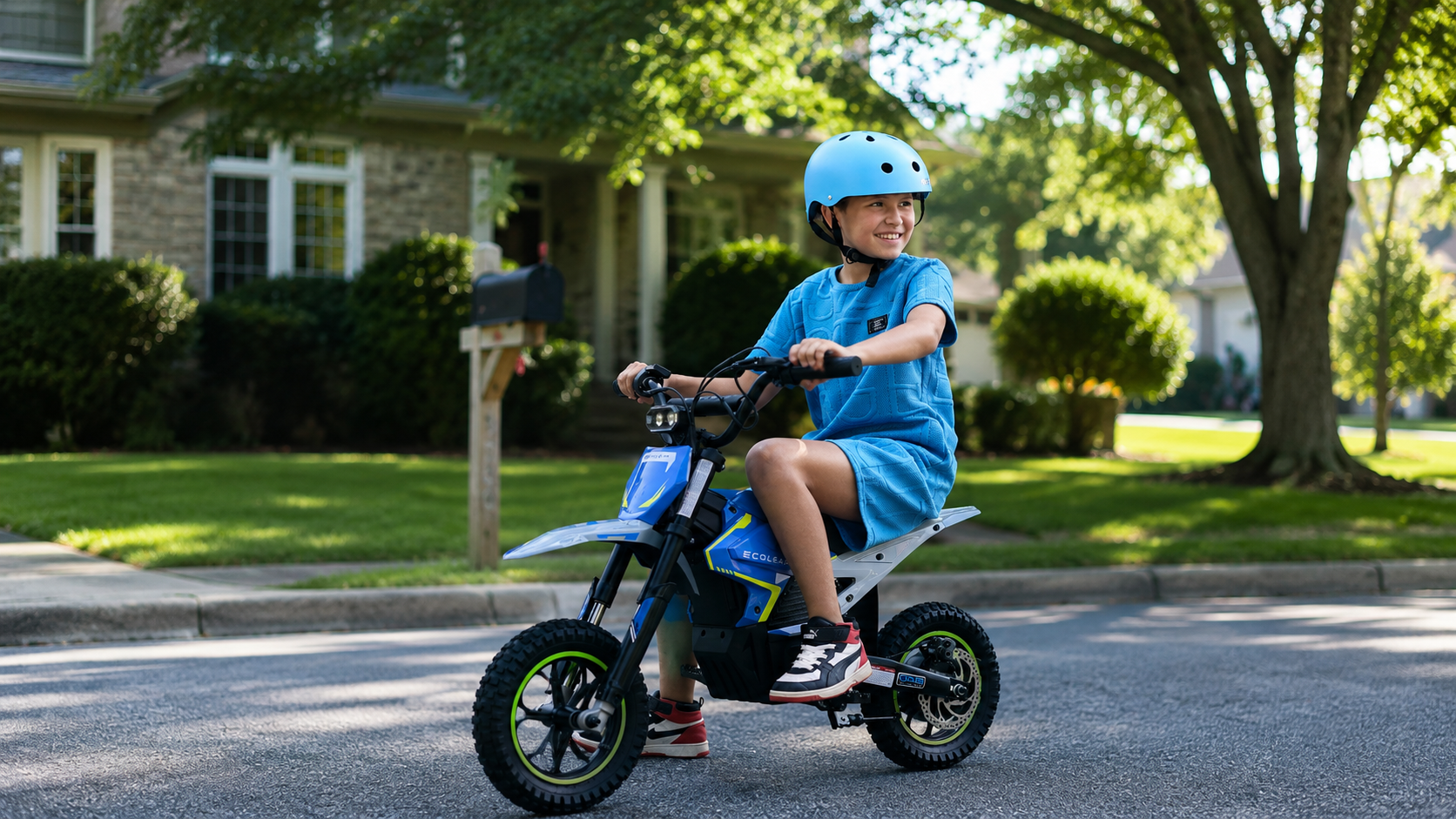
The most expensive first-dirt-bike mistake is not buying too little power. It is buying a bike the child cannot control independently. A machine that is too tall, too heavy or too responsive can turn normal beginner wobbles into fear.
Why moving feels easier than stopping
Once rolling, even a heavy bike can feel stable. The problem appears at walking speed: mounting, turning tightly, stopping on uneven ground and catching a lean. A child may look capable in a straight video yet need an adult every time the bike slows down.
That pattern appeared in this Reddit discussion about introducing a toddler to dirt bikes: parents focused on whether the child could support the bike and recover from small mistakes. Several community stories described confidence improving after moving to a better-fitting machine. These are anecdotes, but the underlying fit test is practical.
Five signs the bike is too much
- The child reaches the ground only by sliding far off the seat.
- An adult must hold the bike for every start or stop.
- The brake lever cannot be squeezed firmly with one hand.
- The rider panics and keeps the throttle open when the bike tips.
- The child avoids riding after one or two low-speed falls.
Do not buy for “room to grow” at the cost of today
A larger bike may last longer physically, but it can delay skill if the child rides less. The correct first bike lets the rider repeat dozens of calm starts and stops. Skill grows from successful repetitions, not from owning unused capability.
Weight matters separately from seat height
Lowering a seat does not remove mass. Ask the child to hold a similar-weight bike upright with the power off, turn the bars and walk backward. If the bike begins controlling the child, speed settings cannot fix the mismatch.
Where K2 fits—and where it does not
Ecoleap K2 is intended as a middle-stage kids’ dirt bike, with a 20.67-inch seat, 41.89 lb weight and a recommended rider-height range of 37–56 inches. Height alone is too broad a test. K2 makes sense for a child who already balances confidently and can manage its weight. It is not the right answer for a toddler or a beginner who still needs a very light platform.
For the correct rider, three speed modes let parents prevent an unnecessary jump in response. Start at 10 mph, teach precision stops and turns, then unlock 15 and 20 mph only after the child earns them through consistent control.
How to rebuild confidence after a bad start
- Stop the session before frustration becomes the memory.
- Return to a bicycle or lighter powered balance bike for several successful rides.
- Practice the feared action—often stopping—with power off.
- Use a flat, open area and visible markers.
- Let the child choose when to repeat the drill.
- Consider a smaller bike instead of more coaching on the wrong bike.
A better buying order
Check inseam and brake reach first, weight and strength second, current skill third, terrain fourth and maximum speed last. Parents naturally notice performance numbers, but beginners spend more time starting, turning and stopping than riding at top speed.
Safety still depends on fit, terrain and supervision
No speed mode or motor type makes a youth dirt bike automatically safe. Use a properly fitted certified full-face helmet, goggles, gloves, long sleeves, long pants, knee and elbow protection and over-the-ankle boots. Ride only on private property or permitted off-road areas, away from traffic, water, drop-offs and bystanders. An adult should inspect the brakes, tires, controls, fasteners and riding area before each session.
Bottom line
The best first dirt bike is the one a child can hold up, stop, restart and control without being rescued every minute. Choose enough bike to teach the next skill—not enough bike to intimidate the rider into quitting.
Model specifications, prices and recommendations can change. Confirm the current manufacturer product page and owner’s manual before buying. Community comments cited here are individual parent experiences, not controlled product tests.
More detail for parents making this decision
A first dirt bike changes several demands at once: balance, weight, brake reach, throttle judgment, terrain reading and emotional confidence. The following checks turn a broad recommendation into a practical decision for one specific child. Use them before comparing maximum speed or planning how many years a bike might last.
Run a power-off fit test
With the bike switched off, have the child mount, straighten the bars, place both feet down, lean slightly to each side and bring the machine upright. Then ask for a short forward and backward walk. This reveals whether seat height and mass are manageable before motor response complicates the picture. The useful test is repeatability: ask whether the child can perform the skill calmly five or ten times, not whether it happened once in a video. Practice with the motor off first when possible, then use the lowest appropriate setting in a flat, clearly bounded area. If posture becomes tense, braking gets late or the child needs frequent rescue, reduce the task instead of adding speed.
Separate seat height from total weight
A low seat can create the impression of an easy bike, yet a heavy chassis still demands strength during slow turns and uneven stops. Conversely, a taller but lighter bike may be manageable for a skilled rider with adequate inseam. Evaluate the two measurements independently. The useful test is repeatability: ask whether the child can perform the skill calmly five or ten times, not whether it happened once in a video. Practice with the motor off first when possible, then use the lowest appropriate setting in a flat, clearly bounded area. If posture becomes tense, braking gets late or the child needs frequent rescue, reduce the task instead of adding speed.
Watch the first three seconds after stopping
Many fit problems appear after the wheels stop. Look for a foot searching for the ground, locked elbows, handlebars turning sharply or the bike leaning beyond the child’s ability to recover. Those details matter more than a smooth straight-line pass. The useful test is repeatability: ask whether the child can perform the skill calmly five or ten times, not whether it happened once in a video. Practice with the motor off first when possible, then use the lowest appropriate setting in a flat, clearly bounded area. If posture becomes tense, braking gets late or the child needs frequent rescue, reduce the task instead of adding speed.
Measure brake reach and hand strength
The child should reach the lever without rotating the hand off the grip and should produce a firm, controlled stop without using every finger. Adjustability helps only within the manufacturer’s limits. A lever that is technically reachable but difficult to squeeze is still a mismatch. The useful test is repeatability: ask whether the child can perform the skill calmly five or ten times, not whether it happened once in a video. Practice with the motor off first when possible, then use the lowest appropriate setting in a flat, clearly bounded area. If posture becomes tense, braking gets late or the child needs frequent rescue, reduce the task instead of adding speed.
Recognize fear versus healthy caution
Healthy caution produces questions, slower choices and attention to coaching. Fear produces freezing, target fixation, refusal to stop or an uncontrolled grip on the throttle. Treat those signals as information about fit or task difficulty, not disobedience. The useful test is repeatability: ask whether the child can perform the skill calmly five or ten times, not whether it happened once in a video. Practice with the motor off first when possible, then use the lowest appropriate setting in a flat, clearly bounded area. If posture becomes tense, braking gets late or the child needs frequent rescue, reduce the task instead of adding speed.
Use a confidence reset after a fall
Turn the bike off, check the child and equipment, and let emotion settle. Rehearse the failed action at walking speed or return to a bicycle for several successful minutes. Restart only if the child chooses and can explain the next simple goal. The useful test is repeatability: ask whether the child can perform the skill calmly five or ten times, not whether it happened once in a video. Practice with the motor off first when possible, then use the lowest appropriate setting in a flat, clearly bounded area. If posture becomes tense, braking gets late or the child needs frequent rescue, reduce the task instead of adding speed.
Avoid the grow-into-it trap
Buying extra chassis size can look economical, but a season of low use has its own cost. A correctly fitted bike encourages frequent practice, cleaner technique and easier resale. Room to progress should come from selectable settings and capability, not from forcing a child to manage adult-sized leverage. The useful test is repeatability: ask whether the child can perform the skill calmly five or ten times, not whether it happened once in a video. Practice with the motor off first when possible, then use the lowest appropriate setting in a flat, clearly bounded area. If posture becomes tense, braking gets late or the child needs frequent rescue, reduce the task instead of adding speed.
Create an objective upgrade checklist
Before moving up, require independent mounting, controlled starts, eyes-up turns in both directions, deliberate throttle release, accurate stops and the ability to pick a safe line around a small obstacle. Add stable behavior after a surprise, because calm recovery is part of readiness. The useful test is repeatability: ask whether the child can perform the skill calmly five or ten times, not whether it happened once in a video. Practice with the motor off first when possible, then use the lowest appropriate setting in a flat, clearly bounded area. If posture becomes tense, braking gets late or the child needs frequent rescue, reduce the task instead of adding speed.
Frequently asked questions
Does touching with one foot mean the bike fits?
For an experienced rider, one-foot support may be normal. For a first-time child, reliable contact with both feet or strong one-foot technique is more reassuring. The standard should match current skill, not what an expert rider can manage.
Can a speed limiter solve a weight problem?
No. Lower response can make powered riding easier, but it does not change what happens when the bike leans at zero speed. Fit, mass and hand strength must be acceptable before speed settings become useful.
Should parents hold the rear of the bike?
Brief support can introduce controls, but repeated adult holding may hide a poor fit and prevent independent balance. Move quickly toward power-off drills the child can complete alone.
A parent-led decision, not a race
Progress is rarely linear. Growth spurts, a difficult fall, a new surface or a long break can temporarily move a rider backward. Keep the next session short enough to finish with a successful repetition. A smaller step that preserves enthusiasm usually builds skill faster than an impressive upgrade that spends most of its time parked.


Share:
Why Is a Brushless Motor Better Than a Brushed Motor for a Kids Dirt Bike?
Why K2 Works as a Pre-PW50 Training Bike