

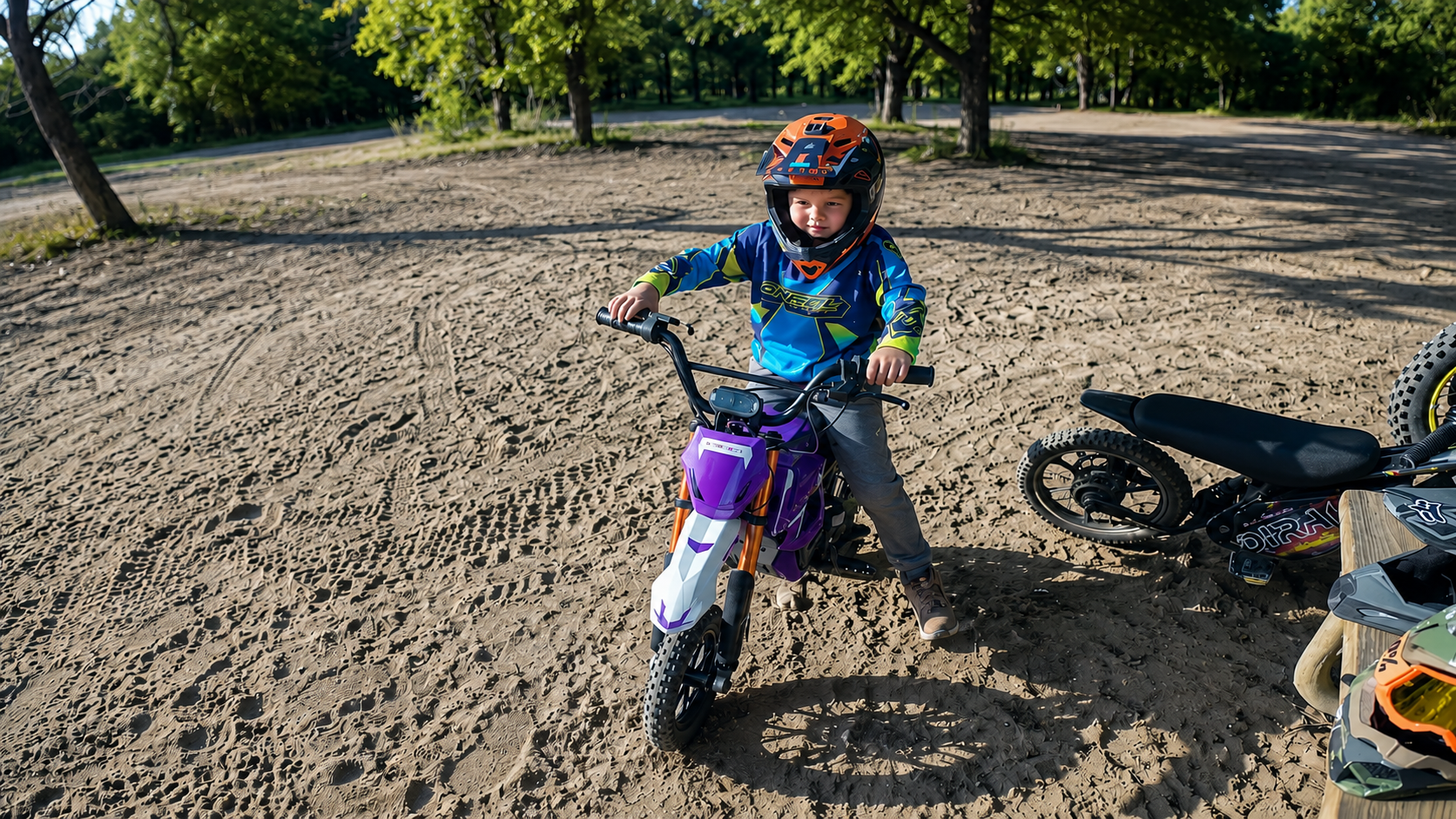
The Ecoleap K2 is best understood as a pre-PW50 training bike: a step for children who have outgrown a powered balance bike but are not yet ready—or do not yet need—to manage a small gas dirt bike.
Pre-PW50 does not mean a PW50 copy
K2 does not try to duplicate an engine, exhaust or gas-bike operating routine. Its purpose is to teach the transferable fundamentals: smooth starts, braking, feet-on-pegs balance, body position, line choice and speed judgment on light off-road terrain.
Three speed modes create a training ladder
K2’s 10, 15 and 20 mph settings should be treated as three curricula, not three buttons to try on the first afternoon.
| Mode | Primary drills | Move up only when |
|---|---|---|
| 10 mph | Starts, straight stops, wide turns, emergency signal | Control is consistent across multiple sessions |
| 15 mph | Tighter turns, mild slopes, standing over bumps | Rider slows before hazards and never panic-throttles |
| 20 mph | Longer lines and advanced open-area control | Fit, judgment, gear and terrain are all appropriate |
Why the brushless motor matters
The 36V hub motor is rated at 400W sustained and 850W peak. Brushless operation avoids the wear brushes found in older brushed designs, and the hub layout removes the external drive chain. Families still need to inspect brakes, tires, fasteners and electrical components, but there is no chain to lubricate, tension or put back on.
Why lithium matters
K2 uses a 36V 7.8Ah, 280.8Wh lithium battery. Compared with the lead-acid packs common in older budget dirt bikes, lithium chemistry supports a more favorable energy-to-weight relationship and does not require the same heavy multi-battery pack. Actual range varies with rider weight, temperature, terrain, speed mode and repeated acceleration; the “up to 18 miles” figure is not a promise for every ride.
Dirt-bike hardware teaches more than speed
A 20.67-inch seat, wide footrests, oil-spring front fork, rear spring shock, 12 × 2.75-inch knobby tires and rear mechanical disc brake give the rider a reason to practice standing, absorbing bumps and braking before turns. That makes the bike a meaningful step beyond a rigid powered balance bike.
Who should not start on K2
K2 weighs 41.89 lb and its lowest powered mode is 10 mph. A child who cannot support the bike, reliably reach the brake or already balance on two wheels should use a lighter, slower platform. “Pre-PW50” describes K2’s role for the right rider; it is not an age guarantee.
Eight skills to master before moving on
- Mount and dismount without help.
- Start without snapping the throttle.
- Stop inside a marked box.
- Turn both directions with eyes up.
- Stand lightly over small bumps.
- Stop and restart on a mild slope.
- Release the throttle immediately when surprised.
- Follow adult signals and mode limits every time.
Safety still depends on fit, terrain and supervision
No speed mode or motor type makes a youth dirt bike automatically safe. Use a properly fitted certified full-face helmet, goggles, gloves, long sleeves, long pants, knee and elbow protection and over-the-ankle boots. Ride only on private property or permitted off-road areas, away from traffic, water, drop-offs and bystanders. An adult should inspect the brakes, tires, controls, fasteners and riding area before each session.
Verdict
K2 works as a pre-PW50 trainer because its value lies in controlled progression, not maximum performance. The brushless motor reduces routine drivetrain chores, the lithium battery supports practical family use, and the three speed modes let the child build skill in measured steps before a Yamaha PW50, KTM or Husqvarna becomes the right next challenge.
Model specifications, prices and recommendations can change. Confirm the current manufacturer product page and owner’s manual before buying. Community comments cited here are individual parent experiences, not controlled product tests.
How to make the transition decision in real life
Model names describe machines, not readiness. Before choosing the next bike, write down what the child can do now, what the next bike will demand and where practice will happen. The gap between those lists is the real transition. A child who rides fast in a straight line may still need work on slow balance, planned braking and responding calmly when a line changes.
Use three kinds of evidence: physical fit with the power off, repeated control drills at the lowest setting, and the child’s emotional response after small mistakes. A birthday, a friend’s bike or one successful ride should not overrule those observations. The goal is a step that creates frequent independent practice rather than a machine the child can use only with constant adult rescue.
It adds motorcycle-style posture
A powered balance bike teaches valuable two-wheel confidence, but a peg-equipped dirt bike changes where the rider supports the body. K2 introduces seated and light-standing positions, wider off-road tires and suspension without requiring the family to begin with gasoline-bike routines.
Three modes can become a curriculum
K2’s 10, 15 and 20 mph settings matter because each can be tied to a behavior standard. Low mode teaches starts and stops; middle mode adds flowing turns and mild terrain; high mode is reserved for riders who already choose safe speed independently.
Brushless power reduces routine drivetrain complexity
K2 uses a 400W sustained, 850W peak brushless hub motor and chainless drive. For family practice, that removes chain adjustment from routine ownership. It does not remove the need to inspect tires, brakes, controls, fasteners and visible wiring before riding.
Lithium battery convenience supports short practice
The 36V 7.8Ah lithium battery allows electric start-and-go sessions without fuel mixing or warm-up. Real riding time varies with mode, rider weight, surface, slope and temperature, so parents should plan a comfortable return margin rather than promise a fixed duration.
Suspension makes terrain a teachable variable
Front and rear suspension let the child begin learning how grass, packed dirt and small bumps affect the chassis. Introduce surfaces gradually. Suspension improves control when used appropriately; it does not make rough terrain suitable for an unprepared rider.
The rear disc brake needs deliberate training
A mechanical disc brake is valuable only when the child reaches the lever, releases the throttle first and applies braking progressively. Use painted or coned stop boxes and measure accuracy. Emergency grabbing should not be the first braking habit.
It keeps the goal focused on preparation
K2’s role is not to defeat a Yamaha PW50, KTM or Husqvarna on every specification. It is to give the right child repeated practice with motorcycle-like weight, pegs, braking and terrain before the next platform adds new demands.
It also has clear limits
K2’s 20.67-inch seat, 41.89-pound weight and 10 mph lowest mode exclude toddlers and many very small beginners. A child who still needs a light powered balance bike should stay there. Honest limits make the pre-PW50 positioning more credible.
Readiness should be visible in behavior
A rider ready to progress mounts independently, starts without lunging, turns both ways, rolls off when uncertain, stops in a target area and remains calm after a small mistake. Those are stronger signals than age, top speed or how long the bike has been owned.
A practical practice plan
Use the modes as three separate courses rather than three speed buttons. At 10 mph, require twenty smooth starts and accurate stops. At 15 mph, add figure eights, mild slopes and surface changes. At 20 mph, judge voluntary slowing, line choice and compliance with boundaries. If behavior deteriorates, return to the previous course without framing it as punishment.
Keep sessions short, use visible cones or markers and change only one variable at a time. For example, retain the same speed setting when introducing loose dirt, or keep the same flat surface when moving to a higher mode. This makes improvement easier to see and helps the child understand exactly what changed.
Frequently asked questions
Is K2 safer than a Yamaha PW50?
No bike is automatically safe. K2 offers staged electric response and simpler operation, while PW50 teaches a gasoline-bike pathway. Fit, settings, terrain, protective gear, maintenance and supervision determine whether either is appropriate.
Can K2 be a child’s first powered two-wheeler?
For a child who already balances confidently and physically fits the bike, it may be. A child still learning basic balance generally needs a lighter, lower stage first.
Why not go directly from STACYC to PW50?
Some children can. K2 is useful when the gap in weight, foot-peg habits, speed control or dirt-bike structure is large enough that an intermediate platform would create more independent practice.
Final parent checklist
- The child can mount, hold and walk the bike with power off.
- Brake reach and hand strength are adequate.
- Throttle release happens automatically when confused.
- Turns and stops are repeatable in both directions.
- The available terrain matches the bike and current skill.
- Protective gear fits correctly and an adult supervises every session.
Move forward when these behaviors are boringly consistent. If one item remains unreliable, practice it on the current bike or choose a smaller intermediate step. That is not falling behind; it is how a rider arrives at the next motorcycle with useful habits intact.
A useful pre-PW50 bike should make improvement visible. Record stop distance, clean turns and correct throttle release at each mode. These measures explain K2’s role more clearly than top speed and help parents decide when the middle stage has done its job.


Share:
Too Big, Too Heavy, Too Soon: Why Kids Lose Confidence on Their First Dirt Bike
Razor Dirt Bike to Yamaha PW50: What Skills Transfer—and What Must Be Relearned?