

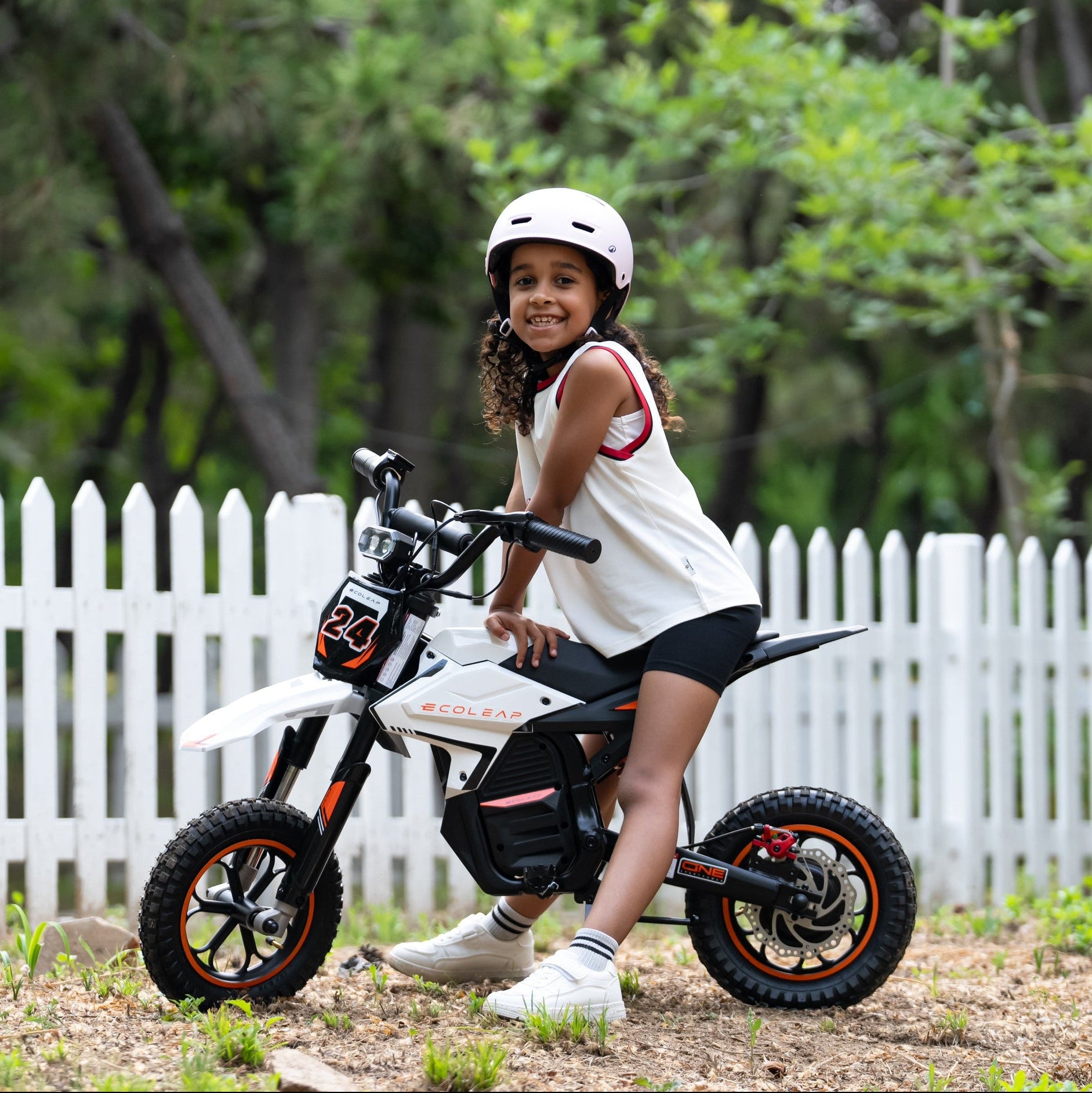
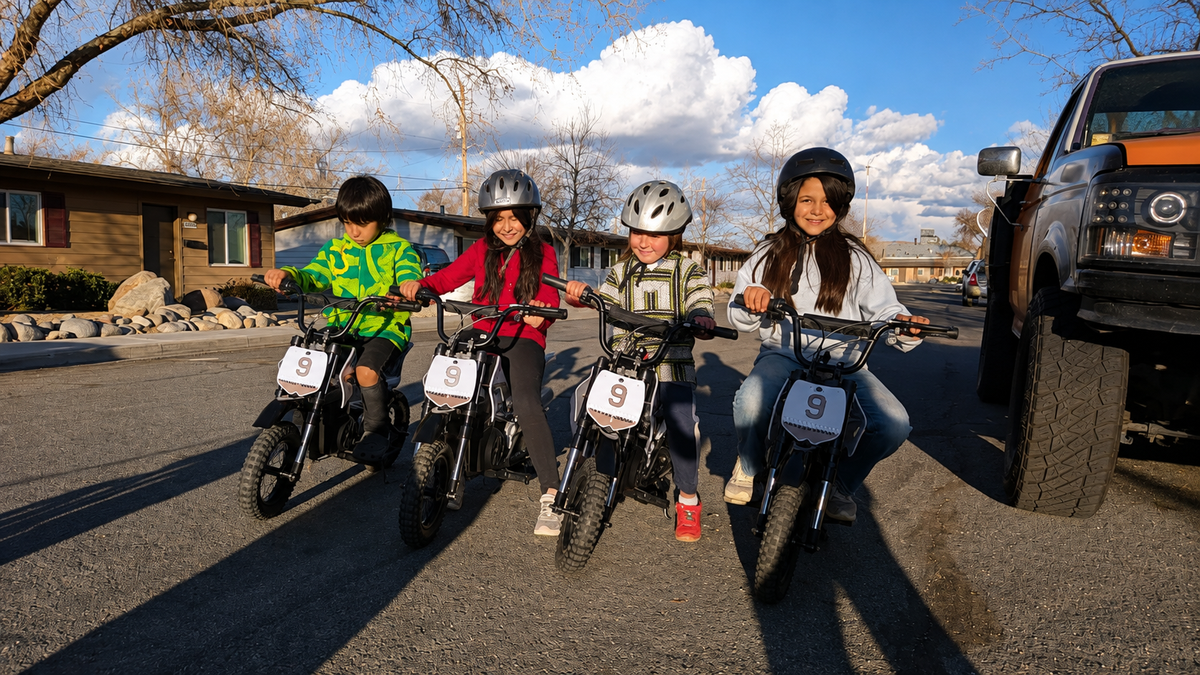
The best electric dirt bike for a 7-year-old is not automatically the fastest or most powerful model. Children of the same age can differ greatly in height, inseam, bicycle experience, hand strength and judgment. The right bike should fit the child today, feel manageable at its lowest setting and provide controlled room to improve.
Why age alone cannot choose the bike
“Age 7” is useful for narrowing a search, but it cannot tell you whether a bike is safe or comfortable. One seven-year-old may be a confident bicycle rider with good braking habits, while another may still be learning balance. Their leg length and strength may also differ even when their standing height is similar.
Measure height and inseam first
Measure the child without shoes while standing against a wall. Then measure inseam from the floor to the crotch using a book held level between the legs. Compare both measurements with the bike’s seat height, seat width and handlebar position.
A beginner should have reliable ground contact and enough strength to stop a small lean from becoming a fall. Remember that a wide seat can make a listed seat height feel taller.
Use this five-point fit test
Whenever possible, perform these checks with the bike powered off and an adult holding it steady:
- Ground contact: The child can place both feet securely enough to stabilize the bike.
- Handlebar reach: The elbows remain slightly bent during normal steering.
- Brake reach: The rider can operate the brake without twisting the wrist or releasing the grip.
- Riding posture: The child can look ahead without sitting on the very front edge of the seat.
- Weight control: The child can push, stop and recover the bike from a slight lean without panic.
If the child passes only because an adult is carrying most of the bike’s weight, the bike is too large or heavy for independent riding.
Match the bike to the child’s experience
New to two wheels
A child who cannot coast, steer and stop a bicycle independently should develop those skills before moving to a powered dirt bike.
Confident bicycle rider, new to a throttle
This child may be ready for a properly fitted bike. Begin with power-off practice and the lowest mode; first master smooth starts, closing the throttle and stopping inside a marked box.
Experienced electric balance-bike rider
Throttle experience helps, but a dirt-bike-style frame may be much heavier and behave differently on grass or dirt. Recheck fit and restart at the lowest setting.
Weight matters as much as seat height
A low seat can make a bike look child-friendly even when its weight is difficult to manage. During slow turns and stops, the rider must control the whole vehicle. A heavy bike can reduce confidence, make falls harder to prevent and require an adult every time it tips over.
Maximum load capacity is not a sizing guide; it describes what the bike can carry, not who can control it.
Choose a manageable lowest speed
Top speed attracts attention, but the lowest usable setting matters more for a beginner. Selectable speed modes allow skills to develop without immediately replacing the bike. However, a speed selector does not make an oversized or overweight bike suitable.
The Ecoleap K2 offers 10, 15 and 20 mph modes. For a seven-year-old who fits its current 44–52 inch guidance, can control its approximately 41.9 lb weight and already has reliable two-wheel balance, the 10 mph mode provides the correct starting point. The 15 and 20 mph settings are later progression levels, not beginner settings.
Think about the real riding surface
Grass, hard-packed dirt and slopes expose differences hidden on pavement. Pneumatic tires and suspension help, but riders must still slow for ruts, roots and large rocks.
Begin in a flat, open permitted area away from traffic and steep slopes. Avoid wet grass, mud and loose gravel until control is consistent.
K1 or K2 for a 7-year-old?
Choose between the Ecoleap K1 and K2 by fit, experience and the intended riding surface—not simply by birthday. The lower-cost K1 may make sense when the child needs a more conservative first step. The K2 is better suited to a rider who fits its size range, already balances confidently and can benefit from three progressive speed modes, front and rear suspension, a 36V lithium battery and an 850W peak brushless hub motor.
K2 is not appropriate just because a parent wants the bike to last longer. If the child cannot support the weight or control 10 mph, choose a lighter or slower step first.
A safe first-ride progression
- Practice mounting, steering and braking with the power off.
- Review how to close the throttle and agree on an adult stop signal.
- Use the lowest mode for short straight-line starts and stops.
- Add wide turns only after stopping is consistent.
- Increase speed only after several sessions of calm, repeatable control.
Use a certified helmet, eye protection, gloves, knee and elbow protection, durable clothing and over-the-ankle footwear. Maintain adult supervision.
Common buying mistakes
- Buying a larger bike for “more years of use”
- Choosing by motor wattage or top speed alone
- Using maximum load capacity as a rider-size recommendation
- Testing only on pavement when the child will ride on grass
- Unlocking higher modes before starts, turns and stops are consistent
Frequently asked questions
How fast should an electric dirt bike for a 7-year-old go?
There is no universal safe number. The correct starting speed is one the child can manage while starting smoothly, turning predictably and stopping on command. Begin with the lowest mode.
Is 850W too much for a 7-year-old?
Peak wattage does not describe behavior by itself. For K2, fit and control of the 10 mph starting mode matter more than the peak-power number alone.
Should a seven-year-old move directly from a bicycle to a dirt bike?
Possibly, if the child has reliable balance and braking skills and the powered bike passes every fit test. Begin with power-off practice and short supervised sessions.
Bottom line
The best electric dirt bike for a 7-year-old is the one the individual child can control now. Measure height and inseam, test control reach and bike weight, begin at the lowest speed and choose for the real terrain. Growth room is valuable only after present-day fit and safety are satisfied.
Safety note: Age ranges are only a starting point. Confirm fit, inseam, reach, braking ability and throttle control. Use proper protective gear, responsible adult supervision and a legal, controlled off-road riding area.


Share:
Off-Road Safety Checklist for Kids’ Dirt Bikes
K2 vs. Husqvarna EE 2: Pre-PW50 Trainer or Premium First Dirt Bike?