

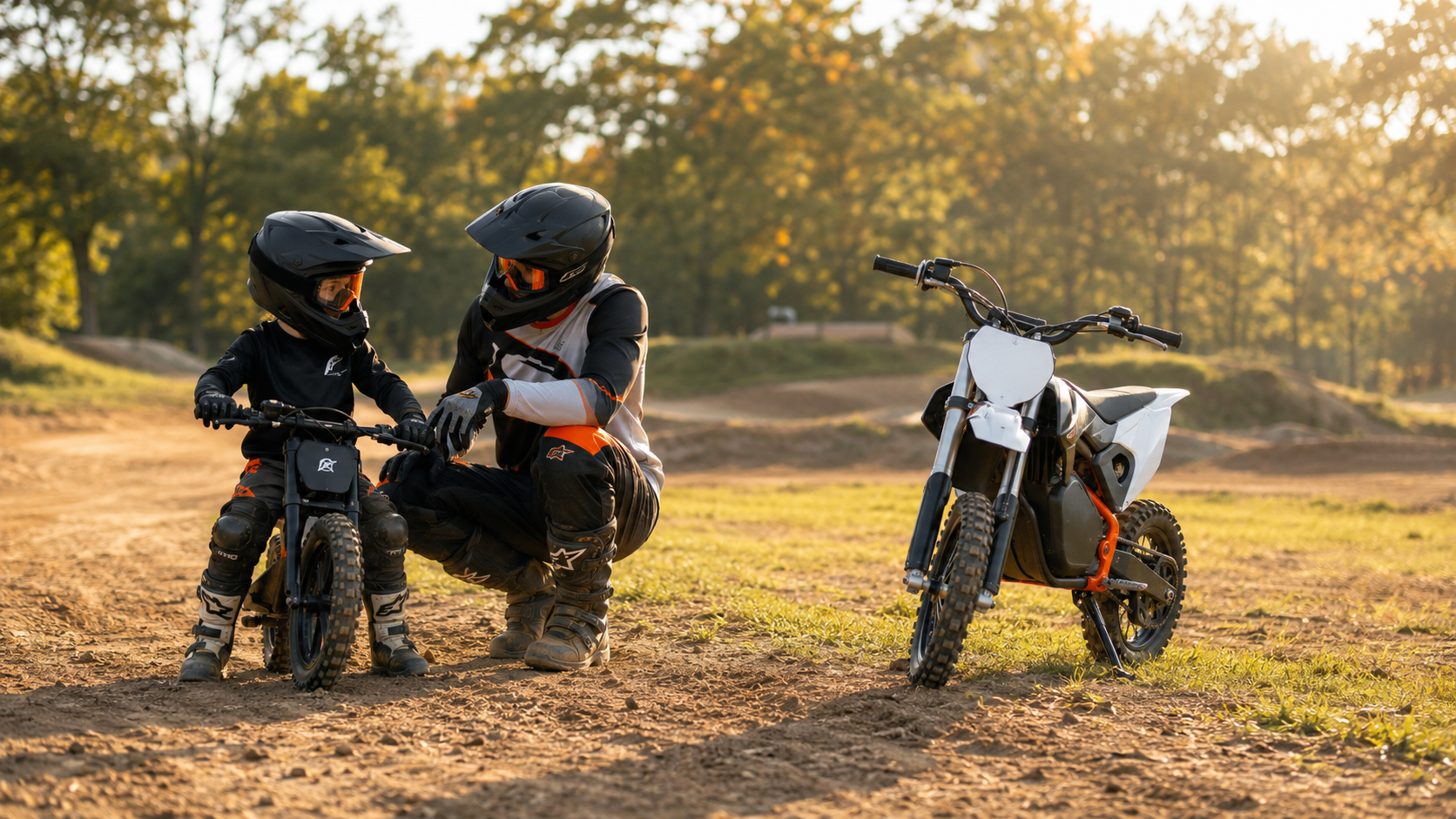
Some children can move directly from a STACYC to a Yamaha PW50 or a small KTM electric dirt bike. Many should not. The answer depends less on brand or age than on the size of the physical and control gap.
Why the jump can be bigger than it looks
A powered balance bike lets a small rider catch a lean with a foot and learn on a very light platform. A PW50 or premium youth dirt bike adds mass, higher consequences, a different riding position and—in the case of a gas bike—a new starting and ownership routine. Being comfortable at a STACYC’s highest setting does not prove that a child can rescue a much heavier bike at walking speed.
In this parent discussion about helping four- and eight-year-old riders progress, parents described children who reacted very differently to similar machines. The recurring advice was to prioritize balance, fit and confidence rather than buying the biggest bike the family could justify.
Use this readiness test
- Strength: Can the rider lift the bike off the side stand, hold it upright and walk it backward?
- Brake reach: Can small hands apply the brake without rotating the wrist awkwardly?
- Throttle discipline: Does the child close the throttle when startled, or freeze and keep holding it?
- Feet-up control: Can they turn both directions without paddling?
- Judgment: Will they slow before a corner rather than after entering it?
- Instruction: Do they stop immediately when the adult signal is given?
When a direct move may work
A direct move is more reasonable when the child fits the destination bike, has strong bicycle and powered-balance-bike skills, can control a similar-weight bike with the power off, and will begin in a restricted mode or highly controlled practice area. Even then, the first sessions should focus on starts and stops—not speed.
When K2 is the more useful middle step
Ecoleap K2 is designed for riders who have moved beyond basic balance but still benefit from staged power. Its 10, 15 and 20 mph modes let a family separate the learning process. The brushless hub motor removes the external drive chain, while the 36V lithium battery, front and rear suspension, foot pegs and rear mechanical disc brake create a more complete dirt-bike experience than a powered balance bike.
K2 is not appropriate if the child cannot manage its 41.89 lb weight or 20.67-inch seat. In that case, stay with a lighter bike. The middle step only works when it fits.
A four-session bridge test
- Controls and walking with power off.
- Ten short starts and precision stops in the lowest mode.
- Wide figure eights while looking through the turn.
- Standing over small bumps and stopping on a mild incline.
If the child needs repeated physical rescue, returns to full-throttle starts or becomes frightened, step back. Confidence is training data, not a personality flaw.
Safety still depends on fit, terrain and supervision
No speed mode or motor type makes a youth dirt bike automatically safe. Use a properly fitted certified full-face helmet, goggles, gloves, long sleeves, long pants, knee and elbow protection and over-the-ankle boots. Ride only on private property or permitted off-road areas, away from traffic, water, drop-offs and bystanders. An adult should inspect the brakes, tires, controls, fasteners and riding area before each session.
Bottom line
Do not assume every STACYC rider needs K2, and do not assume every rider can skip it. Compare the child’s current skill with the destination bike’s height, weight, controls and lowest usable speed. The best pathway is the smallest challenge that produces new skill without taking away independent control.
Model specifications, prices and recommendations can change. Confirm the current manufacturer product page and owner’s manual before buying. Community comments cited here are individual parent experiences, not controlled product tests.
Turn the comparison into a training decision
Moving between youth bikes is not simply an increase in speed. Each platform teaches some habits well and leaves other habits for the next stage. Parents should identify what transfers, what changes and what the child has not yet practiced. This prevents experience on one machine from being mistaken for complete readiness on another.
Evaluate the rider in a controlled area with repeatable drills: independent mounting, smooth launch, two-way turns, throttle release, accurate stopping and recovery after a small error. Look at performance across several sessions. One good lap can reflect excitement or luck; consistent behavior shows a skill that is ready to travel to the next bike.
Start by naming the exact destination
Yamaha PW50 and KTM youth dirt bikes are not one interchangeable category. Their controls, chassis, minimum settings and intended pathways differ. Select the exact model first, then measure the gap from the child’s current STACYC instead of asking whether a generic brand jump is possible.
STACYC creates a strong balance foundation
A confident STACYC rider often understands coasting, looking ahead and keeping both feet up. Those skills matter. However, a low powered balance bike may not teach the same weight management, peg posture, braking demand or terrain response as a motorcycle-style chassis.
Measure the physical jump
Compare seat height, total weight, handlebar reach, lever reach and the effort needed to turn the new bike at walking speed. Let the child mount and walk a non-powered example when possible. Physical strain at zero speed predicts trouble during stops.
Compare minimum response
Maximum power attracts attention, but the lowest usable setting determines the first lesson. Confirm how the parent selects or locks the mode and whether it remains manageable on the family’s actual surface, not only on a showroom floor.
PW50 is a route into gas-bike habits
Families may choose PW50 to introduce gasoline operation, a familiar small-bike ecosystem or local racing pathways. The child must also adapt to sound, vibration and a different routine. These are teachable changes when the bike fits.
KTM can work for the right prepared rider
A direct move can be reasonable when the exact KTM fits, the lowest setting is controllable and qualified coaching and suitable terrain are available. It is a larger jump and should be supported by written restrictions and objective drill standards.
K2 is the intermediate electric route
K2 gives the appropriate rider a 20.67-inch seat, 41.89-pound motorcycle-style platform, foot pegs, suspension, rear disc braking and three speed modes. It is designed to build the missing middle skills before PW50, KTM or Husky.
Use emotional readiness as data
A child who repeatedly asks to stop, freezes at low speed or avoids the bike after a small fall may be facing too large a step. Patience is not lost training time. A lighter stage can restore the independent success that makes coaching effective.
Decide by the next six months, not distant ambition
A family may dream of racing several years from now, but the current purchase should serve the next set of skills on terrain available now. A bike that fits future plans but not today’s rider often slows the path it was meant to accelerate.
Four-session transition plan
First test the destination bike with power off. Then spend one session on starts and stops, one on broad turns, and one on the family’s mildest dirt. If the jump is too large, use K2’s low mode to build the missing behaviors, then repeat the same course at 15 and 20 mph only after accuracy remains stable.
Keep the first sessions deliberately easy. The child should finish wanting another ride, not exhausted by a machine that asks for too many new decisions. Change only one factor at a time—bike, speed setting, surface or obstacle—so the source of any difficulty remains clear.
Frequently asked questions
Can a talented child skip every intermediate bike?
Possibly, but talent does not cancel fit and control requirements. The exact destination must be manageable at its lowest setting, and the child should demonstrate repeated braking, turning and judgment skills.
Is PW50 always easier than a KTM dirt bike?
Not as a universal rule. Compare the exact models, settings and child. PW50 is commonly used as a small gas-bike entry, while KTM offers different youth platforms with different demands.
What is the strongest reason to add K2?
The child already has balance but needs time with more weight, pegs, suspension, dirt-bike braking and staged speed before adding the destination bike’s additional demands.
Readiness checklist
- Physical fit is confirmed with power off.
- The child can control the minimum powered setting.
- Throttle release and braking are deliberate, not panicked.
- Feet return to the pegs without repeated reminders.
- The rider slows before a problem rather than after it.
- The family has legal terrain, correct protective gear and active adult supervision.
If the rider misses a check, train that behavior on the current platform or choose an intermediate bike. The purpose of progression is to preserve confidence while adding one manageable demand at a time.
Use a neutral test course
Whenever possible, compare progress on the same simple course rather than judging different bikes on different terrain. A start lane, two broad turns and a stop box reveal whether the child is truly controlling the new chassis or merely reacting to an exciting first ride.


Share:
Razor Dirt Bike to Yamaha PW50: What Skills Transfer—and What Must Be Relearned?
STACYC vs. K2 vs. Yamaha PW50: Which Riding Stage Fits Your Child?