

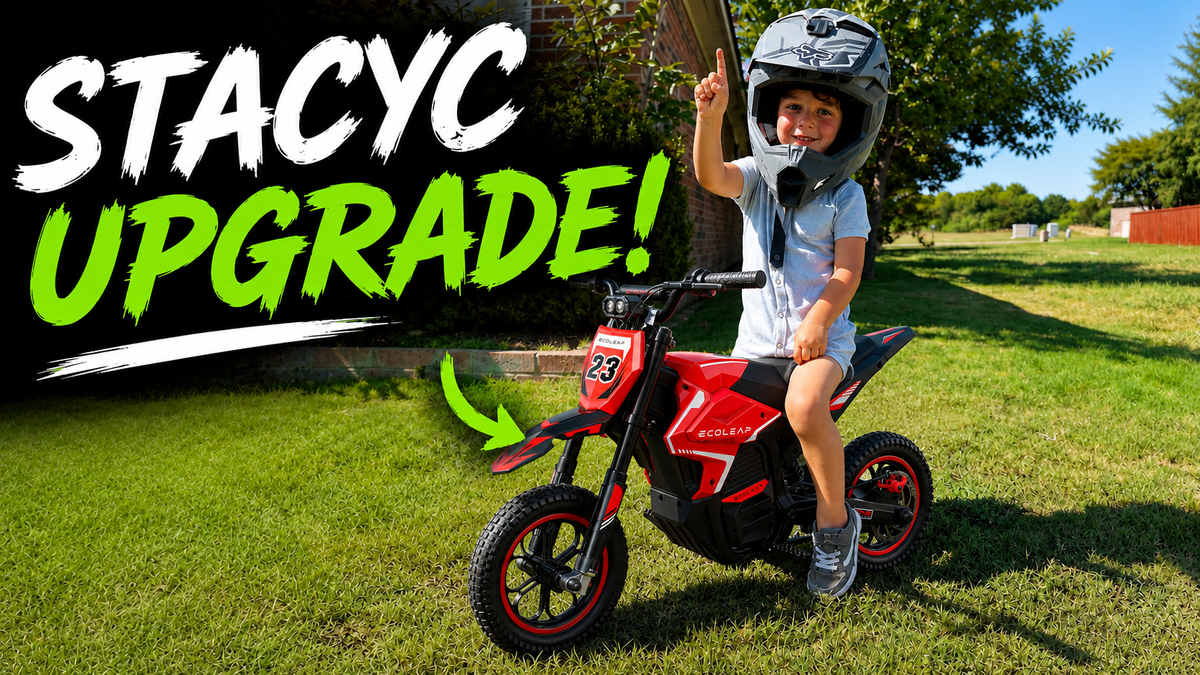
Short answer: STACYC, K2 and the Yamaha PW50 are not simply slow, medium and fast versions of the same bike. They teach different stages. A powered balance bike develops balance and first-throttle confidence. Ecoleap K2 adds foot pegs, suspension, wider off-road tires, a rear disc brake and three speed modes. A Yamaha PW50 introduces the ownership and operating routine of a small gas dirt bike.
The best choice is the stage your child can control today—not the bike you hope they will grow into two years from now.
The three-stage progression
| Stage | Best learning job | Readiness signal |
|---|---|---|
| Powered balance bike / STACYC | Coast, balance, brake and add power gradually | Rider can keep feet up, turn and stop on command |
| K2 pre-PW50 trainer | Use foot pegs, body position, suspension and three controlled speed levels | Rider can manage a 20.67-inch-seat, 41.89 lb bike and start at 10 mph |
| Yamaha PW50 | Learn a small gas-bike routine and prepare for a traditional dirt-bike pathway | Rider reliably controls throttle, brakes, lines and stops while managing the bike’s weight |
Why age is only a starting point
Two children with the same birthday may differ greatly in inseam, hand strength, balance, judgment and willingness to follow instructions. Parents in this Reddit discussion about introducing a toddler to dirt bikes repeatedly returned to weight and the ability to support the bike. A child who cannot steady the machine at a stop may become afraid even if they can ride once moving.
Where K2 fits between the two
K2 is more substantial than a powered balance bike but intentionally less race-focused than a premium youth motocross machine. Its 36V brushless hub motor is rated at 400W sustained and 850W peak. The 36V 7.8Ah lithium battery avoids the heavy lead-acid pack used by many older budget mini bikes. The 10, 15 and 20 mph modes create defined training levels.
The important feature is not the 20 mph maximum. It is the ability to keep a new rider at 10 mph while they learn starts, precision stops, wide turns and standing lightly on the pegs. Parents should unlock 15 mph only after those skills are repeatable and reserve 20 mph for a capable rider in an appropriate area.
Five fit checks before moving up
- The child reaches the brake lever and can squeeze it firmly.
- They can hold the powered-off bike upright and walk it forward and backward.
- Their feet reach the ground securely enough to stop without panic.
- They release the throttle immediately on a verbal stop command.
- They accept protective gear and speed limits without argument.
Do not skip a useful stage just to save money
A larger bike that sits unused is worse value than a correctly sized bike that builds skill every week. If the STACYC still challenges the rider’s turns and braking, stay there. If the child has mastered it but a PW50 feels heavy or intimidating, K2 can provide a practical middle stage. If K2’s lowest mode and weight are already easy to control, begin evaluating the PW50 or another next-stage model.
Safety still depends on fit, terrain and supervision
No speed mode or motor type makes a youth dirt bike automatically safe. Use a properly fitted certified full-face helmet, goggles, gloves, long sleeves, long pants, knee and elbow protection and over-the-ankle boots. Ride only on private property or permitted off-road areas, away from traffic, water, drop-offs and bystanders. An adult should inspect the brakes, tires, controls, fasteners and riding area before each session.
Final verdict
Choose STACYC for balance-first learning, K2 for the pre-PW50 dirt-riding stage, and PW50 when the child is ready for a gas-bike pathway. Progress by demonstrated control, not by age, pressure from friends or the promise of “more years of use.”
Model specifications, prices and recommendations can change. Confirm the current manufacturer product page and owner’s manual before buying. Community comments cited here are individual parent experiences, not controlled product tests.
Turn the comparison into a training decision
Moving between youth bikes is not simply an increase in speed. Each platform teaches some habits well and leaves other habits for the next stage. Parents should identify what transfers, what changes and what the child has not yet practiced. This prevents experience on one machine from being mistaken for complete readiness on another.
Evaluate the rider in a controlled area with repeatable drills: independent mounting, smooth launch, two-way turns, throttle release, accurate stopping and recovery after a small error. Look at performance across several sessions. One good lap can reflect excitement or luck; consistent behavior shows a skill that is ready to travel to the next bike.
Stage one: powered balance-bike skills
STACYC is strongest when the child is learning two-wheel confidence on a low, light platform. Look for long feet-up coasts, controlled turns, throttle release and reliable stops. A rider who still paddles constantly has not finished this stage.
Stage two: motorcycle-style training on K2
K2 introduces a 41.89-pound chassis, 20.67-inch seat, foot pegs, suspension, wider 12 × 2.75-inch tires and rear mechanical disc braking. It suits a rider who already balances and can physically manage the new format.
Stage three: gasoline-bike pathway on PW50
PW50 becomes relevant when the child fits the bike and the family wants gasoline-bike operation, established riding culture or a related competition route. The new sound, vibration and control routine should be introduced progressively.
Compare the job, not only the age range
Manufacturer age guidance is a starting point. Two children of the same age may differ greatly in inseam, hand strength, balance experience and reaction to noise. The correct stage is the one the child can use independently under supervision.
Use K2’s three modes as gates
Ten mph teaches starts, large turns and stop boxes. Fifteen mph adds flowing lines, mild slopes and surface changes. Twenty mph should require voluntary slowing, consistent boundaries and correct responses when surprised.
Know when STACYC is still enough
Stay on the current platform when the child is still learning to coast feet-up, cannot stop accurately or is gaining confidence after a fall. Upgrading because the calendar changed can replace a successful lesson environment with unnecessary pressure.
Know when K2 adds value
Move toward K2 when balance is automatic but the child lacks experience with peg posture, heavier chassis control, suspension and structured dirt riding. Confirm the lowest speed and weight are manageable before purchase.
Know when PW50 becomes the better next lesson
Consider PW50 when the child can control a motorcycle-style bike at slow speed, follows boundaries, fits the controls and is ready for the gasoline-bike routine. It should add a purposeful new skill, not merely a new badge.
Allow alternative paths
Not every family needs all three bikes. Some children go directly from STACYC to PW50; others use K2 before KTM or Husqvarna; some remain electric. The stage model is a decision tool, not a required ownership sequence.
Four-session transition plan
Use the same marked course at every stage: launch lane, broad left turn, broad right turn, mild surface change and stop box. Score balance, foot placement, throttle release and accuracy rather than lap time. The repeated course makes the demands of STACYC, K2 and PW50 easier to compare objectively.
Keep the first sessions deliberately easy. The child should finish wanting another ride, not exhausted by a machine that asks for too many new decisions. Change only one factor at a time—bike, speed setting, surface or obstacle—so the source of any difficulty remains clear.
Frequently asked questions
What is the biggest gap between STACYC and PW50?
It varies by rider, but commonly includes increased weight, peg discipline, brake and throttle feel, plus gasoline-bike sound and routine. Test those demands separately.
Is K2 simply a faster STACYC?
No. Its value is the motorcycle-style chassis, pegs, suspension, wider tires, braking and staged dirt practice. Speed alone is the least useful description of the transition.
How do parents know a stage is complete?
When the child performs its core skills repeatedly and calmly, manages the bike at stops and shows judgment without constant reminders. Age and ownership time are secondary.
Readiness checklist
- Physical fit is confirmed with power off.
- The child can control the minimum powered setting.
- Throttle release and braking are deliberate, not panicked.
- Feet return to the pegs without repeated reminders.
- The rider slows before a problem rather than after it.
- The family has legal terrain, correct protective gear and active adult supervision.
If the rider misses a check, train that behavior on the current platform or choose an intermediate bike. The purpose of progression is to preserve confidence while adding one manageable demand at a time.
Recheck fit after growth or a long break
Children can change quickly, and several weeks away can soften automatic habits. Repeat the power-off fit test and lowest-mode drills after a growth spurt, equipment adjustment or long pause. A stage that was correct last season may now be complete—or may need a short confidence reset.
When comparing stages, ask the child which task feels difficult and why. Young riders often identify a heavy stop, hard lever or intimidating sound before an adult notices it. Their answer should inform the next drill, although the parent remains responsible for the final safety decision.


Share:
Can a Child Go Straight From a STACYC to a Yamaha PW50 or KTM Dirt Bike?
Training Wheels vs. a Pre-PW50 Electric Dirt Bike: What Parents Recommend