

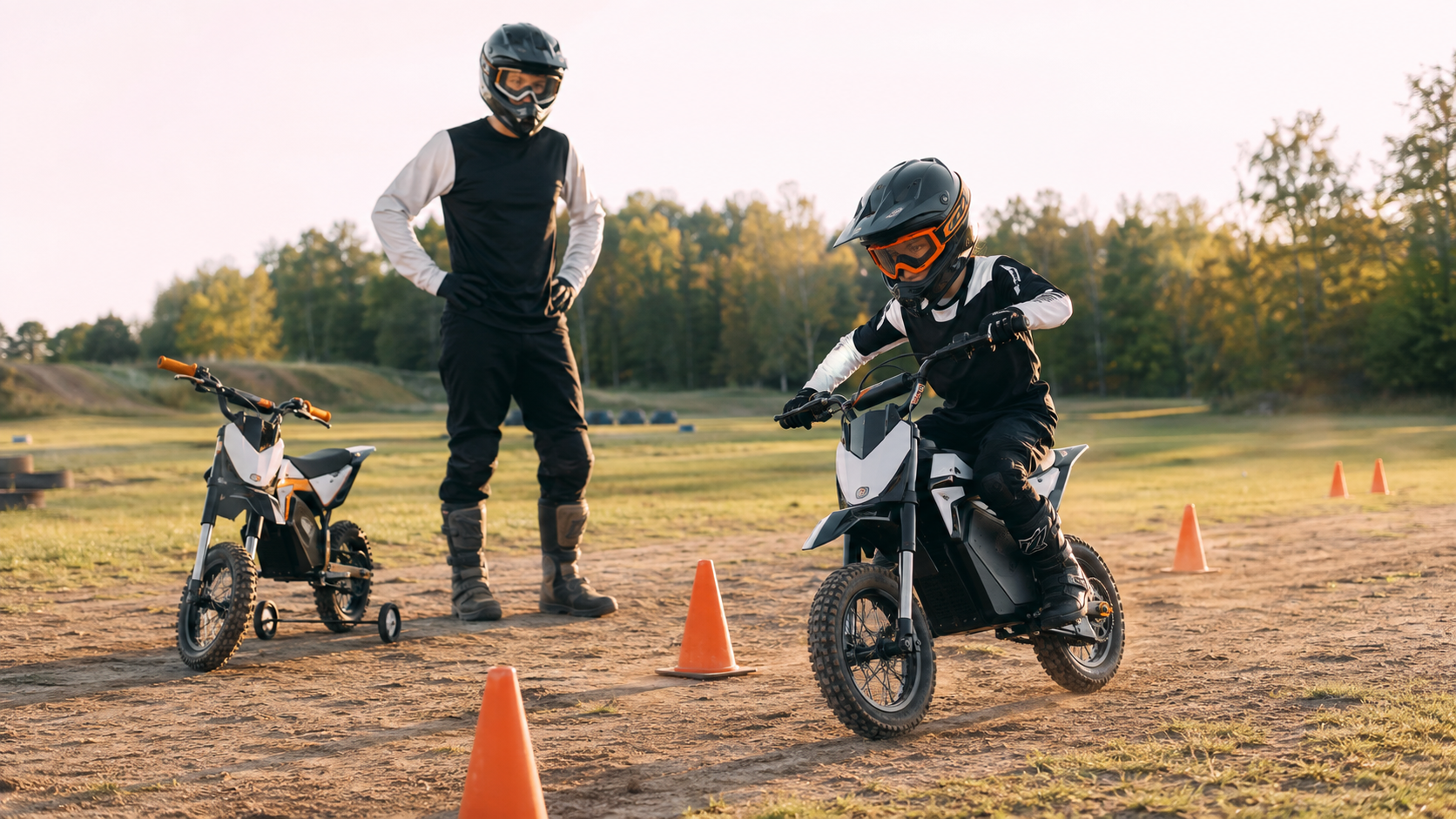
Should a young rider use training wheels on a dirt bike, or learn on a lighter two-wheel electric bike first? Parent communities do not agree completely. The better answer depends on what problem the family is trying to solve.
What training wheels can do
Training wheels can let a child experience controls while reducing the immediate balance demand. Some parents report that this helped a cautious child begin moving. They may also be considered in special circumstances with appropriate professional guidance.
What training wheels do not teach
A two-wheel bike turns by leaning and balancing dynamically. Fixed side wheels can change that behavior, catch uneven ground and allow the child to postpone the balance skill needed later. In this parent discussion about helping four- and eight-year-old riders progress, several commenters argued that training wheels delayed genuine balance learning, while a smaller number described positive experiences. That disagreement is exactly why the topic should not be reduced to “always” or “never.”
Why powered balance bikes are popular
A low, light powered balance bike lets the child push and coast before adding throttle. Their feet remain available for recovery, but the bike still behaves like a two-wheeler. This is often the cleanest first step for a very young or small rider.
Where a pre-PW50 bike fits
Once balance is dependable, Ecoleap K2 can add dirt-bike posture, foot pegs, suspension and staged speed. K2 is not compatible with training wheels and should not be used by a child who still needs them to remain upright. Its lowest setting is 10 mph and the bike weighs 41.89 lb, so it is a next stage—not a toddler substitute.
A practical progression
- Balance bike without power: push, coast and turn.
- Powered balance bike at minimum speed: roll off and brake.
- Correctly sized pre-PW50 electric dirt bike: pegs, body position and three-stage speed training.
- PW50 or suitable youth race bike: only after fit and control tests are passed.
Questions to ask before adding training wheels
- Is the bike simply too tall or heavy for the child?
- Would a lighter, lower bike solve the fear?
- Can the child already ride a bicycle without assistance?
- Will the wheels contact ruts or uneven ground?
- Does the manufacturer permit the modification?
- Are we teaching controls before balance because of adult impatience?
Confidence should guide the pace
Parents sometimes interpret hesitation as a lack of interest. Often the machine is asking for too many new skills at once. Downshifting to a lighter bike or removing power from the first drills can let the child succeed independently. Do not force a frightened child to continue after a fall.
Safety still depends on fit, terrain and supervision
No speed mode or motor type makes a youth dirt bike automatically safe. Use a properly fitted certified full-face helmet, goggles, gloves, long sleeves, long pants, knee and elbow protection and over-the-ankle boots. Ride only on private property or permitted off-road areas, away from traffic, water, drop-offs and bystanders. An adult should inspect the brakes, tires, controls, fasteners and riding area before each session.
Final answer
For most children, building real two-wheel balance on a correctly sized lightweight bike creates the strongest foundation. Training wheels may help in limited situations, but they should not be used to make an oversized or overpowered dirt bike appear suitable. K2 becomes relevant only after independent balance is already reliable.
Model specifications, prices and recommendations can change. Confirm the current manufacturer product page and owner’s manual before buying. Community comments cited here are individual parent experiences, not controlled product tests.
More detail for parents making this decision
A first dirt bike changes several demands at once: balance, weight, brake reach, throttle judgment, terrain reading and emotional confidence. The following checks turn a broad recommendation into a practical decision for one specific child. Use them before comparing maximum speed or planning how many years a bike might last.
Define what training wheels are solving
If the child lacks two-wheel balance, a balance bike or bicycle directly teaches that missing skill. If the child already balances but fears motor response, power-off drills and a lower powered setting address a different problem. Training wheels should not become a general answer to every hesitation. The useful test is repeatability: ask whether the child can perform the skill calmly five or ten times, not whether it happened once in a video. Practice with the motor off first when possible, then use the lowest appropriate setting in a flat, clearly bounded area. If posture becomes tense, braking gets late or the child needs frequent rescue, reduce the task instead of adding speed.
Understand how fixed wheels change turning
A two-wheeler naturally leans while turning. Side wheels can keep the chassis upright, unload one rear side on uneven ground or catch a rut. That altered feedback means time spent steering with training wheels does not transfer perfectly to independent riding. The useful test is repeatability: ask whether the child can perform the skill calmly five or ten times, not whether it happened once in a video. Practice with the motor off first when possible, then use the lowest appropriate setting in a flat, clearly bounded area. If posture becomes tense, braking gets late or the child needs frequent rescue, reduce the task instead of adding speed.
Consider the riding surface
A smooth, level training area is different from grass, loose dirt and ruts. Any add-on wheel system must be permitted by the manufacturer and evaluated for ground clearance and stability. A device that seems calm on pavement may behave unpredictably off road. The useful test is repeatability: ask whether the child can perform the skill calmly five or ten times, not whether it happened once in a video. Practice with the motor off first when possible, then use the lowest appropriate setting in a flat, clearly bounded area. If posture becomes tense, braking gets late or the child needs frequent rescue, reduce the task instead of adding speed.
Use balance-bike drills before adding power
Mark a straight coast lane, a wide circle and a stop box. The child should push, lift both feet, steer through the circle and stop inside the box. Once those actions are automatic, add short throttle pulses at the minimum appropriate setting. The useful test is repeatability: ask whether the child can perform the skill calmly five or ten times, not whether it happened once in a video. Practice with the motor off first when possible, then use the lowest appropriate setting in a flat, clearly bounded area. If posture becomes tense, braking gets late or the child needs frequent rescue, reduce the task instead of adding speed.
Teach throttle-off before brake-on
Beginners often focus only on squeezing the brake. First teach a clear release of the throttle, then smooth braking with eyes forward. Repeating the sequence aloud creates a simple emergency habit: roll off, straighten, brake. The useful test is repeatability: ask whether the child can perform the skill calmly five or ten times, not whether it happened once in a video. Practice with the motor off first when possible, then use the lowest appropriate setting in a flat, clearly bounded area. If posture becomes tense, braking gets late or the child needs frequent rescue, reduce the task instead of adding speed.
Decide when the child is ready for foot pegs
Foot pegs remove the easy habit of dragging feet and introduce dirt-bike body position. The rider should already coast confidently, lift both feet without panic, steer in both directions and stop on command before moving to a heavier peg-equipped bike. The useful test is repeatability: ask whether the child can perform the skill calmly five or ten times, not whether it happened once in a video. Practice with the motor off first when possible, then use the lowest appropriate setting in a flat, clearly bounded area. If posture becomes tense, braking gets late or the child needs frequent rescue, reduce the task instead of adding speed.
Plan a three-session transition
Session one can be power-off mounting, walking and braking. Session two adds short straight starts and planned stops. Session three introduces large turns and stop boxes. There is no benefit in combining every task on the first afternoon. The useful test is repeatability: ask whether the child can perform the skill calmly five or ten times, not whether it happened once in a video. Practice with the motor off first when possible, then use the lowest appropriate setting in a flat, clearly bounded area. If posture becomes tense, braking gets late or the child needs frequent rescue, reduce the task instead of adding speed.
Treat community advice as experience, not a rule
Reddit and Facebook comments reveal common problems, but riders, surfaces and equipment vary. Use community stories to form better questions, then confirm compatibility in the owner’s manual and judge the actual child in a controlled setting. The useful test is repeatability: ask whether the child can perform the skill calmly five or ten times, not whether it happened once in a video. Practice with the motor off first when possible, then use the lowest appropriate setting in a flat, clearly bounded area. If posture becomes tense, braking gets late or the child needs frequent rescue, reduce the task instead of adding speed.
Frequently asked questions
Are training wheels always unsafe?
No universal answer fits every product and circumstance. They change two-wheel handling and may create off-road hazards, so parents should follow manufacturer instructions and consider professional guidance. They should never be used to justify an oversized bike.
What is the best first step for a child who cannot ride a bicycle?
Usually a correctly sized balance bike or bicycle, practiced without power, offers the most direct route to independent two-wheel balance. Add motor skills only after coasting and stopping are dependable.
When does K2 become relevant?
K2 becomes relevant after balance is established and the child can physically manage its 20.67-inch seat, 41.89-pound weight and 10 mph lowest mode. It is a pre-PW50 stage, not a substitute for a toddler balance bike.
A parent-led decision, not a race
Progress is rarely linear. Growth spurts, a difficult fall, a new surface or a long break can temporarily move a rider backward. Keep the next session short enough to finish with a successful repetition. A smaller step that preserves enthusiasm usually builds skill faster than an impressive upgrade that spends most of its time parked.


Share:
STACYC vs. K2 vs. Yamaha PW50: Which Riding Stage Fits Your Child?
Off-Road Safety Checklist for Kids’ Dirt Bikes