

The price on a product page is only the beginning of the ownership story. Parents also pay for protective gear, electricity, wear parts, occasional service, storage, transportation, and eventually a replacement battery. Fortunately, a well-designed kids’ electric dirt bike is usually inexpensive to operate compared with a small gas motorcycle, but the total varies with riding frequency, terrain, rider habits, and parts support.
This guide builds a realistic ownership budget and explains which costs are unavoidable, which are occasional, and which can be reduced through better maintenance. The goal is not to produce one universal number; it is to help families compare bikes on long-term value instead of purchase price alone.
For a broader purchase decision, compare these costs with the features of the Ecoleap K2 kids’ electric dirt bike, then review our battery care and lifespan guide and guide to how long children use a first dirt bike.
The purchase price is only one comparison point
Entry-level ride-on toys and serviceable youth dirt bikes may look similar in photos but use very different frames, brakes, batteries, suspension, tires, and electrical systems. A lower initial price can be false economy if the battery cannot be replaced or basic parts are unavailable. Before buying, check what is included, the warranty, replacement-parts access, charger specifications, and whether the bike is appropriately sized for the child now.
Buying an oversized model “to grow into” can also waste money. If a child cannot support, steer, or stop the bike confidently, it may sit unused. A correctly fitted bike that develops skills is usually a better investment than a larger machine with a longer theoretical lifespan.
Protective equipment belongs in the first-year budget
A properly fitted certified helmet is essential. Goggles, gloves, over-the-ankle boots, long pants, long sleeves, and knee and elbow protection add meaningful cost but should never be treated as optional decoration. Children grow, so boots and armor may need replacement before the motorcycle does. A helmet should also be replaced after a significant impact or according to its manufacturer’s service-life guidance.
Families can control cost by choosing durable, correctly fitted gear rather than buying oversized equipment. Loose armor and helmets can shift during a fall. Inspect straps, shells, lenses, soles, and closures at the beginning of each season.
Charging costs are usually small
Battery capacity is measured in watt-hours. Multiply voltage by amp-hours, then divide by 1,000 to estimate kilowatt-hours. A 36-volt, 15-amp-hour pack stores about 0.54 kilowatt-hours. At an electricity rate of $0.20 per kilowatt-hour, the energy in a full charge costs about eleven cents before modest charging losses.
Even frequent recreational riding normally adds only a small amount to the household power bill. Electricity is rarely the largest ownership expense. Battery care, replacement parts, and protective equipment matter much more.
The battery is the largest future component expense
Lithium batteries gradually lose capacity through age, heat exposure, deep discharge, and charge cycles. A well-cared-for pack may remain useful for years; one stored empty in a hot garage can decline much sooner. Always use the approved charger, let the pack cool after riding, keep connectors clean and dry, and follow the recommended storage charge.
Ask about replacement cost and availability before buying. An unsupported bike can become unusable when its battery reaches the end of its service life. A model with documented parts and technical support may therefore be cheaper over several years.
Tires, tubes, brakes, and chains are normal wear items
Knobby tires wear faster on pavement than on soil or grass. Sharp rocks, thorns, skidding, low pressure, and aggressive riding increase wear. Brake pads also wear faster in sand and mud. Replacing a thin pad early is inexpensive compared with damaging a brake rotor.
Chain-driven bikes need correct chain tension, alignment, cleaning, and suitable lubricant. A chain that is too tight stresses bearings and shafts; one that is too loose can derail. Small, regular checks reduce both repair cost and downtime.
Maintenance costs depend on riding conditions
A child riding gently on dry grass places far less stress on a bike than a rider using rocky trails every weekend. Mud, water, dust, jumps, crashes, and hard braking shorten service intervals. Budget according to use rather than assuming every owner will have the same annual cost.
Parents can usually handle tire-pressure checks, cleaning, visual inspections, and basic chain care. Brake service, wheel damage, electrical diagnosis, or crash repairs may require a qualified technician. Local service availability is part of the buying decision.
Transportation, storage, and security
Some families need tie-down straps, a ramp, cargo liner, hitch carrier, or pickup-bed system. Measure the bike and vehicle before buying equipment, and secure the bike at strong frame points without crushing cables or controls. Remove the key and follow battery-transport guidance.
Storage should be dry, secure, and protected from extreme temperatures. A floor mat, lock, or wall anchor may be worthwhile. Apartment owners should measure doors and elevators and consider where charging can be done safely.
Resale value can offset ownership cost
Condition, battery health, brand support, and parts availability all affect resale value. Keep the charger, keys, manuals, and purchase record. Avoid irreversible modifications and document maintenance. A clean, functional bike with a healthy battery is easier for another parent to evaluate.
Think of value as cost per useful ride rather than simply resale price. A dependable bike ridden every weekend may deliver far more value than a cheap bike that is uncomfortable, unsupported, or frequently broken.
Frequently Asked Questions
How much should parents reserve each year?
Routine costs may be modest for light use, but setting aside money for pads, tubes, lubricant, hardware, and an occasional professional inspection is sensible. Heavy trail use needs a larger reserve.
Does an electric dirt bike require no maintenance?
No. It avoids engine oil, fuel-system, and exhaust maintenance, but tires, brakes, chain, bearings, suspension, fasteners, battery, and electrical connectors still require inspection.
Is electricity a major cost?
Usually not. For youth-size batteries, a full charge often costs only a small fraction of a dollar, depending on battery size and local rates.
How This Applies to the Ecoleap K2
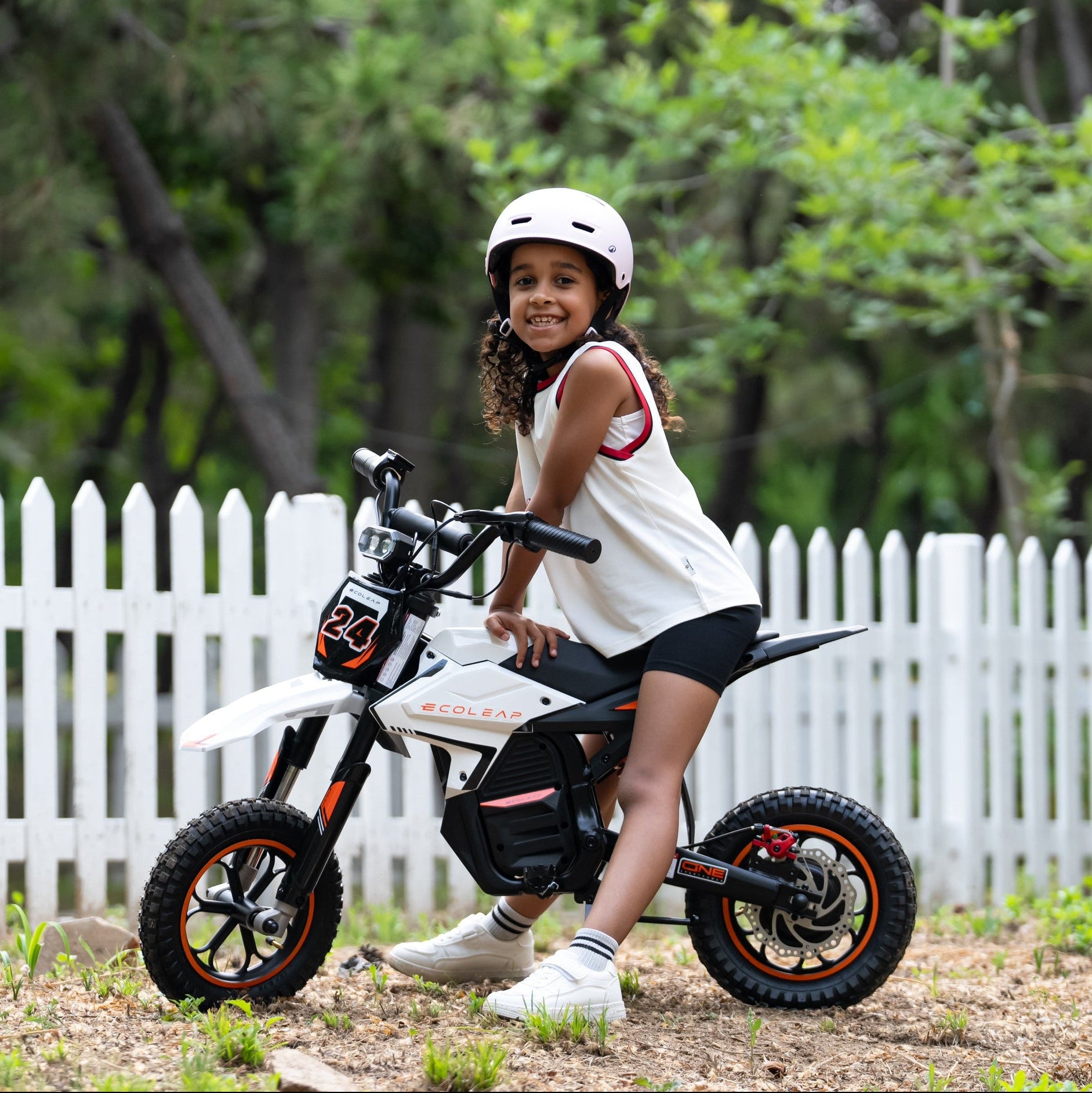
The K2 uses a lithium battery, brushless motor, three selectable speed modes, front and rear suspension, disc brakes, and 2.75-inch off-road tires. These features make it a serviceable learning platform, but they still require the routine inspections described above.
Example ownership budgets for different families
A light-use family might ride two or three short sessions per month on dry grass. Their first-year budget is dominated by the bike and protective equipment, with very little electricity cost and only basic cleaning supplies, lubricant, and perhaps a tube or brake adjustment. A frequent weekend family using dirt trails should expect faster pad, tire, and chain wear, more cleaning time, and at least one professional inspection. A family riding in sand, mud, or rough terrain should create a larger repair reserve because abrasive contamination and impacts shorten service intervals.
These scenarios show why a single “annual cost” number is misleading. The most useful budget separates fixed costs from usage-driven costs. Helmet and bike purchase are largely fixed. Electricity changes slightly with use. Tires, pads, drivetrain parts, and crash repairs change dramatically. Write down how many riding days are realistic, where the child will ride, and how far the bike must be transported before comparing models.
Five-year thinking without buying too much bike
Parents often try to lower long-term cost by choosing a larger, faster bike. That calculation ignores the value of safe, frequent use during the first year. A child who cannot stop securely or manage the weight may develop poor habits or refuse to ride. Instead, estimate the likely riding stage for the next two seasons, expected resale value, and the cost of moving up later.
A supported youth bike may serve a younger sibling or be sold to another family. That can make a correctly sized bike more economical than an oversized one. Preserve the charger, keys, manual, packaging information, and maintenance notes from day one.
Questions to ask before checkout
- What battery and charger replacements are available, and what do they cost?
- Are brake pads, tires, tubes, chains, and controls standard or proprietary?
- Who handles warranty diagnosis and where are parts shipped from?
- What routine work can a capable parent perform?
- Does the bike fit inside the family vehicle?
- What protective gear must be purchased immediately?
- What is excluded from warranty coverage?
- Is the child likely to use the bike often enough to justify the investment?
Costs that should never be cut
Do not save money by using an incompatible charger, a questionable battery, worn brake pads, damaged helmet, poorly fitted boots, or improvised electrical repair. These choices turn a budget issue into a safety issue. Delay the ride until the correct part or equipment is available.
The most effective savings come from fit, preventive care, sensible terrain, and early repairs. Correct tire pressure, a clean and adjusted chain, dry storage, conservative charging, and low-speed beginner practice cost little but protect expensive components.
Parent Planning Workbook: ownership cost
Before changing equipment or introducing a harder riding condition, write down the specific goal: estimate a realistic three-year budget. A written goal prevents one attractive specification or one successful ride from dominating the decision. Record the child’s current skill, the bike’s normal behavior, the riding environment, and the adult who will supervise. Then decide what evidence would count as success and what condition would end the session.
Review these factors together rather than in isolation:
- purchase price and included equipment
- rider growth and protective gear
- battery replacement availability
- terrain-driven wear
- transport and storage
- resale value
Give each factor a simple rating of ready, needs attention, or unknown. An unknown is not an automatic failure, but it requires an answer before the family adds risk. Manufacturer instructions, a qualified technician, local rules, and direct low-speed observation are better evidence than comments based on a different bike or rider.
A Real-World Comparison Exercise
Compare a family riding on dry grass twice a month and another family visiting muddy trails every weekend. Keep the child’s safety and the bike’s approved limits constant, then identify what changes: load, grip, temperature, energy use, stopping distance, supervision, maintenance, or convenience. This exercise helps parents see why a general answer can be correct for one household and wrong for another.
After the comparison, choose the lower-risk situation for the first trial. Use a short session close to the starting point. Record what happened instead of relying on memory. A second controlled trial on another day is more informative than immediately increasing speed, distance, or difficulty.
Stop, Check, and Decide
Use three questions whenever something changes. First, did the rider remain calm, look ahead, and respond to the stop signal? Second, did the bike accelerate, steer, brake, and sound like its normal baseline? Third, did the environment remain within the planned boundary? If any answer is no, power off and inspect before continuing.
Pay particular attention to using an incompatible charger or postponing brake repairs. This shortcut may feel convenient, but it can conceal a fit, maintenance, electrical, or supervision problem. The correct response is to reduce uncertainty, not to test the limit with a child on the bike.
Questions to Discuss as a Family
- What is today’s single riding goal?
- Which adult has final authority to start or stop the session?
- What visible boundary must the child follow?
- Which speed setting is appropriate and who controls it?
- What new sound, warning, or feeling must be reported immediately?
- Where is the safe runoff and where do spectators wait?
- How will the bike and battery be checked after the ride?
- What would make the family repeat this stage instead of progressing?
Children do not need every technical detail, but they should understand the rules that affect their actions. Involving them in a short checklist builds responsibility without transferring adult maintenance decisions to them.
How to Review the Result
End with a two-minute review while the bike is powered off. Ask the child what felt predictable and what felt difficult. Inspect the relevant controls and components, record approximate riding time, and note the conditions. Praise a specific behavior such as closing the throttle early, looking through a turn, or reporting a problem.
Use that evidence to choose the next session. Repeat the same stage when control is inconsistent. Make only one meaningful change at a time when it is consistent. This measured progression may look slower than casual riding, but it creates skills that transfer to future terrain and future bikes.
Final Takeaway
A good decision comes from matching the bike, the child, and the riding environment rather than focusing on one specification. Use the manufacturer’s instructions, supervise young riders, require properly fitted protective gear, and stop riding whenever the bike behaves differently from normal. With sensible setup and routine care, a kids’ electric dirt bike can provide years of progressive, confidence-building practice.


Share:
Kids’ Electric Dirt Bike Won’t Start? A Parent’s Troubleshooting Guide
Where Can Kids Legally Ride an Electric Dirt Bike?