

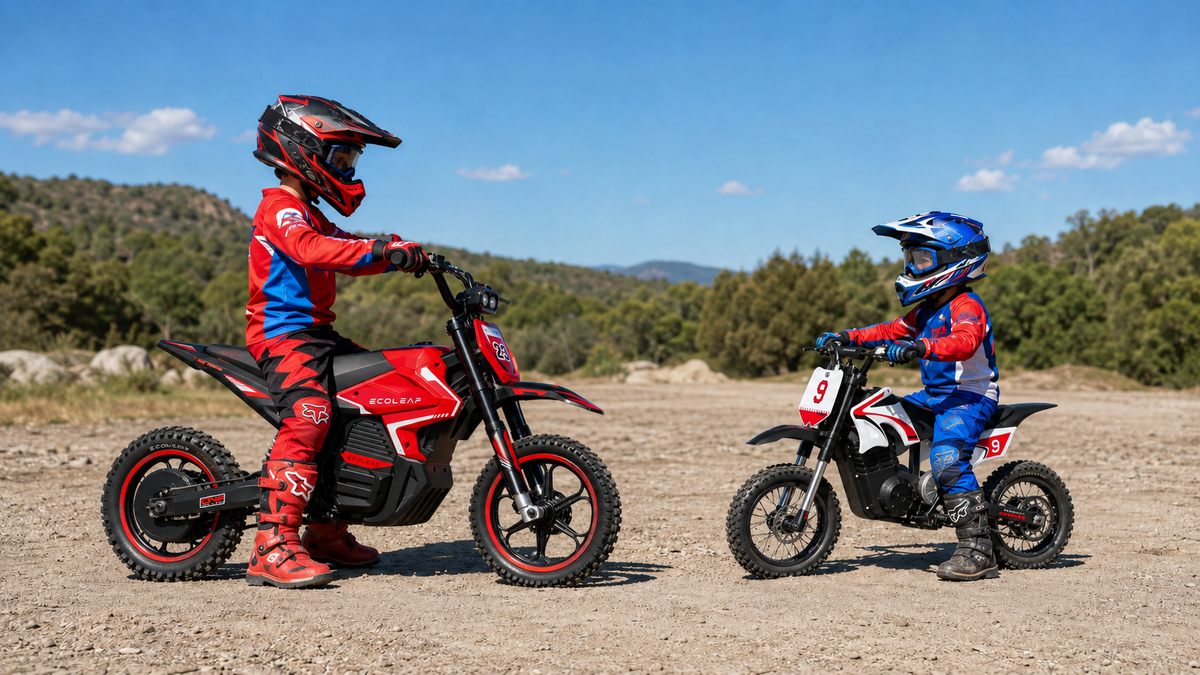
Parents often begin with a simple question: “What age is a dirt bike for?” The honest answer is that age can narrow the choices, but it cannot tell you whether a particular child is ready for a particular bike.
Two children of the same age may differ greatly in height, leg length, strength, balance, attention span and confidence. One six-year-old may already ride a bicycle confidently and use hand brakes smoothly. Another may still be learning to balance or may become frightened by the weight and acceleration of a powered bike.

Kids dirt bike age chart: a practical starting point
This chart describes common starting points, not guarantees. Always compare the child’s height and inseam with the bike, then complete the readiness checks later in this guide.
| Age range | Common stage | Usually appropriate starting point | Do not move up yet if… |
|---|---|---|---|
| 3–4 | Learning balance, stopping and following simple boundaries | Balance bike, pedal bike or a very light, low-speed powered option for a capable rider | The child cannot balance independently, reach the brake or support the bike |
| 5–6 | Building hand-brake, throttle and turning skills | A correctly sized beginner electric dirt bike with a manageable lowest mode | The child freezes under pressure, cannot stop on command or still needs training wheels |
| 7–8 | Developing independent control and mild off-road skills | A larger multi-speed electric model or appropriately sized beginner gas bike | The rider cannot manage the bike’s weight at a stop or brake before a turn |
| 9 and older | Skills and body size vary widely | Choose by rider fit, experience and terrain—not by age alone | The next bike is adult-sized, too heavy or delivers more power than the rider can control |
What an age recommendation does—and does not—tell you
A manufacturer’s age range is useful because it reflects the general size and intended rider group. It can prevent a parent from comparing a preschool balance bike with a machine intended for teenagers. However, it does not measure your child’s:
- Height, inseam or arm reach
- Ability to balance on two wheels
- Hand size and ability to operate the brake lever
- Strength to hold the bike upright when stopped
- Understanding of throttle control
- Ability to follow riding boundaries
- Response to noise, speed, mistakes or a fall
That is why “best dirt bike for a six-year-old” does not have one universal answer. Age starts the search; fit and readiness finish it.
Is your child actually ready? The five-point test
Before buying a powered dirt bike, ask the child to demonstrate the following abilities. A rider does not need to look perfect, but the basics should be reliable enough that adding a motor will not overload them.
1. Independent two-wheel balance
The child should be comfortable on a balance bike or bicycle without relying on training wheels. Powered riding adds throttle, braking and route decisions. If balance still requires all of the child’s attention, continue practicing it before adding acceleration.
2. The ability to support the bike while stopped
The rider should be able to stop, put one or both feet down and prevent the bike from immediately falling to the side. Both feet do not always need to be completely flat, but the child must have a stable and repeatable stopping position.
This parked test is one of the most important checks. A child may be able to ride a larger bike once it is moving but still be unable to support it at a stop. Repeated tip-overs can create fear and make the rider dependent on an adult for every start and stop.
3. Comfortable brake reach
With the child’s hand in a normal riding position, confirm that they can reach and squeeze the brake without twisting the wrist or releasing most of the handlebar. Small hands can struggle with large or stiff levers even when the rest of the bike appears to fit.
4. Basic throttle understanding
The rider should understand that releasing the throttle is the first response when the bike feels too fast. Practice the sequence “release, brake, feet down” at very low speed until it becomes familiar.
5. The judgment to follow boundaries
A ready rider can wait for permission to start, stay inside a marked area, slow down when asked and stop immediately on a clear signal. Excitement is normal; repeatedly ignoring boundaries means the child needs more supervised preparation before accessing greater speed.
Fit matters more than buying a bike to grow into
Parents understandably want a bike that will last. However, buying substantially above the child’s current size can make learning slower and less enjoyable.
An oversized or overly heavy bike can cause the child to:
- Depend on an adult to hold the bike at every stop
- Avoid leaning naturally through turns
- Struggle to recover after a small mistake
- Become trapped or frightened when the bike tips
- Associate practice with pressure instead of progress
Before purchasing, compare the stated rider-height range and seat height with your child’s inseam. Also consider handlebar reach, control position, bike width and weight. If possible, reproduce the riding posture at home and check whether the child can plant a foot firmly without sliding far off the seat.
Why bike weight can matter more than motor power
Power and top speed receive most of the attention, but total bike weight often has a greater effect on a beginner’s confidence.
A heavier bike carries more momentum and requires more strength to balance, push and lift. A child who cannot reposition the bike independently may feel capable while moving in a straight line but helpless whenever they stop or tip over.
Compare bike weight with the rider’s body size and strength—not only with competing specifications. Extra suspension, a larger battery and a stronger frame can improve capability, but those features also have to remain manageable for the intended child.
Ages three to four: build balance before chasing speed
Many children in this group are still learning to balance, coast, steer and follow more than one instruction at a time. A balance bike or pedal bicycle is often the most productive starting point because it teaches the child to correct a lean without also managing a throttle.
A powered option may be appropriate for an unusually capable three- or four-year-old, but only when the bike is low, light and genuinely manageable. The child should already balance independently, reach the controls and understand how to stop.
Keep sessions short and use flat, open ground. At this age, willingness matters as much as ability. If the child appears intimidated, continue with the lighter stage instead of treating a larger powered bike as something they must learn immediately.
Ages five to six: the widest range of readiness
This is the age at which many parents begin comparing mini dirt bikes, but readiness varies enormously. Some five- and six-year-olds are confident bicycle riders who can begin structured throttle and brake practice. Others still need time to make balance and stopping automatic.
A suitable first powered bike for this group should offer:
- A rider-height range that matches the child
- A low mode that feels calm and predictable
- A brake lever the child can use comfortably
- A weight the child can support at a stop
- Enough capability to develop skills without being oversized
For a smaller beginner who fits the bike, the Ecoleap K1 can provide a more manageable entry point. It uses three speed modes—approximately 6.2, 9.3 and 16 mph—so the first goal can remain starts and stops rather than maximum performance.
The Ecoleap K2 is not automatically the better choice simply because the child is six. Its lowest mode is 10 mph, and its larger battery, stronger performance and approximately 41.9 lb bike weight are better suited to a rider who already balances confidently, fits its 44–52 in recommended height range and is ready for a more capable platform.
Ages seven to eight: develop control before unlocking more speed
Many riders in this group have the size and coordination for a more complete electric dirt bike, but prior experience still matters. A seven-year-old who has never ridden without training wheels should not begin at the same setting as a seven-year-old who has spent two years riding bicycles and low-speed electric bikes.
The K2’s three modes—10, 15 and 20 mph—are most useful when treated as three training stages:
- 10 mph: smooth starts, straight lines, releasing the throttle and controlled stops
- 15 mph: wide turns, partial-throttle control and mild changes in terrain
- 20 mph: only after the child voluntarily slows before corners, judges terrain and stops without adult intervention
The value of multiple modes is not that the child can go faster on the first day. It is that parents can match available performance to demonstrated ability and unlock the next stage only when the rider is ready.
Age nine and older: do not jump straight to adult-size power
Older children may outgrow the dimensions of small kids models, but that does not mean an adult electric dirt bike is the correct next step. Recheck seat height, vehicle weight, control reach, acceleration and intended terrain.
An older first-time rider may be physically tall enough for a larger machine while still lacking throttle and braking habits. Look for a bike that fits the rider’s body and gives the parent a practical way to limit performance during the learning phase.
Ecoleap K1 vs. K2: age range is only one difference
| Fit and learning factor | Ecoleap K1 | Ecoleap K2 |
|---|---|---|
| General age reference | 3–6 years | 4–8 years |
| Recommended rider height | Approximately 37–56 in | Approximately 44–52 in |
| Bike weight | Approximately 36.4 lb | Approximately 41.9 lb |
| Speed modes | 6.2 / 9.3 / 16 mph | 10 / 15 / 20 mph |
| Motor | 350W sustained / 700W peak brushed mid-motor | 400W sustained / 850W peak brushless hub motor |
| Battery | 36V 5.2Ah lithium battery | 36V 7.8Ah lithium battery |
| Best matched to | A smaller rider who fits the bike and needs a gentler lowest mode | A confident bicycle rider who fits the bike and is ready for greater off-road capability |
These figures help compare the models, but they do not replace the parked fit test. A child outside the stated height range, unable to reach the brake or unable to hold the bike upright should use a better-fitting option regardless of age.
When the K1 is the better first step
Consider the K1 when the child fits its dimensions but would benefit from a lighter platform and a lower beginner mode. Its 6.2 mph setting creates more room to practice the sequence of starting, releasing the throttle and braking before adding more speed.
K1 may be the more sensible choice when:
- The child is at the younger or smaller end of the category
- They ride a bicycle but are new to a throttle
- A 10 mph lowest mode would be too large a first step
- The parent values a more gradual introduction over maximum growth potential
If the child still cannot balance independently or support the K1, continue with a balance bike or bicycle rather than forcing the powered-bike stage.
When the K2 is the better fit
Consider the K2 for a rider who is within its height range, already has reliable two-wheel balance and can manage its additional weight. Its brushless hub motor, larger lithium battery, suspension, rear mechanical disc brake and 12 × 2.75 in tires make it a more capable platform for developing light off-road skills.
K2 may be the better choice when:
- The child already rides a bicycle confidently
- They can support the bike and operate the brake without assistance
- They are calm and consistent with simple riding instructions
- They need three performance stages for continued development
- The intended use includes grass, gravel and permitted light dirt trails
K2 should not be promoted as a replacement for a very light powered balance bike for a child who is only beginning to balance. A four-year-old who cannot independently hold it upright is not ready simply because four appears in the age range.
Electric dirt bike or gas dirt bike?
Electric and gas bikes can both teach useful skills. The better choice depends on what the child is ready to learn and where the family wants the riding path to lead.
| Beginner factor | Electric kids dirt bike | Small gas dirt bike |
|---|---|---|
| Starting | Simple, with no engine-starting routine | Adds engine-starting and fuel-related procedures |
| Noise | Relatively quiet | Louder engine sound can intimidate some beginners |
| Early learning focus | Balance, steering, throttle and braking | The same riding basics plus gas-bike operation |
| Routine maintenance | No fuel or oil changes; drive maintenance varies by model | Fuel, oil and additional engine maintenance |
| Traditional racing path | Excellent for foundational skills, but class eligibility varies | May better match families entering conventional gas-bike classes |
A Yamaha PW50 or similar gas model can be an excellent next step for a physically ready child, particularly when the family plans to follow a traditional motocross path. But a child does not need to begin with a gas bike to learn balance, line choice, throttle discipline and braking. A correctly matched electric model can reduce noise and operating complexity while those fundamentals develop.
A sensible progression from balance bike to dirt bike
Many children benefit from a gradual route:
- Balance bike
- Pedal bicycle without training wheels
- Light, low-speed electric bike
- Multi-speed electric dirt bike such as K1 or K2, depending on fit
- Appropriately sized gas bike or larger electric model when skills and size support it
This is not a fixed calendar. A child may move quickly through one stage and spend months at another. Move up when the current controls have become calm and repeatable—not because of a birthday or because another child progressed faster.
What about dirt bike training wheels?
Training wheels can let a very young child become familiar with a throttle and brake, but they can also delay true two-wheel balance. On uneven ground, fixed stabilizers may change how the bike leans or interacts with ruts and obstacles.
For most riders, learning balance first on a balance bike or bicycle provides a stronger foundation. If training wheels are used on a compatible model, treat them as a temporary familiarization tool on flat ground—not as a substitute for balance training. Ecoleap K1 and K2 are not designed for training wheels.
How parents can reduce the risk of whiskey throttle
“Whiskey throttle” describes a frightened rider accidentally continuing or increasing throttle input instead of releasing it. This can happen when the child becomes tense and pulls against the handlebar.
Teach one simple response:
Release the throttle, apply the brake, put feet down.
Practice that sequence repeatedly in the lowest available mode before introducing tighter turns, hills or greater speed. Also:
- Use a wide, flat practice area free from traffic and fixed obstacles
- Confirm the rider can comfortably reach the brake lever
- Keep early sessions short
- Do not run beside the bike while permanently holding it upright
- Do not unlock the next mode after a single successful lap
- Stop when the child becomes tired, frustrated or unable to follow instructions
A first-week practice plan
Session 1: controls with the bike stationary
With the power off, identify the throttle, brake and power controls. Practice the child’s hand position and the “release, brake, feet down” sequence. Confirm that the helmet and other protective equipment fit properly.
Session 2: short starts and stops
Use the lowest mode in a flat, open area. Ride only a short distance between two markers. The goal is not continuous laps; it is several calm starts and complete stops.
Session 3: wide turns
Add large left and right turns. Teach the child to look toward the intended path and reduce speed before the turn rather than braking abruptly while already leaned.
Session 4: repeat before adding difficulty
Repeat the same skills until the rider can perform them without constant reminders. Do not increase speed just to create novelty. Consistency is evidence of readiness.
Session 5 and beyond: mild terrain changes
Only after the basics are reliable should the rider try gentle grass, packed dirt or small surface changes. Avoid steep slopes, jumps, public roads and crowded areas.
Common parent buying mistakes
Choosing the longest age range
A wider age claim does not prove better fit. Compare the physical dimensions and controls instead.
Buying too large for future growth
A bike that lasts longer on paper can delay learning if the child cannot support or control it now.
Comparing only motor wattage
Motor power does not describe throttle smoothness, lowest speed, bike weight, brake reach or rider confidence. Those factors often matter more on day one.
Unlocking higher modes too early
Higher speed should follow demonstrated control. It should not be used as a reward or unlocked simply because the rider asks.
Forcing the child to continue after a fall
After a fall, check for injury and let the child regain composure. A pressured rider may become more tense and repeat the same mistake. Restoring confidence is part of the training process.
Final parent checklist
Before purchasing a kids dirt bike, confirm that:
- The child has the required two-wheel balance for the intended model
- The rider-height range matches the child
- The child can support the bike while stopped
- Handlebars, throttle and brake are within comfortable reach
- The lowest speed mode matches the rider’s current ability
- The bike is not unnecessarily heavy for the child
- Power delivery is predictable
- The intended terrain matches the bike’s design
- Replacement parts and product support are available
- The child has a properly fitted helmet, gloves, eye protection and protective clothing
- A responsible adult will supervise every session
- You have a safe, legal and permitted off-road practice area
Frequently asked questions
What age can a child start riding a dirt bike?
Some children begin balance-bike training around ages two or three, but a powered dirt bike requires additional balance, brake, throttle and judgment skills. There is no single starting age that applies to every child.
Is four years old too young for an electric dirt bike?
Not always, but many four-year-olds are better served by a balance bike or very light, low-speed model. A four-year-old should not use K2 merely because its general age range begins at four; the child must also fit the bike, balance independently and support it while stopped.
What is the best dirt bike for a five-year-old?
Choose by fit and readiness. A five-year-old who already rides a bicycle and fits K1 may benefit from its 6.2 mph lowest mode. A child still learning balance should continue with a balance bike or bicycle first.
Can a six-year-old ride the Ecoleap K2?
Possibly. The child should fit the 44–52 in recommended height range, be able to manage the bike’s approximately 41.9 lb weight, reach the brake and already demonstrate reliable two-wheel balance. Age alone is not enough.
Should my child be able to put both feet flat?
Both feet do not always need to be completely flat, but the rider needs a stable stopping position and must be able to prevent the bike from falling without immediate adult help.
What if my child is tall for their age?
Height may improve physical fit, but it does not replace balance, coordination, throttle control or judgment. Complete the full readiness test.
What if my child is small but experienced?
Experience does not correct a poor physical fit. Choose a model that allows safe control reach and stable stops, even if the rider’s skills are advanced for their age.
Are three speed modes safer?
Multiple modes give parents a useful way to match available speed to current ability. They do not make riding risk-free. The lowest mode still needs to be appropriate for the child, and supervision and protective equipment remain essential.
When should a child move from K1 to K2?
Consider moving up when the rider fits K2, can support its additional weight and consistently controls starts, turns and stops. Reaching K1’s highest mode is not, by itself, proof that the child is ready.
When is a child ready for a PW50 or another gas bike?
A child may be ready when they can hold the bike upright, start and stop independently, apply throttle progressively, brake before turns, recover calmly after small mistakes and follow riding boundaries. A gas bike may also make sense when the family intends to enter a traditional motocross program.
Can kids ride dirt bikes on public roads?
Kids dirt bikes are generally intended for off-road use on private property or permitted riding areas, not public streets. Rules vary by location, so parents should confirm local requirements before riding.
The bottom line
The best kids dirt bike is not the one with the biggest motor or the broadest age label. It is the bike the child can confidently hold up, start, steer, slow and stop today.
For a smaller rider who already has two-wheel balance and needs a gentler first speed, the Ecoleap K1 may be the more manageable starting point. For a confident bicycle rider who fits its dimensions and is ready for greater off-road capability, the Ecoleap K2 offers a brushless motor, larger lithium battery and three-stage speed progression.
If neither bike can be supported and controlled independently, continue with a balance bike or bicycle. That is not falling behind—it is building the foundation that makes later progress safer, faster and more enjoyable.
For more help comparing formats and features, read our kids’ electric dirt bike buyer’s guide.
Safety note: Rider readiness varies. Speed and range can change with rider weight, terrain, temperature and riding mode. Children should ride off-road only in permitted areas, wear appropriate protective equipment and remain under responsible adult supervision.


Share:
PW50 vs Electric Dirt Bike for Kids: Which Is Better?
KTM SX-E 2 vs Yamaha PW50: Electric or Gas for a First Dirt Bike?