

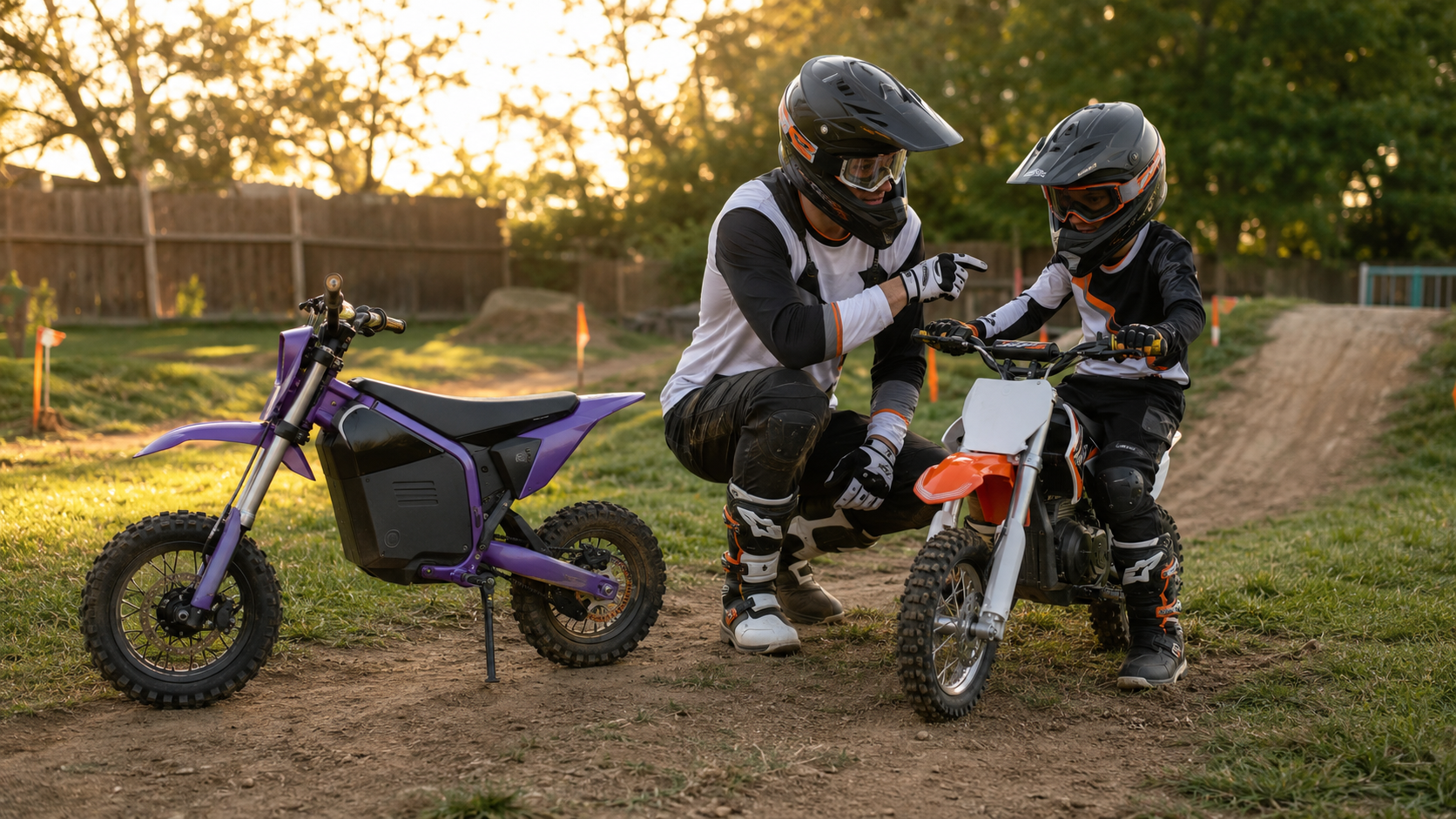
For many parents, the choice between a Yamaha PW50 and a kids’ electric dirt bike looks simple: gasoline tradition on one side, quiet electric convenience on the other. In practice, the better choice depends less on the power source and more on what your child can confidently control today, where the bike will be ridden, and what kind of riding path your family wants to follow.
Quick answer:
Choose a PW50 when your child fits its 18.7-inch seat, can manage its 90-pound wet weight, and your family wants a proven gasoline motorcycle with an established trail and motocross progression. Choose a kids’ electric dirt bike when quieter practice, lower running complexity, lighter weight and parent-selectable speed stages matter more. Neither is automatically safer or better for every child; correct fit, supervision and progressive training matter more than the fuel type.

PW50 vs. Kids’ Electric Dirt Bike at a Glance
| Comparison point | Yamaha PW50 | Ecoleap K1 | Ecoleap K2 |
|---|---|---|---|
| Power system | 49cc air-cooled two-stroke | 350W sustained / 700W peak brushed mid-motor | 400W sustained / 850W peak brushless hub motor |
| Transmission / drive | Wet centrifugal automatic; enclosed shaft final drive | Electric single-speed; chain drive | Electric single-speed; chainless hub drive |
| Speed control | Adjustable mechanical throttle stop | 6.2 / 9.3 / 16 mph modes | 10 / 15 / 20 mph modes |
| Energy | Gasoline plus separate oil-injection supply | 36V 5.2Ah lithium battery, 187.2Wh | 36V 7.8Ah lithium battery, 280.8Wh |
| Claimed range | Not directly comparable to battery range; refuel as needed | Up to 10 miles | Up to 18 miles |
| Bike weight | 90 lb wet | 36.38 lb | 41.89 lb |
| Seat height | 18.7 in | Confirm current product fit before purchase | 20.67 in |
| Suspension | Telescopic fork and rear suspension | Front suspension fork and dual-spring rear shock | Telescopic oil-spring fork and rear spring shock |
| Brakes | Front and rear drum brakes | Rear drum brake | Rear mechanical disc brake |
| Best fit | Families wanting a true gasoline motorcycle pathway | Smaller or newer riders who need a gentler first speed | Confident bicycle riders ready for more terrain and growth |
Specifications are based on current manufacturer information and can change. Electric speed and range vary with rider weight, terrain, temperature, tire pressure, battery condition and riding style. Always verify the current product page and rider fit before ordering.
The Most Important Difference Is Not Gas vs. Electric
The most important question is not which machine sounds more like a “real” dirt bike. It is whether the child can hold the bike upright, reach the controls, stop without help and remain calm when something goes wrong.
The PW50 has an unusually low 18.7-inch seat, which can help a short rider reach the ground. But it weighs 90 pounds wet. A lighter electric model may have a slightly taller seat yet still feel easier to push, stabilize and recover after a tip-over. Seat height and total weight therefore need to be considered together.
Before buying either type, have the child demonstrate that they can:
- Ride a bicycle or balance bike independently without training wheels.
- Place a foot down and support a powered bike at a stop.
- Reach and pull the brake control without rotating the entire hand off the grip.
- Release the throttle immediately when instructed.
- Follow a boundary and stop signal even when excited.
- Recover emotionally from a small mistake without freezing or panicking.
A child who cannot yet complete these tasks may need more bicycle practice or a smaller, lighter platform. Buying a bigger machine “to grow into” often produces the opposite result: fewer independent starts, more adult assistance and less confidence.
What the PW50 Teaches Well
The Yamaha PW50 has remained popular because it packages a real gasoline motorcycle experience into a very small chassis. Its 49cc two-stroke engine, automatic centrifugal transmission and twist-and-go operation remove the need to learn a manual clutch or gear shifting. The rider can focus on throttle, braking, balance and line choice.
The adjustable throttle-stop screw lets an adult limit how far the throttle can open. This is not the same as selecting a precise digital speed ceiling, because actual speed still depends on terrain and load, but it gives parents a practical way to reduce available performance while a child learns.
The shaft final drive is another genuine advantage. Unlike a typical chain-driven mini bike, it is enclosed and does not require routine chain cleaning, lubrication or adjustment. Yamaha’s oil-injection system also means the owner does not have to premix oil into every tank of gasoline.
For a family already involved in motorcycles, the PW50 offers:
- A familiar gasoline-engine ownership experience.
- Fast turnaround between sessions when fuel is available.
- A long-established dealer, parts and service network.
- A natural cultural and mechanical step toward larger gas trail bikes.
- Relevance for families planning to join traditional riding clubs or race programs.
However, “low maintenance for a gas bike” does not mean maintenance-free. The family still manages gasoline, two-stroke oil, spark-plug condition, carburetor behavior, air filtration, drum-brake adjustment and storage procedures. Noise and exhaust also affect when and where the bike can be used.
What a Kids’ Electric Dirt Bike Teaches Well
An electric dirt bike removes engine starting, warm-up, fuel handling and exhaust from the practice routine. The child turns the bike on, selects an appropriate mode and can begin working on balance, steering, throttle control and braking.
This simplicity matters because young children often learn best in short sessions. A family may have only 15 or 20 minutes after school. An electric bike makes that short practice window easier to use, provided the battery is charged and there is a legal riding area.
Electric models also offer a different form of parent control. On the Ecoleap K1 and K2, three speed modes create clearly separated stages. The value is not simply that the bike has a high top speed. The value is that the child does not need access to all of it on day one.
Electric advantages commonly include:
- Quieter operation and no exhaust at the riding area.
- No gasoline, engine oil changes or carburetor service.
- Immediate starting and consistent short-session convenience.
- Lower total bike weight in many youth models.
- Selectable speed stages that support a structured training plan.
- Fewer engine-related wear items.
Electric ownership has its own responsibilities. The battery must be charged with the correct charger, kept away from damage and extreme temperatures, and stored according to the manufacturer’s instructions. Tires, brakes, fasteners, steering and suspension still need inspection. Quiet operation also does not make the bike street legal or acceptable on every trail.
Throttle Control: Mechanical Restrictor vs. Three Speed Modes
Both platforms give parents a way to limit performance, but they do so differently.
PW50 adjustable throttle stop
The PW50 uses a mechanical stop screw to restrict throttle opening. It is simple, durable and adjustable. Parents can begin with reduced throttle travel and gradually allow more as the child becomes smoother. Because it limits input rather than selecting a specific electronic speed mode, speed still changes with surface, incline and rider weight.
K1 and K2 selectable modes
The K1 provides 6.2, 9.3 and 16 mph settings. Its lowest mode is particularly useful for a smaller rider moving from bicycle skills to powered controls. The K2 provides 10, 15 and 20 mph modes for a rider who already balances confidently and is ready for a larger performance window.
A responsible three-stage plan looks like this:
- Low mode: Practice smooth starts, straight lines, throttle release and controlled stops on flat ground.
- Middle mode: Add wide turns, varied throttle, mild grass and gentle terrain changes.
- High mode: Unlock only after the child voluntarily slows before turns, reads terrain and stops without adult prompts.
Higher speed should not be a reward for bravery or a birthday milestone. It should follow repeated evidence of control.
Weight, Seat Height and Confidence
The PW50’s very low seat is valuable, but its 90-pound wet weight is more than twice the listed weight of either Ecoleap model. That difference becomes noticeable during slow riding, parking and falls.
A heavier motorcycle can feel planted while moving, but the rider needs enough strength and coordination to keep it from tipping at a stop. If the child cannot independently reposition or steady the bike, every pause becomes an adult-assisted event. That can make a capable rider feel less capable.
The K1’s lower 36.38-pound weight makes it the more manageable Ecoleap option for a smaller beginner. The K2 weighs 41.89 pounds and has a 20.67-inch seat, so it should not be recommended automatically to every young child. It is better suited to a rider who fits it and already has reliable two-wheel balance.
When checking fit, do not rely on age alone. Let the child sit in a normal riding position with shoes or boots on. Confirm that they can:
- Touch down securely rather than stretching to the tips of their toes.
- Hold the handlebars without locked elbows.
- Reach the brake comfortably with small hands.
- Stand on the pegs and return to the seat without losing balance.
- Push the bike a short distance and turn it around with minimal help.
Grass, Dirt and Hills: Which Performs Better?
Terrain changes the comparison. A smooth driveway test does not reveal how a bike will behave on thick grass, loose soil or an incline.
Flat hard-packed dirt
Both types can work well when properly sized. The PW50 has true motorcycle geometry, front and rear suspension and predictable automatic power. The K1 and K2 allow parents to choose a speed stage and provide suspension intended for light off-road use.
Grass
Grass creates more rolling resistance than pavement, especially when wet or tall. A low-powered ride-on may slow significantly. The K1’s 350W sustained / 700W peak motor provides more usable performance than toy-grade 100W platforms, while the K2’s 400W sustained / 850W peak brushless hub motor adds stronger headroom and eliminates chain losses and chain maintenance. Actual speed will still drop with rider weight, slope and surface conditions.
Gentle hills
Motor wattage alone does not guarantee climbing performance. Rider weight, battery charge, controller tuning, tire grip and incline all matter. The K2 is the more appropriate Ecoleap choice for a rider who fits it and needs more performance on mild off-road terrain, but it is not intended for steep technical climbs or motocross jumps.
The PW50 can provide longer continuous riding with quick refueling, and its gasoline engine is part of a mature motorcycle package. Yet a small rider still needs the strength and judgment to control the additional weight on a slope. Never use a hill to “test courage.” Begin on flat ground and introduce only gentle gradients after stopping and turning are reliable.
Mud, jumps and motocross tracks
Neither a beginner electric bike nor a stock PW50 should be chosen solely because a child wants to jump immediately. The K1 and K2 are intended for light off-road surfaces such as dirt trails, grass and gravel, not extreme motocross tracks. The PW50 is a real youth motorcycle, but rider preparation, track rules, suspension limits and professional instruction still matter.
Brushless vs. Brushed Electric Motors
The K1 and K2 should not be described as the same motor system in different frames.
The K1 uses a mid-mounted brushed motor and chain drive. It offers useful beginner performance and a gentler lowest mode, but the brushed system contains wear components and the chain needs periodic attention.
The K2 uses a brushless hub motor. Its practical family benefits include:
- No motor brushes to replace as a routine wear item.
- No chain to lubricate, tension or put back after a drop.
- Quieter operation and fewer exposed drive components.
- Smoother, low-maintenance power delivery.
- Up to 850W peak output for grass and light off-road demands.
This does not make the K2 maintenance-free or automatically suitable for a beginner. The brake, tires, axle hardware, fork, rear shock, electrical connections and battery still require inspection. Its 10 mph lowest mode also assumes the child already has basic balance and coordination; a smaller novice may be better served by the K1’s 6.2 mph first stage.
Lithium Battery vs. Gasoline: Daily Ownership
Charging an electric dirt bike
The K1 uses a 36V 5.2Ah lithium battery, while the K2 uses a larger 36V 7.8Ah lithium battery. Current listed charging time for both is approximately five to six hours. This means electric ownership works best when charging becomes part of the family routine rather than an afterthought ten minutes before riding.
Good battery practice includes:
- Use only the specified charger.
- Charge in a dry, ventilated area away from flammable materials.
- Do not charge or ride with a damaged case, cable or connector.
- Allow a hot battery to cool before charging.
- Follow the manual for long-term and winter storage.
- Never treat an advertised maximum range as a guaranteed session length.
The K1 is advertised for up to 10 miles, while the K2 is advertised for up to 18 miles. Those are maximum figures under favorable conditions. Hills, soft ground, cold weather, frequent acceleration and heavier riders reduce range.
Fueling a PW50
The PW50 can be refueled quickly, which suits families spending long days at a riding property or track. Yamaha’s oil-injection system avoids premixing fuel and oil, but owners still need gasoline, the correct two-stroke oil, safe containers and proper storage.
Fuel can degrade during storage, and a carbureted bike that sits for extended periods may require more attention than an electric bike stored according to its battery instructions. On the other hand, a healthy gas bike can keep riding after a quick refuel without waiting several hours for a charge.
Maintenance and Total Cost of Ownership
Purchase price is only one part of the decision. Compare the full first-year ownership package:
- Helmet, goggles, gloves, boots and body protection.
- Delivery, dealer setup or assembly.
- Fuel and oil, or electricity and eventual battery replacement.
- Brake, tire and suspension service.
- Replacement levers, body panels and other fall-related parts.
- Transportation to a legal riding area.
- Dealer labor or the family’s ability to perform maintenance.
- Resale value and the likelihood that the child will outgrow the bike.
The PW50 benefits from Yamaha’s long history, dealership coverage and a strong used-bike market. Electric models reduce routine engine work and can cost less to operate per session, but battery condition becomes an important long-term value factor.
The K2’s chainless hub system is especially simple for families who do not want chain adjustment. The K1 requires chain care, while the PW50’s enclosed shaft drive also avoids routine chain maintenance. Therefore, “electric equals no chain” is not universally true, and “gas equals constant chain work” is not true for the PW50.
Noise and Where Your Child Can Practice
Electric bikes are much quieter than a two-stroke PW50. This may make communication between parent and rider easier and may reduce disturbance during short home practice sessions. It can also help a noise-sensitive child focus on control.
But quieter does not mean legal everywhere. Neither category should be assumed street legal. Homeowner-association rules, local ordinances, public-land classifications, trail access and landowner permission all vary. A backyard may be physically large enough yet still be unsuitable because of neighbors, property boundaries or obstacles.
Before buying, identify at least one safe and permitted practice area. The best bike offers little value if the family cannot use it consistently.
Which Bike Builds Better “Real Dirt Bike” Skills?
Both can build real skills. Balance, vision, body position, throttle control, braking and terrain judgment transfer between platforms. The difference is which additional tasks the child learns.
A PW50 introduces engine noise, fuel-bike habits and the feel of a gasoline motorcycle. It is a logical step for families committed to that ecosystem.
An electric dirt bike lets a beginner spend more attention on riding itself. There is no engine start procedure, warm-up or exhaust, and speed modes provide a clear learning ladder. The child is not learning less; the learning sequence is simply different.
A practical progression may look like:
- Balance bike or bicycle without training wheels.
- Light electric dirt bike in its lowest mode.
- Middle and higher electric modes after consistent control.
- PW50 or another appropriately sized gas motorcycle when the rider and family are ready.
That is only one route. A physically ready child with access to instruction can begin on a PW50. Another child may remain on electric platforms for years. The correct progression is based on demonstrated ability, not peer pressure.
K1, K2 or PW50: A Practical Decision Guide
| Your child and family | Best starting direction | Why |
|---|---|---|
| Smaller new rider who needs walking-speed-style practice | Consider K1 | Lighter bike and 6.2 mph lowest mode |
| Confident bicycle rider who fits a 20.67-inch seat | Consider K2 | Three growth stages, brushless motor, larger battery and light off-road capability |
| Short rider who can safely manage a 90-pound motorcycle | Consider PW50 | Very low seat, automatic transmission and adjustable throttle stop |
| Family wants quiet, frequent practice close to home where permitted | Electric | Fast setup, low noise and no exhaust |
| Family already rides gas motorcycles and wants that pathway | PW50 | Established gas-bike experience and dealer ecosystem |
| Child cannot yet balance or follow stop instructions | Neither yet | Continue balance-bike or bicycle practice first |
A First-Week Training Plan
Session 1: Controls with the power off
Show the child the throttle, brake, power switch and adult stop signal. Practice the sequence “release, brake, feet down” without moving.
Session 2: Straight starts and stops
Use the lowest available setting or a heavily restricted throttle. Ride only a short straight line. End the session before fatigue causes mistakes.
Session 3: Wide turns
Place two visible markers far apart. Practice looking through a wide turn and slowing before the turn rather than during a panic.
Session 4: Controlled repetition
Combine start, straight line, wide turn and stop. Do not add speed simply because one run looked good.
Session 5: Mild terrain change
Only after flat-ground skills are consistent, introduce short grass or a very gentle slope. Return to easier terrain if the child stops using the correct brake-and-throttle sequence.
How to Reduce Whiskey Throttle Risk
“Whiskey throttle” describes a frightened rider accidentally maintaining or increasing throttle instead of releasing it. It can happen on electric or gasoline bikes.
Teach one simple response until it becomes automatic:
Release the throttle. Apply the brake. Put both feet down.
Reduce risk by beginning in the lowest mode, confirming brake reach, using a wide obstacle-free area, keeping sessions short and never running beside the bike while holding the handlebar. If the child freezes during practice, stop the session and return to power-off drills.
Frequently Asked Questions
Is a PW50 safer than an electric dirt bike?
Safety cannot be determined by fuel type alone. The PW50 has an adjustable throttle stop and a low seat; an electric model may be much lighter and provide discrete speed modes. Correct fit, protective gear, supervision, terrain and rider behavior are more important than whether the bike uses gasoline or a battery.
Is an electric dirt bike only a toy?
Some low-cost electric ride-ons are toy-grade, while others use metal frames, pneumatic off-road tires, suspension and serviceable brakes. Judge the actual construction and intended use rather than the power source.
Can a child learn on electric and later ride a PW50?
Yes. Balance, steering, body position, throttle release and braking transfer. The child will still need to learn the sounds, starting routine and ownership habits of a gasoline motorcycle.
Which one is easier to maintain?
An electric model usually removes more routine engine work. The PW50 is simpler than many gas bikes because it has oil injection and shaft drive, but it still needs fuel-system, spark-plug, air-filter and engine-related care. Both need brake, tire, fastener and suspension checks.
Which is better for backyard practice?
Electric is usually more practical because it is quieter and produces no exhaust at the riding point. However, local rules, neighbor impact and property safety still apply. Quiet does not mean automatically permitted.
Does the PW50 require shifting?
No. It uses a fully automatic centrifugal transmission, so the child does not operate a manual clutch or shift gears.
Is the K2 better than the K1 for every child?
No. The K2 has more performance, a brushless motor, larger battery and chainless drive, but it is heavier and its lowest mode is faster. The K1 can be a better first step for a smaller or less experienced rider who benefits from the 6.2 mph low setting.
Can training wheels be added?
K1 and K2 are designed for two-wheel balance and are not compatible with training wheels. Training wheels on dirt bikes are also controversial because they can delay balance development and interact poorly with uneven ground. A balance bike or pedal bicycle is usually the better foundation.
How long does an electric dirt bike take to charge?
Current listed charge time for the Ecoleap K1 and K2 is about five to six hours. Plan charging in advance and follow all battery and charger instructions.
Which is better for long riding days?
The PW50 can be refueled quickly. Electric session length depends on battery capacity and riding conditions, and recharging takes time. Families can manage this through shorter sessions, planned charging or model-specific battery options where supported.
When is a child ready for the PW50?
A child may be ready when they fit the bike, can support its weight, use throttle and brakes calmly, stop without assistance, follow boundaries and genuinely wants to ride. Being old enough according to a general age range is not enough by itself.
Final Verdict: Which Is Better?
The PW50 is better for a child who can physically manage it and for a family that wants a proven gasoline motorcycle, quick refueling and a traditional trail or motocross pathway. Its low seat, automatic transmission, adjustable throttle stop, oil injection and shaft drive make it unusually beginner-friendly within the gas category.
A kids’ electric dirt bike is better when the family values lower weight, quiet practice, simple session setup and staged electronic speed control. The Ecoleap K1 offers a lighter starting point and gentler low mode. The Ecoleap K2 gives a confident, appropriately sized rider more room to progress through a brushless 850W-peak motor, 36V lithium battery, three speed modes, suspension and a chainless drive system.
The best first dirt bike is not the machine with the longest spec sheet. It is the one the child can hold up, stop, restart and control with confidence today.
Compare the Next Step
See the Ecoleap K1 for a lighter entry point, see the Ecoleap K2 for more progressive performance, or read Best Dirt Bike Before a Yamaha PW50 for a step-by-step progression guide.
Safety note: Dirt bikes can cause serious injury. Use an appropriately certified helmet and full protective gear, supervise every session, inspect the bike before riding, and ride only off-road on private property or in permitted areas. Manufacturer age guidance is only a starting point; rider height, strength, balance, coordination and judgment must also be evaluated.
New: Where a pre-PW50 electric bike changes the comparison
The usual electric-versus-PW50 comparison can hide an important distinction. A powered balance bike and a pre-PW50 electric dirt bike are not the same category. A model such as the Ecoleap K2 adds motorcycle-style foot pegs, suspension, off-road tires and a rear disc brake while retaining simple electric starting and selectable speed.
K2 uses a 36V brushless hub motor rated at 400W sustained and 850W peak, a 36V 7.8Ah lithium battery and 10, 15 and 20 mph modes. That makes its strongest argument neither silence nor maximum speed. Its advantage is repeatable staged practice: the family can keep the rider at 10 mph until starts, stops and turns are automatic, then progress without immediately changing machines.
Choose by the skill you want next
| Next learning goal | Direction to evaluate |
|---|---|
| Basic balance and very low-speed confidence | Light powered balance bike |
| Foot pegs, suspension, body position and progressive speed | K2-style pre-PW50 electric dirt bike |
| Gas-bike routine and traditional motorcycle pathway | Yamaha PW50 |
| Premium youth electric/motocross pathway | Suitable KTM or Husqvarna model after exact fit checks |
Community experience: confidence often follows fit
Parent discussions on Reddit and the FB material reviewed for this guide repeatedly mention children gaining confidence after moving to a bike they could better support and control. Treat those stories as useful prompts, not proof that one model is universally safer. The transferable lesson is to compare complete weight, brake reach, throttle response and the child’s reaction to mistakes.
Related reading: Why K2 Works as a Pre-PW50 Training Bike and K2 vs. Husqvarna EE 2.


Share:
Razor MX125 vs. Ecoleap K1: Which First Dirt Bike Fits Your Child?
Kids Dirt Bike Age Guide: What Parents Should Know