

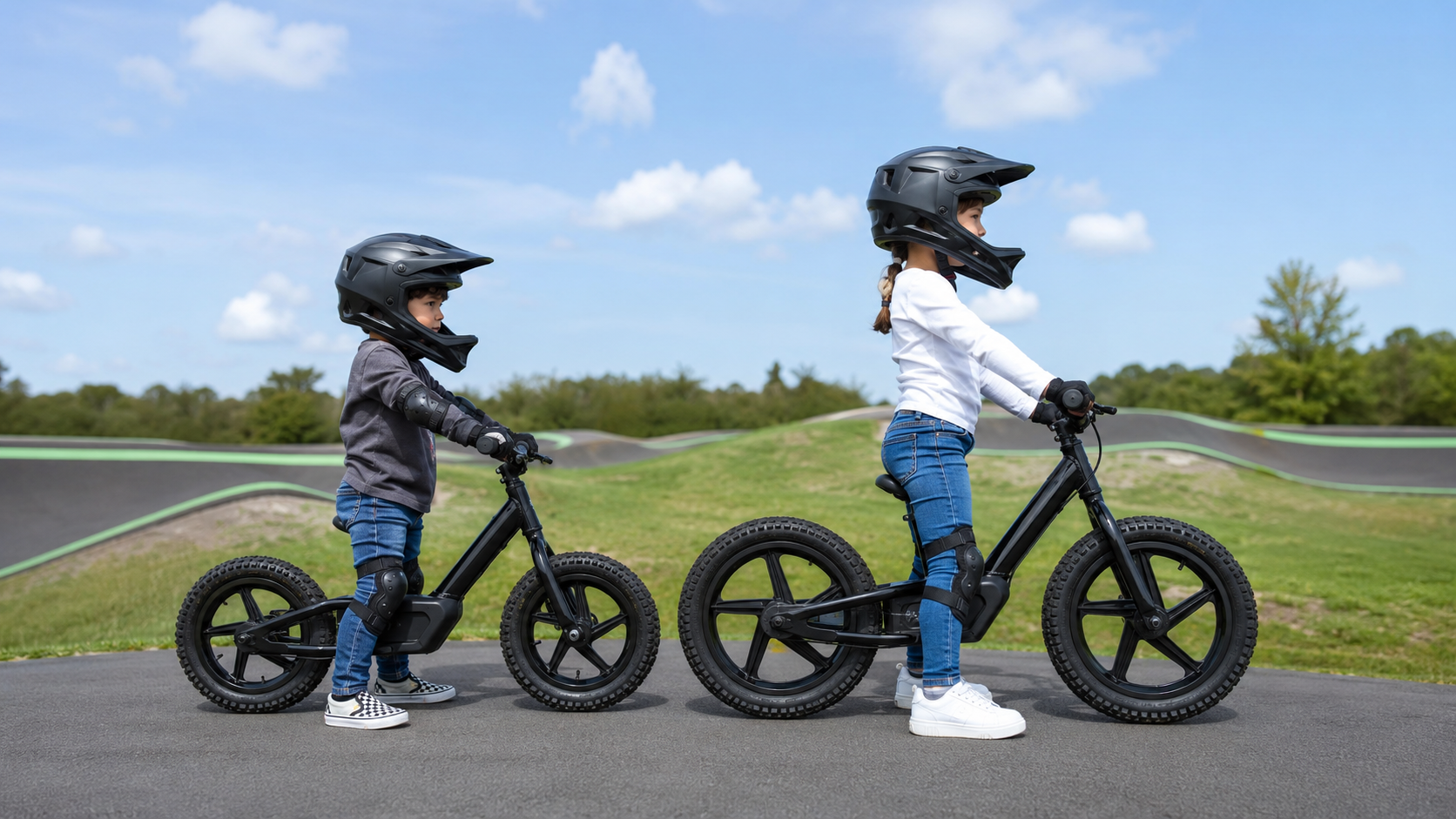
The STACYC 12eDRIVE and 16eDRIVE look similar because both are lightweight electric balance bikes built around the same basic learning idea: a child first learns to walk, glide, steer and brake without power, then adds throttle in progressive speed modes. The important difference is not simply that one has 12-inch wheels and the other has 16-inch wheels. The larger bike also has a taller seat, a longer cockpit, more weight, a larger battery and substantially more speed in its highest mode.
That means the best choice is not automatically “12 for a younger child and 16 for an older child.” Age is only a starting point. Inseam, balance experience, hand size, strength and confidence determine which bike a child can actually control.
Quick answer: 12eDRIVE or 16eDRIVE?
Choose the STACYC 12eDRIVE for a smaller beginner who is still learning to glide, uses frequent foot dabs and benefits from the lowest and lightest platform. Choose the STACYC 16eDRIVE for a taller child who already balances confidently, can operate the hand brake without changing grip and needs more cockpit room.
If your child falls into the overlapping size range, do not buy the 16eDRIVE simply for “room to grow.” Buy the larger model only if the child can place both feet securely on the ground, hold the bike upright, turn the handlebar fully and stop without adult help.
STACYC 12eDRIVE vs 16eDRIVE specifications
| Specification | STACYC 12eDRIVE | STACYC 16eDRIVE |
|---|---|---|
| Typical official age guidance | 3–5 years | 5–7 years |
| Current comparison-page inseam guidance | About 16–19 in | About 18–22 in |
| Seat height | 15 in | 17 in |
| Bike weight with battery | 17 lb | About 19 lb |
| Rider weight guidance | Under 75 lb | Under 75 lb |
| Wheel size | 12 in | 16 in |
| Low mode | About 5 mph | About 6 mph |
| Medium mode | About 7 mph | About 8 mph |
| High mode | About 9 mph | About 13.5 mph |
| Battery | 20V Max, commonly 2Ah | 20V Max, commonly 4Ah |
| Estimated run time | 30–60 minutes | 30–60 minutes |
| Best starting point | Small or first-time powered balance-bike rider | Taller rider with established balance skills |
Important: STACYC has sold different generations, branded editions and brushed or brushless versions. Some official legacy pages list slightly different seat, weight, speed, battery and charge-time figures. The table above follows the current standard-model comparison information available at the time of writing. Confirm the exact product listing, serial number and owner’s manual before purchasing parts or setting expectations.
Age is a filter, not a fit measurement
STACYC describes the 12eDRIVE as a model for many riders around ages 3–5 and the 16eDRIVE for many riders around ages 5–7. Those ranges are useful for narrowing the search, but children of the same age can differ greatly in leg length, strength and riding experience.
A tall four-year-old who has spent a year on a balance bike may be physically and mentally ready for the 16eDRIVE. A smaller six-year-old who is new to two wheels may learn faster on the 12eDRIVE. Neither choice is wrong if the bike fits and the power mode matches the rider’s ability.
Age becomes especially unreliable around four to six years old because growth does not happen evenly. One child may have long legs and a short torso; another may be tall overall but still have difficulty reaching the brake with small hands. This is why parents should measure and test instead of relying only on the birthday printed on the box.
How to measure your child’s inseam correctly
Inseam is more useful than total height because it tells you how comfortably the child can reach the ground from the seat.
- Have the child wear the shoes or riding boots they will normally use.
- Ask them to stand with their back against a wall and feet a few inches apart.
- Place a thin hardcover book between the legs and raise it until it makes firm contact, similar to a bicycle saddle.
- Keep the book level with the floor.
- Measure from the floor to the top edge of the book.
- Repeat the measurement two or three times and use the smallest consistent result.
Do not measure the inside seam of pants. Clothing sizes and cuts vary, and they do not represent the rider’s actual body measurement.
What the number should look like on the bike
For a beginning balance-bike rider, the goal is not merely to touch the ground with the tips of the toes. The child should sit naturally with both feet making secure contact and the knees slightly bent. STACYC’s own guidance emphasizes a low seat because these bikes do not use pedals; stable ground contact supports walking, gliding and confidence.
A child stretched onto tiptoes may pass a basic height chart but still struggle to:
- Catch the bike when it leans
- Stop on uneven ground
- Push off without help
- Turn at walking speed
- Recover after a surprise
The 18–19 inch overlap: how to choose
The published inseam ranges overlap. A child around 18–19 inches may physically fit both models. This is where parents are most tempted to buy the 16eDRIVE for future growth, but the correct answer depends on control rather than reach alone.
Use this four-part test with the power switched off:
- Feet-down test: The child can sit centered on the saddle with both feet securely down and knees relaxed.
- Catch test: Lean the bike slightly to each side. The child can stop the lean without immediately stepping away or asking for help.
- Brake test: The child can keep a normal grip and pull the brake lever firmly. They should not need to rotate the wrist or release most fingers from the handlebar.
- Turning test: The child can walk the bike through a tight left and right turn without the handlebar, knees or arms becoming cramped.
If the child passes all four tests on the 16eDRIVE and already glides confidently, the larger model may be appropriate. If the larger bike causes hesitation, tiptoe contact or awkward brake use, the 12eDRIVE is the better learning tool even if it will be outgrown sooner.
Why two pounds matters to a young rider
The difference between roughly 17 and 19 pounds sounds small to an adult. To a preschool rider, two pounds can be a meaningful percentage of body weight. More importantly, the 16eDRIVE places that weight on a larger frame with a taller center of mass.
The lighter 12eDRIVE is generally easier for a small child to:
- Push out of a garage
- Turn around in a narrow practice area
- Catch during a slow lean
- Lift after a minor fall
- Reposition without adult help
Independent recovery is part of learning. A child who can stand the bike up, reset and try again often gains confidence faster than one who needs an adult after every small mistake.
The larger wheels of the 16eDRIVE can roll more smoothly over small cracks, grass transitions and mild bumps. That advantage only matters when the child is strong enough to control the larger platform. Bigger wheels do not compensate for poor fit.
Speed guide: the difference grows in high mode
Both bikes use three progressive power modes, but the modes are not identical. On current comparison information, the 12eDRIVE is approximately 5, 7 and 9 mph, while the 16eDRIVE is approximately 6, 8 and 13.5 mph.
Low and medium modes are relatively close. High mode is where the character of the two bikes separates. A top setting near 13.5 mph carries much more momentum than 9 mph and gives a young rider less time to react. That is one reason a child should not move to the 16eDRIVE merely because the 12eDRIVE looks small in a photo.
Low mode: throttle introduction
Low mode should be used only after the child can glide and brake with the power off. The first powered sessions should focus on a simple sequence:
Twist gently, release, brake, feet down.
The child does not need to make long laps. Short straight runs allow the parent to see whether the rider releases the throttle naturally or freezes when surprised.
Medium mode: steady control
Move to medium mode only when starts and stops no longer require constant reminders. Practice wide turns, slowing before corners and maintaining partial throttle rather than repeatedly switching between fully open and fully closed.
Many riders can spend a long time in medium mode. There is no requirement to unlock high mode just because it exists.
High mode: earned through judgment
High mode is appropriate only when the child consistently:
- Releases the throttle when uncomfortable
- Brakes before reaching a boundary
- Looks through turns
- Slows voluntarily near people or obstacles
- Maintains control over mild surface changes
- Follows stop commands immediately
Do not use higher speed as a reward. It is a training setting that requires more mature decisions.
12eDRIVE: who it fits best
The 12eDRIVE is usually the stronger choice for a small child transitioning from a non-powered balance bike. Its lower seat and lighter chassis make the walking-and-gliding learning method easier to use.
It is especially suitable when the rider:
- Is around the lower end of the age range
- Has an inseam near the smaller official range
- Still uses frequent foot dabs
- Is cautious about leaning or turning
- Needs the bike to feel easy to catch
- Will practice mainly on pavement or firm, flat ground
The 12eDRIVE is not automatically “too small” because a child can ride faster than 9 mph on another device. The purpose of the bike is to develop balance, brake use, throttle release and line choice on a platform the child can manage independently.
16eDRIVE: who it fits best
The 16eDRIVE is designed for a taller rider who already has meaningful balance-bike experience. The 17-inch seat, larger wheels and longer cockpit give growing children more room. Its larger battery and higher advanced-mode speed can provide a longer development window, but only after basic control is established.
It is usually the better fit when the rider:
- Has an inseam around 18 inches or more and reaches securely
- Looks cramped on the 12eDRIVE
- Can glide with both feet on the platforms
- Uses the hand brake confidently
- Can support and reposition the larger bike
- Needs more wheel size for firm grass or mild surface changes
The 16eDRIVE should not be confused with the 16eDRIVE ELITE. The ELITE is a heavier, higher-voltage, higher-performance platform with different brakes, suspension and rider guidance. It is not simply a better-equipped standard 16 for a first-time preschool rider.
Battery size, charging and real run time
Current standard-model comparison information commonly lists a 2Ah 20V Max battery for the 12eDRIVE and a 4Ah 20V Max battery for the 16eDRIVE. Both use a quick-connect power-tool-style battery system, which makes removal and swapping convenient.
STACYC estimates approximately 30–60 minutes of run time, but that is not a fixed promise. Actual time depends on:
- Rider weight
- Speed mode
- Frequent starts and stops
- Hills
- Grass, sand or soft dirt
- Tire pressure
- Temperature
- Battery age and condition
A light rider cruising on flat pavement may ride longer than a heavier rider repeatedly accelerating uphill through grass. Parents comparing used bikes should pay close attention to battery condition because an older pack can reduce both run time and performance.
A spare battery can extend a family session, but extra batteries do not make an unsuitable bike fit better. Solve chassis fit and rider readiness first.
Where should a beginner ride?
Start on a flat, open, firm surface with clear boundaries. A smooth driveway, empty paved area or hard-packed practice field is easier than deep grass because the tires roll freely and the bike responds predictably.
Pavement and hard-packed ground
These surfaces are best for first starts, stops and turns. They reduce motor load and help the parent judge whether the child is controlling the throttle smoothly.
Short grass
Short, dry grass can be introduced after the rider is comfortable. It adds rolling resistance and may shorten run time. Wet grass can reduce traction, especially while turning or braking.
Hills
Do not begin on hills. Uphill riding increases motor load; downhill riding allows the bike to coast faster than the selected mode. A powered balance bike can gain speed down a slope even with the throttle released.
Loose dirt and true trails
The 12eDRIVE and standard 16eDRIVE are skill-building balance bikes, not full motocross machines. They do not offer the suspension, braking system, ground clearance or footpeg layout of a dedicated dirt bike. Mild firm dirt can be appropriate after skills develop, but rocks, ruts, jumps and steep trail sections require a different platform and more protective equipment.
A practical seven-session learning plan
Progress should be based on skill, not a fixed calendar. Some children may repeat one session several times.
Session 1: walk and steer with no power
Let the child walk the bike while seated. Practice full left and right turns, then stop with both feet down.
Session 2: glide and brake with no power
Use gentle pushes and short coasts. The child should place both feet on the platforms briefly and use the hand brake before the boundary.
Session 3: introduce low mode
Use short straight runs. Repeat “release, brake, feet down.” End the session before fatigue causes mistakes.
Session 4: controlled starts
Practice applying only enough throttle to begin moving. Avoid full-throttle launches.
Session 5: wide turns
Set two widely spaced markers and ride a large oval in both directions. The child should slow before the turn.
Session 6: emergency response
Call “stop” at unpredictable but safe moments. The rider should release the throttle, brake and place feet down without panic.
Session 7: combine skills
Add starts, stops, both turn directions and a mild surface transition. Stay in low mode until every action is calm and repeatable.
Common buying mistakes
Buying for growth
An oversized bike may last longer physically but slow skill development. A child who is afraid to stop or lean will practice less.
Using maximum rider weight as a fit recommendation
“Under 75 lb” is an operating limit, not a statement that every child below 75 pounds fits the bike. A small rider can be well below the limit and still lack the inseam or strength for the 16eDRIVE.
Assuming low mode fixes an oversized bike
A speed setting can reduce acceleration and maximum speed. It cannot lower the seat, shorten the reach or remove weight.
Skipping non-powered practice
The non-powered stage is one of the main benefits of the STACYC format. It lets the child learn balance, steering and braking before throttle is added.
Unlocking high mode too soon
One successful ride does not prove consistent judgment. The child should demonstrate control across multiple sessions and different situations.
Comparing model names without checking generation
Used listings may combine specifications from different years. Confirm whether the bike is brushed or brushless, the battery capacity, charger, seat height and exact speed settings.
When has a child outgrown the 12eDRIVE?
Outgrowing a bike is not only about knees looking bent. Consider moving from the 12eDRIVE when the child:
- Is genuinely cramped while turning
- Cannot maintain a relaxed elbow position
- Has secure control but needs a taller cockpit
- Can easily manage the 16eDRIVE’s extra size and weight
- Consistently uses the brake rather than dragging feet
Do not upgrade only because the child has reached a certain birthday or requests more speed. The next bike should support a new skill, not just provide a faster setting.
When is a child ready to move beyond STACYC?
A powered balance bike teaches valuable fundamentals, but some riders eventually need a true dirt-bike platform. Signs include:
- Reliable starts and stops without foot dragging
- Controlled standing position over mild bumps
- Voluntary slowing before turns
- Interest in longer trail sessions rather than only speed
- Need for real suspension and more capable brakes
- Physical ability to support a heavier bike
For a smaller rider ready for footpeg technique and a more motorcycle-like chassis, compare the Ecoleap K1 kids electric dirt bike. A taller, stronger rider with established two-wheel control can compare the Ecoleap K2, which offers progressive speed modes on a larger dirt-bike platform.
The transition should be based on fit and demonstrated control. A child who still depends on frequent foot dabs may benefit from more time on the STACYC even if they are old enough for a dirt bike on paper.
STACYC 12eDRIVE vs 16eDRIVE decision table
| Rider situation | Better starting point |
|---|---|
| Small first-time balance-bike rider | 12eDRIVE |
| Child still needs frequent foot dabs | 12eDRIVE |
| Inseam is below the secure fit range for the 16 | 12eDRIVE or continue with a non-powered balance bike |
| 18–19 in inseam but limited experience | Usually 12eDRIVE; complete the fit test |
| 18–19 in inseam and strong balance/brake skills | Test both; 16eDRIVE may fit |
| Child is cramped on the 12 and controls it confidently | 16eDRIVE |
| Taller rider who already glides with feet on platforms | 16eDRIVE |
| Parent wants the fastest option regardless of current control | Neither decision should be based on speed alone |
| Child cannot support either bike independently | Continue with a smaller non-powered balance bike |
Frequently asked questions
Can a three-year-old ride a STACYC 12eDRIVE?
STACYC generally positions the 12eDRIVE for ages 3–5, but the child should already walk confidently, fit the bike, follow instructions and receive close adult supervision. Starting in non-powered mode is essential.
Can a four-year-old ride a STACYC 16eDRIVE?
Possibly. A tall, experienced four-year-old may fit, but age alone is not enough. Check inseam, both-feet ground contact, brake reach, bike weight and balance experience.
Is the 16eDRIVE just a faster 12eDRIVE?
No. It has a taller seat, larger wheels, longer rider space, more weight and commonly a larger battery. The high-mode speed difference is also substantial.
Should both feet be flat on the ground?
For a beginning powered balance-bike rider, secure contact with both feet and a slight knee bend is ideal. Tiptoe-only contact can make stops and slow turns more difficult.
Which model is safer?
Neither model is universally safer. The safer choice is the one the child physically fits and can control in an appropriate speed mode, riding area and protective gear.
Does the 16eDRIVE have better run time?
It commonly uses a larger-capacity battery, but official estimates still vary with rider weight, terrain, speed mode and riding style. Do not assume a fixed number of minutes.
Can these bikes ride in grass?
Yes, on short and relatively firm grass after basic skills are established. Grass increases rolling resistance, motor load and battery use. Deep or wet grass can be difficult for a beginner.
Can a child start directly in powered mode?
They can physically do so, but it removes one of the best parts of the learning process. Non-powered walking, gliding and braking create a more reliable foundation before throttle is introduced.
Does high mode need to be unlocked eventually?
No. A child can continue riding in low or medium mode for as long as those settings suit the practice area and skill level.
What protective gear is needed?
Use a properly fitted helmet and follow the manufacturer’s safety guidance. Closed-toe footwear, gloves, long sleeves, long pants, knee protection and elbow protection are sensible for powered practice. Gear must fit the child now; oversized equipment can interfere with vision and control.
Is a used 12eDRIVE or 16eDRIVE a good purchase?
It can be, but inspect the frame, fork, wheels, tires, brake, throttle, chain or drive components, battery terminals and charger. Confirm the exact generation and test battery run time. Do not use a damaged battery, charger or wiring.
Final fit checklist
Before buying either model, confirm that:
- The child’s measured inseam matches the exact model guidance.
- Both feet reach the ground securely with relaxed knees.
- The child can hold the bike upright without adult support.
- The handlebar and brake are within comfortable reach.
- The child can walk and turn the bike with power off.
- The child already understands “release, brake, feet down.”
- The lowest mode suits the available practice area.
- The child can follow boundaries and stop commands.
- The exact model generation, battery and charger are confirmed.
- Protective equipment and a safe, legal riding area are ready.
The bottom line
The STACYC 12eDRIVE is the better first powered balance bike for many smaller or less experienced children because it is lower, lighter and slower at the top setting. The 16eDRIVE is the better choice for a taller child who already has balance and braking skills and genuinely needs the larger cockpit.
In the overlapping inseam range, choose by control—not growth room. If the child can sit securely, catch the bike, operate the brake and turn confidently on the 16eDRIVE, the larger model may provide useful room to develop. If any of those actions are difficult, the 12eDRIVE will usually create a better first experience.
The right bike is the one your child can master today. Speed and the next size can wait until the rider is ready.


Share:
How Long Does a Razor Dirt Bike Battery Last? Charging and Ride-Time Guide
What Comes After STACYC?