

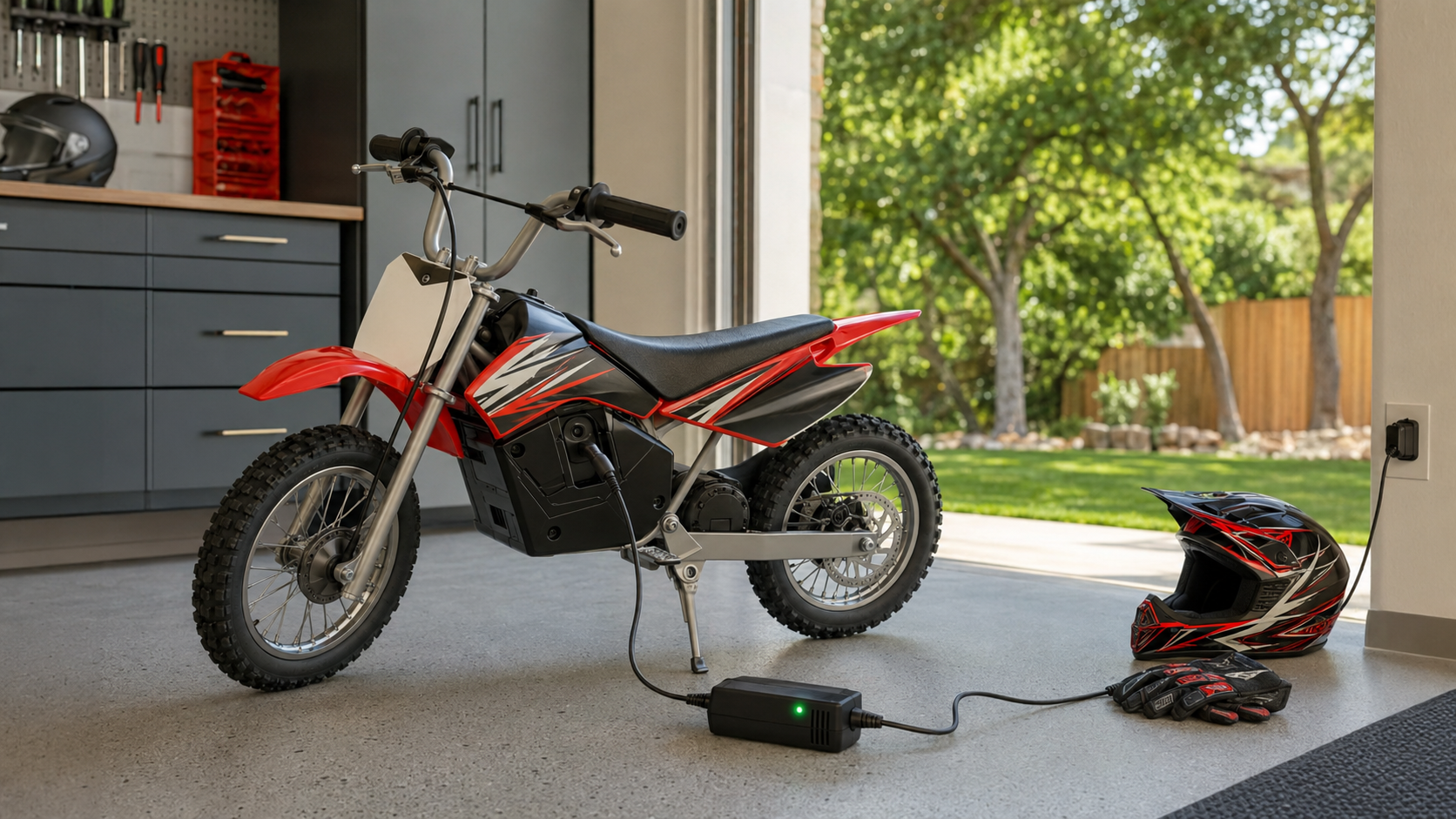
“How long does a Razor dirt bike battery last?” can mean ride time on one charge, charging time between rides or the number of months and years before the pack loses useful capacity. Separate those questions before comparing models.
The short answer
Ride time is not a fixed distance. Real results depend on rider weight, hills, grass, temperature, tire pressure, speed and battery condition. Full-throttle starts on soft ground use far more energy than steady riding on a firm surface.
| Factor | Effect |
|---|---|
| Heavier rider | More energy for acceleration and hills |
| Grass/loose soil | Higher rolling resistance |
| Steep grades | Large motor load |
| Low tire pressure | More drag and heat |
| Cold weather | Temporary performance reduction |
| Old battery | Lower usable capacity |
Ride time versus service life
Ride time describes one session. Battery service life describes capacity across many cycles. One short ride on wet grass is not proof of failure; a steady decline under the same conditions is more meaningful.
Lead-acid battery behavior
Many Razor Dirt Rockets use sealed lead-acid batteries. They are affordable and proven, but heavy and sensitive to being stored discharged. Follow the exact manual, use the specified charger and inspect the charger, port and wiring.
Charging routine
- Turn the bike off and let it cool.
- Inspect the port and cable.
- Use only the correct model charger.
- Charge for the manual's specified time.
- Recharge after use instead of storing depleted.
- Follow maintenance-charging guidance during long storage.
Never use a higher-voltage charger to make charging faster. Voltage, current, connector and protection logic must all match.
Signs of a weakening battery
- Ride time drops sharply under similar conditions
- The bike slows much sooner
- Performance collapses on mild hills
- The charger never completes normally
- Connectors become unusually hot
- The pack swells, leaks or smells abnormal
Stop using damaged or unusually hot equipment and have the system inspected.
Check the bike before blaming the battery
Verify tire pressure, brake drag, chain condition, connectors and full charge. A tight brake or poorly maintained chain can imitate a weak battery.
Terrain changes everything
Grass can shorten sessions dramatically. Hills are even harder because the motor must lift bike and rider. If thermal protection repeatedly activates, the terrain may exceed the model's intended use.
Lead-acid versus lithium
| Point | Lead-acid | Lithium-ion |
|---|---|---|
| Upfront price | Usually lower | Usually higher |
| Weight | Heavier | Better energy-to-weight ratio |
| Storage | Dislikes being left discharged | Needs model-specific storage care |
| Power feel | Voltage sag may be noticeable | Often more consistent |
Chemistry alone does not determine quality. Cells, charger, protection, replacement support and total bike efficiency matter.
Should you install a higher-voltage battery?
Battery conversions can change speed, current, heat and braking demands, create fire risk and void coverage. A purpose-built bike is safer than forcing entry-level components beyond design limits. Compare complete lithium systems such as the Ecoleap K1 and K2.
Battery-shopping checklist
- Is the claim time or distance?
- What rider weight and terrain were used?
- What are voltage and capacity?
- Is a replacement pack available?
- What does storage require?
- Does the battery have separate warranty terms?
A Razor battery lasts longest when rider, model and terrain match, the drivetrain is maintained, and charging follows the manual. Next use our Razor model comparison.


Share:
KTM SX-E 2 vs Yamaha PW50: Electric or Gas for a First Dirt Bike?
STACYC 12eDRIVE vs 16eDRIVE: Age, Inseam and Speed Guide