

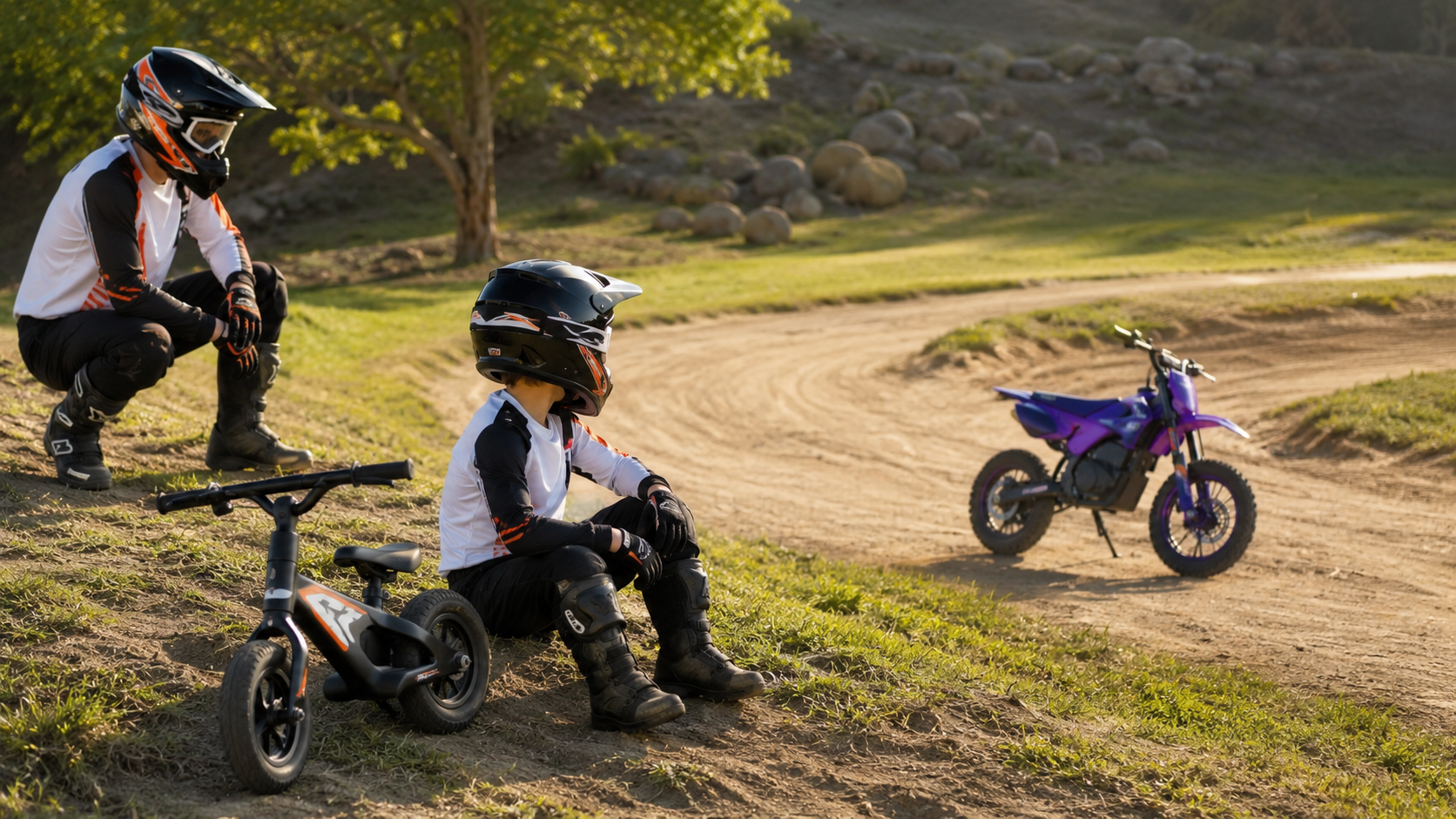
A child who has mastered a STACYC does not automatically need the fastest youth bike available. The best next step is usually a properly fitted electric dirt bike that adds a seated riding position, real foot pegs, suspension, stronger brakes and progressive speed control without asking the rider to manage too much weight or power at once.

What a STACYC teaches well
STACYC bikes are effective learning tools because they separate the early riding skills. A child can begin by pushing and coasting, learn to look ahead and balance, then add a low powered mode, throttle control and hand braking. Their light weight also makes it easier for a small rider to catch the bike, turn around and recover from a mistake.
That learning format is valuable, but it is different from riding a dirt bike. On a dirt-bike-style platform, the rider sits higher, keeps both feet on dedicated pegs while moving, uses suspension to manage uneven ground and must control a heavier machine during starts, stops and slow turns.
Five signs your child is ready to move beyond STACYC
1. The bike is physically too small
The clearest sign is fit. The rider’s knees may feel crowded near the handlebar, the torso may be compressed, or the child may need to hunch forward to ride normally. A child can remain below a manufacturer’s weight limit while already being too tall for the cockpit.
2. The rider has mastered the highest appropriate mode
Using high mode once is not mastery. Look for repeatable control: smooth starts, partial-throttle riding, left and right turns, stopping on command and releasing the throttle before braking. The child should respect boundaries even when excited.
3. The current chassis limits the terrain
A rigid fork, small tires and low ground clearance can become limiting on grass, packed dirt and mild trail irregularities. If the rider is controlled but the bike repeatedly bottoms, bounces or loses composure on reasonable terrain, a suspension-equipped platform may be more useful than simply unlocking more speed.
4. The child wants dirt-bike skills, not only more speed
The next category should teach foot-peg position, seated and standing body movement, braking before turns and maintaining balance without dragging the feet. A higher top speed without better chassis capability does not necessarily create a better progression path.
5. The child can manage more bike weight
Before buying, let the rider handle a similarly sized bike with the power off. The child should be able to hold it upright, turn the handlebar, push it, stop without panic and recover from a slight lean. If an adult must catch or reposition the bike every time, the step may be too large.
When not to upgrade yet
- The child still puts both feet down through every turn.
- Starts are abrupt or uncontrolled.
- The rider forgets to release the throttle before braking.
- The child cannot stop reliably at a chosen marker.
- The current bike still fits and provides enough challenge.
- The reason for upgrading is mainly peer pressure or boredom.
A new bike cannot correct missing fundamentals. A few more weeks of structured practice often produces more progress than a major increase in power.
STACYC models do not all lead to the same next bike
“After STACYC” can mean very different things. A rider coming from a 12eDRIVE has a different fit and experience level from one riding a 16eDRIVE ELITE or 20eDRIVE.
| Current platform | Typical reason to move up | What to prioritize next |
|---|---|---|
| STACYC 12eDRIVE | Outgrown 15-inch seat and small cockpit; rider has mastered balance and braking | Low seat, manageable weight, gentle first mode and easy brake reach |
| STACYC 16eDRIVE | Needs suspension, foot-peg technique or more terrain capability | Correct inseam, progressive modes, suspension and predictable braking |
| 16eDRIVE ELITE | Experienced rider wants a true dirt-bike riding position or different competition path | Chassis fit, brake/throttle transition and intended riding discipline—not merely more speed |
| STACYC 20eDRIVE | Rider has outgrown the balance-bike format or needs a motorcycle-style chassis | Appropriately sized youth dirt bike; avoid treating a heavier adult bike as the automatic next step |
Current official STACYC information lists the 12eDRIVE at a 15-inch seat and 17 lb, the standard 16eDRIVE at a 17-inch seat and 19 lb, the 16eDRIVE ELITE at a 19-inch seat and 31 lb, and the 20eDRIVE at a 23-inch seat and 33 lb. Model generations and availability can change, so verify the exact official product page before comparing fit.
Balance bike versus youth dirt bike: what actually changes?
| Feature | Powered balance bike | Next-stage electric dirt bike |
|---|---|---|
| Learning method | Push, coast, foot-dab and add power gradually | Ride with feet on pegs; practice seated/standing control and planned braking |
| Chassis | Low, light and easy to catch | Heavier and taller, with motorcycle-style geometry |
| Suspension | May be rigid on entry models | Suspension should help keep tires composed on uneven ground |
| Controls | Simple throttle and rear hand brake | Throttle, hand brake controls and speed modes on a larger cockpit |
| Terrain | Smooth pavement, short grass and packed dirt depending on model guidance | More suitable for controlled off-road practice when the chassis and tires support it |
How to choose the next bike
Start with inseam and seat height
Have the child wear riding shoes and measure from the floor to the top of a firmly held book between the legs. Compare this number with the bike’s seat height and manufacturer guidance. The rider should not feel trapped above the ground, but flat-foot contact is not the only fit test.
Check reach to the handlebar and brake
The elbows should remain slightly bent rather than locked. The rider should pull the brake lever without rotating the entire hand off the grip. Small hands can struggle with a lever even when the seat height appears correct.
Compare complete bike weight
Power figures attract attention, but weight affects every low-speed moment. Ask whether the rider can catch the bike at a stop, make a tight turn, push it back to the practice area and lift it after a tip-over. Buying a bike “to grow into” can delay learning if it removes independence.
Examine the lowest speed mode
The first mode matters more than the maximum speed on day one. A useful training mode should let the child practice smooth throttle input and stopping without the bike immediately running away from the rider’s current skill level.
Match suspension and tires to real terrain
A bike used on smooth pavement does not need the same chassis as one used on grass and packed trails. Suspension can improve control and comfort on uneven ground, but it does not make jumps, steep hills or technical terrain appropriate for a beginner.
Look for predictable braking
Brake type alone does not guarantee control. Lever reach, modulation, tire traction, rider weight and surface conditions all matter. Practice braking progressively instead of teaching the child to grab the lever suddenly.
Where Ecoleap K1 and K2 fit
Ecoleap K1 and K2 are dirt-bike-style alternatives for children ready to move beyond a powered balance-bike format. They use a seated chassis, dedicated foot pegs, suspension and progressive speed modes, but they serve different stages.
Ecoleap K1: a smaller first dirt-bike-style step
The K1 is the more approachable direction for a smaller rider who has learned basic balance and wants a motorcycle-style riding position without immediately moving to a much larger youth bike. Its three selectable speed modes progress up to 16 mph. Parents should begin in the lowest mode and evaluate physical fit before considering the top setting.
Ecoleap K2: more room and progression
The K2 is designed for a developing rider who needs more chassis capability and a higher progression ceiling. Current Ecoleap configuration uses an 850W brushless motor, 12 × 2.75-inch tires, rear disc braking, suspension and three modes up to 20 mph. That top speed is not a beginner setting; it should be introduced only after the rider repeatedly demonstrates control.
| Rider situation | Direction to evaluate | Reason |
|---|---|---|
| Still learning two-wheel balance | Stay with a balance-bike platform | A dirt-bike-style chassis can add weight and controls before the rider is ready |
| Confident on STACYC; physically smaller rider | Evaluate Ecoleap K1 | Smaller first step into seated dirt-bike geometry and progressive modes |
| Confident rider needs more room, suspension and progression | Evaluate Ecoleap K2 | Higher-capability platform while retaining selectable speed modes |
| Experienced rider already on 16 ELITE or 20eDRIVE | Compare by exact fit and riding discipline | A model change is not automatically an upgrade if chassis size or capability overlaps |
Common upgrade mistakes
Choosing by age alone
Two children of the same age can differ greatly in inseam, strength, coordination and maturity. Age can narrow the search, but it should not make the final decision.
Buying the highest power for future growth
Power does not create room in the cockpit, reduce bike weight or improve brake reach. A bike that is too large today may teach hesitation rather than confidence.
Comparing only maximum speed
The jump from 9 mph to 16 or 20 mph is meaningful. The parent should compare the lowest mode, throttle response, braking and rider fit before considering the headline top speed.
Assuming knobby tires mean trail-ready
Tread pattern is only one part of off-road capability. Wheel size, suspension, ground clearance, chassis strength, braking and rider control all affect where a bike can be used responsibly.
Skipping a power-off fit test
The best test happens before the motor is switched on. If the child cannot hold, steer and stop the complete bike calmly while stationary or walking, powered riding is premature.
A safer first-week transition plan
- Fit and controls: with power off, identify the throttle, brake and power controls. Confirm reach and teach “release throttle, brake, feet down.”
- Walking-speed handling: push the bike, make full-lock turns and practice holding it upright at a stop.
- Lowest-mode starts and stops: use a flat, open private area and two markers. Start at one and stop before the other.
- Wide turns: add large circles in both directions. The rider should look through the turn and keep throttle steady.
- Controlled surface changes: move from smooth ground to short grass or packed dirt only after starts, turns and stops are consistent.
- Progress by skill: unlock a higher mode only when the child can stop on command, maintain boundaries and ride without panic.
Protective gear and riding area
Use a properly fitted certified helmet, eye protection, gloves, long sleeves, long pants, over-the-ankle footwear and suitable knee and elbow protection. Gear does not replace adult supervision, mechanical checks or an appropriate riding area.
Ride only where motorized use is permitted. Avoid public roads, traffic, pedestrians, water, wet grass, loose gravel, steep slopes, jumps and technical terrain during the learning phase. Check tire pressure, controls, fasteners and brake function before every session.
Frequently asked questions
Should my child move up as soon as the STACYC looks small?
Physical fit is important, but the rider should also demonstrate consistent throttle release, braking and turning. If the current bike is too small, stop using it; then choose the next correctly fitted platform rather than jumping multiple sizes.
Is a 16 mph bike a reasonable step after a 9 mph STACYC?
It can be if the new bike fits and provides a genuinely manageable low mode. The parent should treat 16 mph as the top of a progression range, not the starting speed.
Is the fastest STACYC rider automatically ready for a 20 mph dirt bike?
No. Speed familiarity helps, but a dirt-bike-style platform can be taller and heavier and uses a different body position. Test fit, brake reach and low-speed handling first.
Does my child need suspension after STACYC?
Suspension becomes valuable when the rider is controlled and regularly uses uneven grass or packed dirt. It improves chassis composure and comfort, but it does not make aggressive terrain safe for a beginner.
K1 or K2 after STACYC?
Evaluate K1 for the smaller rider taking a first step into dirt-bike-style geometry. Evaluate K2 for a confident developing rider who fits the larger platform and needs more progression. Use actual measurements and a power-off fit check instead of choosing from age labels alone.
What if my child is tall but cautious?
Choose a chassis that fits physically, then prioritize the lowest mode and manageable weight. A tall beginner does not need the highest-performance model that accommodates the rider’s inseam.
Should a child move directly from STACYC to a gas dirt bike?
Some experienced riders can make that transition with professional instruction and an appropriately sized bike. Others benefit from a progressive electric platform with selectable modes. The correct path depends on fit, controls, training access and intended riding—not brand loyalty.
Bottom line
The best bike after STACYC is not automatically the fastest or most expensive option. It is the smallest next step that adds the capability the rider actually needs while preserving confidence and control.
Choose by inseam, reach, complete bike weight, lowest speed mode, brake operation and terrain. A smaller rider moving from a 12eDRIVE or standard 16eDRIVE may find the Ecoleap K1 a more manageable first dirt-bike-style direction. A confident developing rider who needs more room and progression can evaluate the Ecoleap K2. Riders coming from high-performance STACYC models should compare exact chassis fit and intended use because model categories can overlap.
See the Ecoleap K1, see the Ecoleap K2, or read the STACYC size guide before choosing.
Safety note: Rider readiness varies. Manufacturer age and weight ranges are only starting points. Product speed and runtime vary with rider weight, terrain, temperature and riding mode. Children should ride only in permitted areas with responsible adult supervision and appropriate protective equipment.
Official specification references
- STACYC 12eDRIVE official product page
- STACYC 16eDRIVE official product page
- STACYC 16eDRIVE ELITE official product page
- STACYC 20eDRIVE official product page
New: Is your child actually ready to leave STACYC?
Before shopping, run a three-part test over several riding sessions. First, ask the rider to complete ten smooth starts without snapping the throttle. Second, mark a stop box and require five accurate stops with throttle closed before braking. Third, have the child hold and walk a bike close to the next model’s total weight with the power off. If any part requires repeated adult rescue, the current STACYC is still teaching something useful.
The pre-PW50 middle stage
Parents often think the next choice must be another balance bike or a Yamaha PW50. There is a useful middle category: a correctly sized electric dirt bike with foot pegs, suspension and controlled speed levels. The Ecoleap K2 fills this role for riders who can manage its 20.67-inch seat, 41.89 lb weight and 10 mph lowest mode.
K2’s 400W sustained/850W peak brushless hub motor removes the external drive chain, while its 36V 7.8Ah lithium battery, rear mechanical disc brake and 12 × 2.75-inch tires support longer dirt-specific practice. The three modes should be treated as a syllabus: 10 mph for starts and stops, 15 mph for turns and mild slopes, and 20 mph only after advanced control is dependable.
What parents say about moving up too soon
In a Reddit discussion about toddler dirt-bike introductions and a second discussion about four- and eight-year-old riders, parents repeatedly focused on weight, ground reach, confidence and throttle habits. These comments are individual experiences, but they support a practical rule: do not buy “more years of use” by taking away a child’s ability to control the bike today.
Related reading: STACYC vs. K2 vs. Yamaha PW50 and Can a Child Go Straight From STACYC to PW50 or KTM?.


Share:
STACYC 12eDRIVE vs 16eDRIVE: Age, Inseam and Speed Guide
Yamaha PW50 Size Guide: Seat Height, Weight and Rider Readiness