

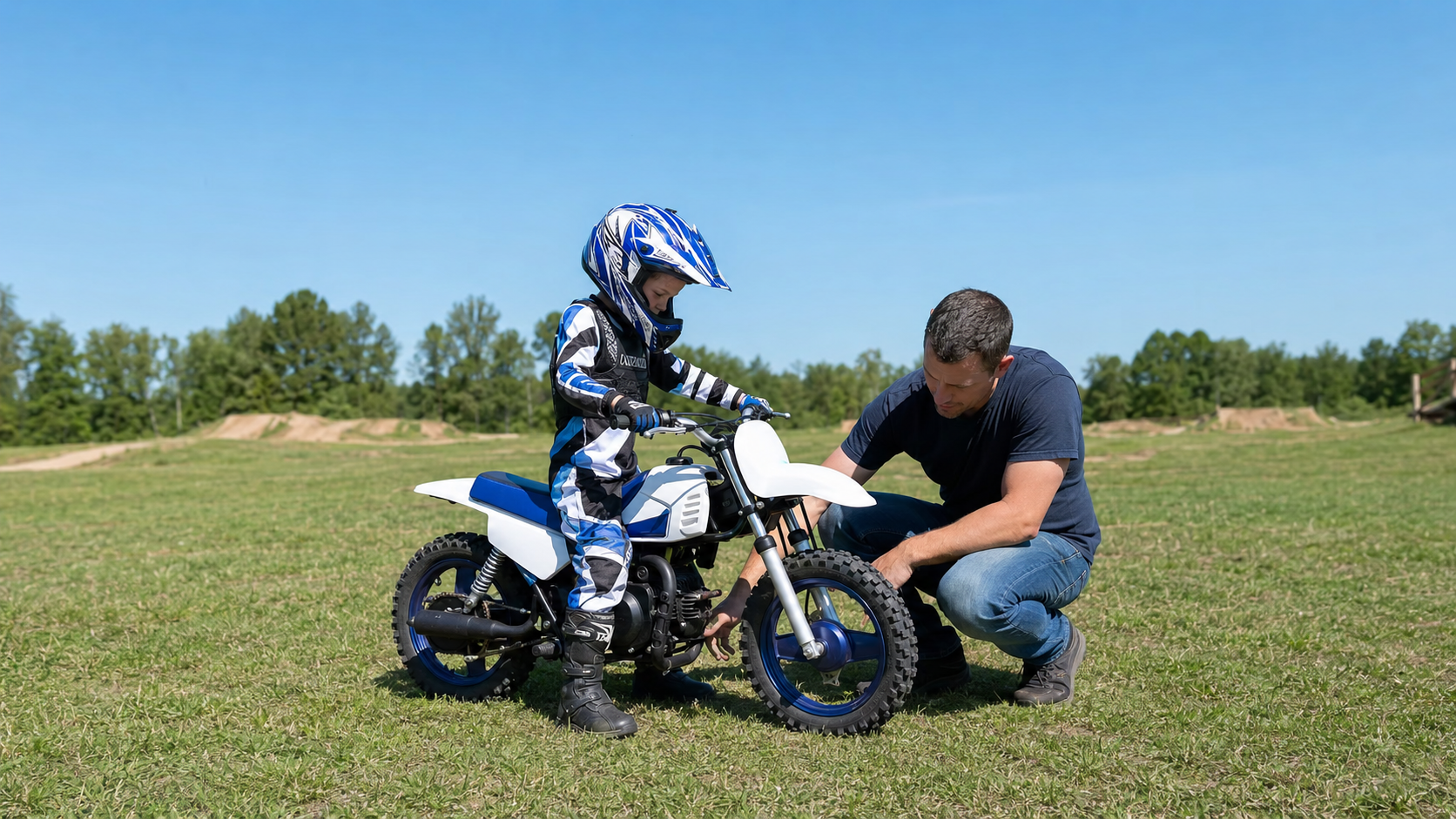
The Yamaha PW50 is often described as a first dirt bike, but an age label cannot tell you whether it fits your child. The useful questions are whether the rider can support the motorcycle, reach the controls, understand the throttle and recover calmly from a small mistake.
Yamaha currently lists the PW50 with an 18.7-inch seat height and a 90-pound wet weight. This explains both its appeal and its main limitation: the seat is exceptionally low, but the motorcycle is much heavier than a balance bike or many small electric learning bikes.
Quick answer: who fits a Yamaha PW50?
The PW50 can suit a small rider who already balances confidently, follows instructions and is physically comfortable with the motorcycle. It is not automatically right for every child whose feet touch the ground.
| Fit check | Ready sign | Warning sign |
|---|---|---|
| Feet down | Stops and stabilizes without panic | Bike immediately leans beyond the child's strength |
| Handlebar | Elbows stay slightly bent | Arms lock and shoulders pull forward |
| Brake | Lever works from a normal grip | Whole hand must move to reach it |
| Balance | Rides a bicycle independently | Still depends on training wheels |
| Instructions | Releases throttle and stops when asked | Excitement regularly overrides directions |
Seat height is only one measurement
Seat width, riding boots, suspension sag and body proportions change ground reach. Measure inseam in riding boots, then test the real motorcycle whenever possible. A beginner does not always need both feet perfectly flat, but should place the balls of both feet down and keep the bike upright.
Why 90 pounds matters
Ninety pounds is manageable for an adult but substantial for a young child. The rider does not need to lift it alone, yet should balance it at a stop and steer at walking speed. If an adult must continuously support the bike, physical fit has not been achieved.
Control reach and throttle readiness
The PW50 has a fully automatic transmission and an adjustable throttle stop screw. Those features reduce complexity, but do not replace training. Practice the response release the throttle, apply the brake, feet down at walking speed until it becomes automatic.
A five-minute fit test
- With the engine off, mount the child in complete riding gear.
- Turn the handlebar fully and check knee and elbow clearance.
- Ask the child to squeeze each brake without changing grip.
- Lean the bike slightly each way and see whether the rider recovers it.
- Have the child paddle forward, steer and stop at a marker.
PW50 versus a small electric bike
| Priority | PW50 | Small electric learning bike |
|---|---|---|
| Traditional gas-bike path | Strong fit | Useful preparation step |
| Quiet practice | Limited by engine noise | Usually more flexible where legal |
| Refill | Fast refueling | Charging required |
| Maintenance | Fuel and engine service | No gasoline or carburetor |
| Weight | 90 lb wet | Often lighter, model dependent |
Readiness matters more than age
- Rides without training wheels
- Starts, turns and stops independently
- Understands that releasing the throttle reduces power
- Follows boundaries every time
- Remains calm after a stall or low-speed tip
- Wants to ride without pressure
When the PW50 is a strong choice
Choose it when the child fits, the family has a legal riding area, an adult can maintain a gas motorcycle and the rider may progress through traditional motocross. The low seat, automatic transmission, throttle limiter and shaft final drive make it approachable within the gas-bike category.
When to start lighter
Choose a lighter electric platform when the child cannot stabilize the PW50, is sensitive to noise or needs frequent low-speed repetition. Ecoleap's K1 is one option for smaller beginners; the K2 is for riders who already have stronger two-wheel skills and fit its larger platform.
Final checklist
- Measure inseam in boots.
- Test brake and handlebar reach.
- Confirm independent stabilization.
- Begin with restricted power on flat ground.
- Use full protective equipment.
- Reassess after growth spurts.
For broader context, read our PW50 vs electric dirt bike guide and kids dirt bike height chart.


Share:
What Comes After STACYC?
Is My Child Ready for a PW50?