

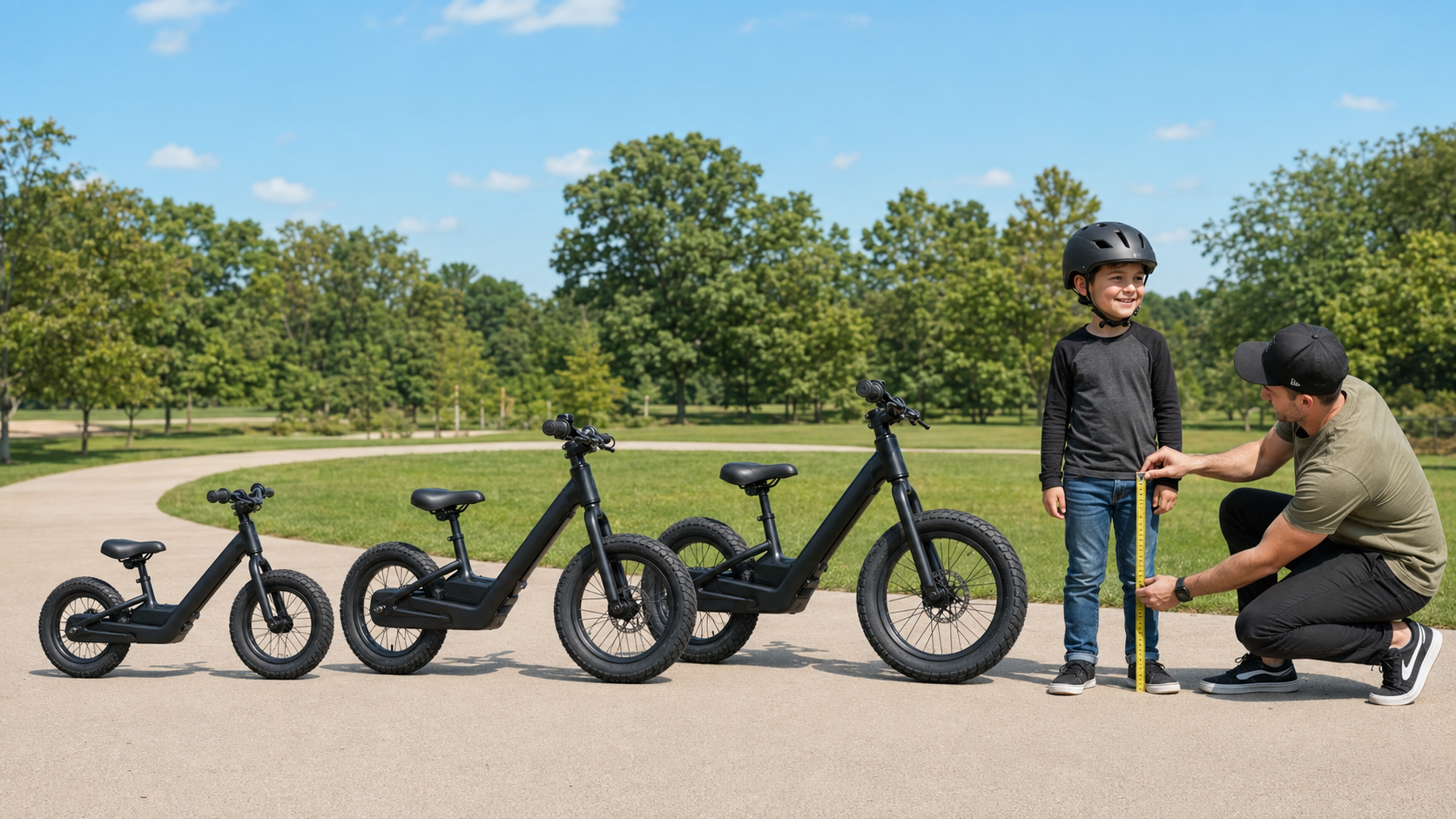
STACYC offers several powered balance-bike sizes, and wheel names do not directly tell you seat height, reach or skill level. The best fit comes from inseam, bike weight, balance experience and the terrain your child will ride.
Current model reference
| Model | Typical guidance | Seat | Weight | Use |
|---|---|---|---|---|
| 12eDRIVE | Ages 3–5, under 75 lb | 15 in | 17 lb | First powered balance bike |
| 16eDRIVE | Ages 5–7, under 75 lb | 17 in | 19 lb | Taller balance-bike rider |
| 16eDRIVE ELITE 36V | Ages 6–9, under 115 lb | 19 in | 31 lb | Experienced rider seeking more capability |
| 20eDRIVE | Ages 9–12, under 115 lb | 23 in | 33 lb | Older/taller rider |
Model generations differ. Verify the exact official listing.
1. Measure inseam
- Wear riding shoes.
- Stand naturally.
- Place a book firmly between the legs.
- Measure floor to book top.
- Repeat and use the smaller consistent number.
2. Check feet-down confidence
Powered balance bikes depend on foot dabs. A rider stretched onto tiptoes may fear turns and stops. Secure ground contact is more valuable than growth room.
3. Consider complete weight
The standard 12 and 16 are very light. The ELITE and 20 are significantly heavier. Ask the child to push, turn and pick up the bike with power off.
4. Match experience
A tall beginner does not automatically need the most powerful model that fits. Check gliding, steering, hand-brake use and stop commands. Experienced riders may benefit from ELITE capability; beginners often learn faster on a lighter platform.
12eDRIVE
Best for a small child moving from a non-powered balance bike. Begin without power, then use the lowest mode.
16eDRIVE
Best for a child who has outgrown the smaller cockpit and already glides confidently. It stays light while offering larger wheels and more room.
16eDRIVE ELITE
The 36V ELITE is a major weight and performance step, not merely a taller standard 16. It suits an experienced rider who fits the 19-inch seat.
20eDRIVE
The 23-inch seat and 33-pound weight require more strength. Families should compare whether the balance-bike format still serves the rider or a true dirt bike offers better footpeg, suspension and braking practice.
Modes cannot fix poor fit
Low mode cannot shrink the frame or reduce weight. The chassis must fit before power restriction matters.
Common mistakes
- Buying by age only
- Choosing the next size for growth
- Ignoring bike weight
- Using maximum weight as a fit recommendation
- Skipping non-powered practice
- Unlocking speed too soon
- Assuming all generations match
When to move to a dirt bike
Consider the transition when the rider needs real suspension and footpeg technique, controls braking without foot dragging and wants longer trail sessions. Smaller riders can compare the Ecoleap K1; taller confident riders can compare the K2. See What Comes After STACYC?
Final checklist
- Inseam fits current guidance.
- Feet reach securely.
- Brake is easy to squeeze.
- Elbows remain relaxed.
- The child can push and catch the bike.
- Low mode fits the practice area.
- Protective gear fits.
The model that fits now usually teaches more than the model bought for next year. Start with inseam and weight, then choose power capability.


Share:
Best First Dirt Bike for a 5-Year-Old: Parent Buying Guide
7 Common First Dirt Bike Mistakes Parents Can Avoid