

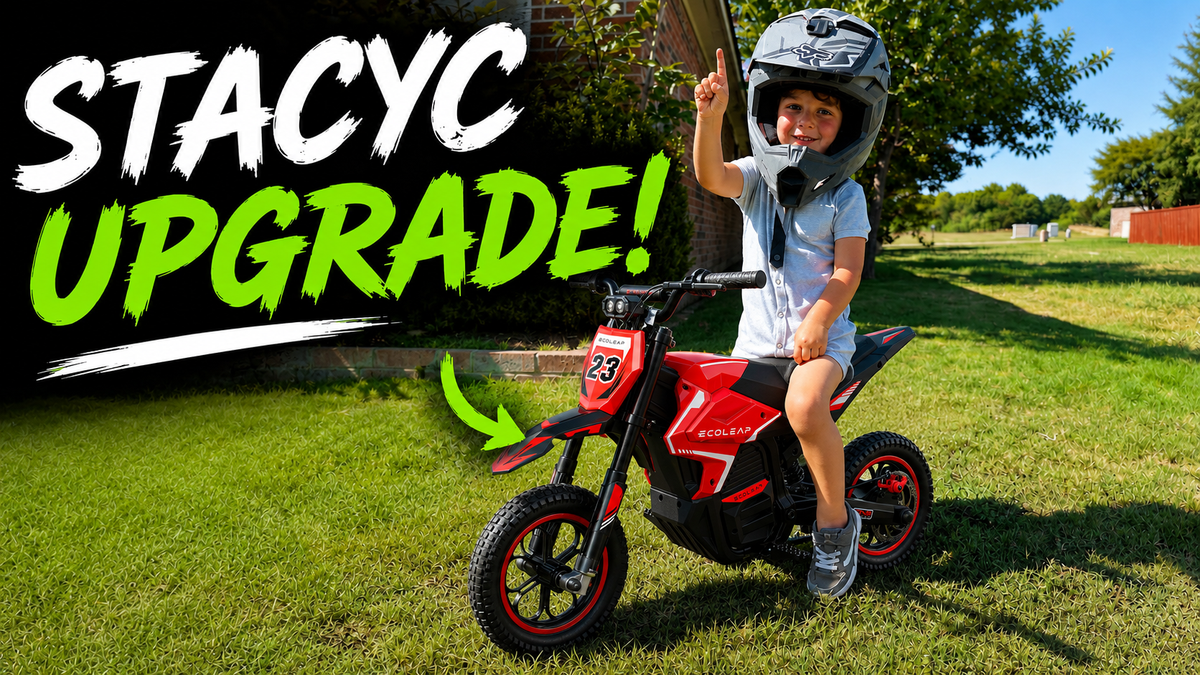
Short answer: the STACYC 12eDRIVE and the Ecoleap K2 are built for different stages. The 12eDRIVE is a 17 lb powered balance bike for small beginners learning to push, coast, balance, brake and use a throttle. The K2 is a 41.9 lb kids’ electric dirt bike with suspension, a rear disc brake, wider tires and 10, 15 and 20 mph speed modes.
For a child who is still developing basic balance or has a 16–19 inch inseam, the 12eDRIVE is usually the more appropriate learning tool. For a taller child who already rides confidently on two wheels, stops on command, manages a twist throttle smoothly and can physically control a 41.9 lb bike, the K2 offers much more room to grow.
The important point is that moving from a 12eDRIVE to a K2 is not a simple one-speed upgrade. It is a move from a powered balance bike to a more substantial off-road machine. Age alone should never make that decision.
STACYC 12eDRIVE vs Ecoleap K2 at a glance
| Feature | STACYC 12eDRIVE | Ecoleap K2 |
|---|---|---|
| Product type | Powered balance bike | Kids’ electric dirt bike |
| Current listed price | $799 | $499 |
| Official fit guidance | Ages 3–5, under 75 lb, 16–19 in inseam | Recommended rider height 37–56 in; readiness also matters |
| Seat height | 15 in | 20.67 in |
| Bike weight | 17 lb with battery | 41.9 lb |
| Speed modes | About 5 / 7 / 9 mph | 10 / 15 / 20 mph |
| Battery | 18V nominal, 2Ah lithium-ion | 36V 7.8Ah, 280.8Wh lithium-ion |
| Motor | Proprietary chain-drive system | 400W sustained / 850W peak brushless hub motor |
| Braking | Enclosed rear drum brake | Rear mechanical disc brake |
| Suspension | Rigid BMX-style steel fork | Oil-spring front fork and rear spring shock |
| Tires | 12 in pneumatic tires | 12 × 2.75 in off-road tires |
| Best use | Balance and throttle fundamentals | Grass, hard dirt, gravel and light off-road riding |
Specifications and prices can change. Confirm the exact product page and manual before purchasing.
These bikes teach different stages of riding
The 12eDRIVE starts with the logic of a balance bike. A child can remove or disengage power, push with both feet, coast and learn where the balance point is. Once coasting and braking become reliable, a parent can introduce the 5 mph training mode. This makes it especially useful for a small rider with little or no powered two-wheel experience.
The K2 assumes more foundational skill. It has foot pegs, a dirt-bike riding position and a lowest powered setting of 10 mph. The rider needs to commit to the pegs, look through turns and control the bike using body position rather than repeatedly catching it with both feet. Its suspension and wider tires also encourage riding on surfaces that are rougher than a driveway or smooth grass.
That is why the better question is not “Which bike is faster?” It is “Which learning stage is my child in?” A child who still paddles through every turn will gain more from the 12eDRIVE. A rider who confidently starts, turns, brakes and stops with feet up may be ready for what the K2 adds.
Fit: inseam and height are only the first checks
STACYC currently recommends the 12eDRIVE for children with a 16–19 inch inseam. Its 15 inch seat and very low weight let small riders place their feet down and recover from a lean. The K2 has a 20.67 inch seat and a much larger overall structure. Ecoleap lists a broad rider-height range of 37–56 inches, but a height chart cannot test strength, reach or judgment.
Before choosing the K2, have the child sit on a similarly sized bike and check all of the following:
- They can reach the handlebar without locking their elbows or leaning far forward.
- They can comfortably wrap their hand around the brake lever and apply meaningful pressure.
- At least the balls of both feet reach the ground, or the rider can confidently support the bike with one solid foot.
- They can hold the bike upright while turning the handlebar left and right.
- They can walk the bike forward and backward without the bike controlling them.
A child can be tall enough for K2 but not yet strong or coordinated enough to manage it. Another child may be slightly younger than expected but have excellent balance, bicycle experience and disciplined braking. Treat age as context, not permission.
The 24.9 lb weight increase matters more than the 1 mph speed gap
Parents often notice that the K2’s 10 mph beginner mode is only 1 mph above the 12eDRIVE’s 9 mph advanced mode. That makes the transition look small on paper. Physically, it is not.
The K2 weighs about 41.9 lb versus 17 lb for the 12eDRIVE—a difference of almost 25 lb. That extra mass changes low-speed balance, stopping distance, turning effort and what happens when the bike begins to fall. A rider who can rescue a 17 lb balance bike with one foot may not be able to save a 41.9 lb dirt bike using the same technique.
Before upgrading, test whether the child can intentionally lean a powered-off bike slightly, bring it upright and hold it there. If the child panics, twists the throttle while trying to recover, or needs an adult to keep the bike upright, continue practicing on the lighter bike.
Speed control and room to grow
The 12eDRIVE’s 5, 7 and 9 mph settings create small, manageable steps. Its first mode is close to an energetic child’s bicycle speed, giving parents time to teach “roll off first, then brake.” Its 9 mph ceiling is often enough for small backyards, pump tracks and basic dirt loops.
K2 begins where the STACYC finishes, then continues to 15 and 20 mph. This gives an experienced young rider a longer progression path, but only if adults treat the modes as training levels rather than features to unlock quickly.
A rider should remain in 10 mph mode until they can:
- release the throttle immediately on a verbal stop command;
- brake at a marked point without skidding or dragging their feet;
- complete wide and tight turns while looking ahead;
- restart smoothly without a sudden full-throttle launch;
- ride standing on the pegs over small bumps;
- stop on a mild incline and restart under control.
Only after these behaviors are consistent should a parent consider 15 mph. The 20 mph mode is for an advanced rider in a suitable off-road area with full protective gear—not a default setting for a child who has just outgrown a balance bike.
Suspension, tires and terrain
The 12eDRIVE has pneumatic 12 inch tires but no suspension. That simplicity keeps the bike light and direct. It works well for learning on pavement where permitted, packed dirt, short grass and smooth pump-track features. On repeated roots, ruts or rough ground, the rider absorbs more of each impact through the arms and legs.
K2 uses a telescopic oil-spring front fork, a rear spring shock and 12 × 2.75 inch tires. Those components help the tires follow uneven ground and reduce the sharpness of small impacts. For a child who already has basic control, this makes grass, hard dirt, gravel and light off-road trails more comfortable and predictable.
Suspension does not make every trail appropriate. Neither bike should be treated as a motocross race bike, and children should not ride on public roads. Parents should inspect the area for vehicles, drop-offs, deep mud, hidden holes, pedestrians and local restrictions before every session.
Brakes and drivetrain
Both bikes use a single rear brake, but the systems differ. STACYC uses an enclosed rear drum brake. It is protected and well suited to a light training bike. K2 uses a rear mechanical disc brake, which provides a more dirt-bike-like braking system for its heavier chassis and higher speeds.
The 12eDRIVE uses a BMX chain and freewheel, so the owner should include chain inspection and adjustment in routine maintenance. The K2’s brushless hub motor removes the external drive chain. There is no chain to lubricate, tension or put back on after a derailment. Families still need to inspect tire pressure, brake function, fasteners, charging equipment and any damage before riding.
Battery and real-world riding time
The 12eDRIVE includes a compact power-tool-style lithium battery. STACYC estimates 30–60 minutes of runtime and 30–60 minutes of charge time, depending heavily on terrain, hills and rider behavior. The quick-connect format also makes battery swaps convenient.
K2 has a much larger 36V 7.8Ah battery rated at 280.8Wh. Ecoleap lists up to 18 miles of range and a 5–6 hour charge time. These figures should not be compared as if one brand reports the same test as the other: STACYC publishes time, while Ecoleap publishes distance, and actual results change with rider weight, mode, temperature, hills, grass and frequent acceleration.
Practically, STACYC prioritizes a light, quickly swappable training battery. K2 prioritizes longer sessions and greater off-road output, with a longer recharge afterward.
Is K2 really the better value?
At the time of writing, the standard 12eDRIVE is listed at $799 while K2 is listed at $499. K2 therefore offers more speed, suspension and battery capacity for a lower advertised price. But value depends on whether the child can safely use those features.
A bike that is too tall, heavy or fast is not a bargain. For a three-year-old who is just learning to coast, the 12eDRIVE’s 17 lb weight and 5 mph mode may provide far more useful riding time than a larger dirt bike parked in the garage. For a confident rider who has already mastered a 12eDRIVE, K2 may deliver a longer next stage without moving immediately to a heavy gas motorcycle.
Choose the STACYC 12eDRIVE if your child:
- is generally in the 3–5 age range and fits the 16–19 inch inseam guidance;
- is learning balance, coasting and braking for the first time;
- needs a very light bike they can catch and maneuver independently;
- benefits from a 5 mph starting mode;
- will mainly practice on smooth, controlled terrain;
- needs a non-powered balance-bike stage before using the throttle.
Choose the Ecoleap K2 if your child:
- already rides a bicycle or powered balance bike confidently with feet up;
- fits the 20.67 inch seat and can reach the brake correctly;
- can independently balance and maneuver a 41.9 lb bike;
- releases the throttle immediately when asked and stops at a chosen marker;
- is ready to begin at 10 mph rather than 5 mph;
- wants suspension and wider tires for grass, hard dirt, gravel and light trails;
- needs 15 and 20 mph modes for future progression under adult control.
Six tests before moving from 12eDRIVE to K2
- Stop-command test: At 7–9 mph, the child must close the throttle and brake immediately when the parent gives the agreed signal.
- Feet-up test: Complete repeated straight runs and turns without paddling except when starting and stopping.
- Precision-stop test: Stop inside a marked box five times without overshooting.
- Slow-turn test: Ride a controlled figure eight while looking through each turn.
- Strength test: With power off, hold and walk a bike close to K2’s size and weight without adult support.
- Behavior test: Follow mode limits, wear full gear and stop riding when tired or frustrated.
If any test is inconsistent, that does not mean the child has failed. It means the lighter bike is still teaching a useful skill. Continue practicing and retest later.
A safer first-week transition plan
Session 1: controls with power off. Identify the throttle, brake and power controls. Practice mounting, dismounting, walking and releasing the throttle without moving.
Session 2: straight starts and stops. Use 10 mph mode in a flat, open area. Keep runs short and place a visible braking marker well before the boundary.
Session 3: wide turns. Add two large cones. Focus on looking through the turn, keeping the inside foot ready and rolling the throttle smoothly.
Session 4: figure eights and emergency stops. Make the turns gradually tighter. Practice the family’s verbal stop command at unpredictable but safe moments.
Session 5: mild uneven ground. Introduce short grass or packed dirt only after starts, turns and stops are automatic. Teach the rider to stand lightly on the pegs over small bumps.
Do not raise the speed mode during this first week merely because the child asks. Move to 15 mph only after control remains consistent across multiple sessions.
Frequently asked questions
Is K2 a direct replacement for the 12eDRIVE?
No. It is a next-stage option for a child who has outgrown the size and performance of a powered balance bike and can manage a heavier dirt-bike chassis.
Can a complete beginner start on K2?
Some taller, coordinated children with strong bicycle skills may succeed in 10 mph mode, but a child with no two-wheel balance or throttle experience will usually learn more easily on a lighter, slower machine.
Is the K2 safer because it has a disc brake?
No brake type makes a bike automatically safe. The rider must be able to reach the lever, close the throttle and apply the brake progressively. Fit, training, terrain and supervision remain essential.
Why is the 12eDRIVE more expensive even though it is slower?
Price does not directly measure motor output. STACYC emphasizes a very light aluminum platform, compact swappable battery system and balance-bike learning design. K2 emphasizes higher performance, suspension and longer progression at a lower listed price.
Should I skip the 12eDRIVE so my child will not outgrow it?
Not if the child still needs its learning stage. Buying for future size can make today’s bike harder to control. A properly fitted lighter bike often builds skill faster than a larger bike the child fears or cannot recover.
Does a child need to reach 9 mph before upgrading?
No. Speed alone is not the qualification. Smooth throttle use, reliable braking, turning, judgment and the physical ability to control K2 matter more than riding the STACYC at maximum speed.
What protective gear is needed?
Use a properly fitted certified helmet, eye protection, gloves, long sleeves, long pants, over-the-ankle boots, knee protection and elbow protection. Riding should take place only in a permitted off-road area under close adult supervision.
Final verdict
Choose the STACYC 12eDRIVE for the earliest powered two-wheel stage: small rider, low seat, very low weight and 5–9 mph progression. Choose Ecoleap K2 when the child has already mastered that foundation and is physically ready for a 41.9 lb dirt bike with 10–20 mph modes, suspension, wider tires and a stronger off-road focus.
K2 provides substantially more performance and long-term growth at a lower current listed price, but it is only the better choice when the rider passes the fit, strength, braking and judgment tests. The best upgrade is the one that stretches a child’s skills without exceeding their control.
For a broader look at the progression beyond powered balance bikes, read What Comes After STACYC?.


Share:
Kid's First Dirt Bike: When Is It Time to Upgrade to a PW50?
How Much Does a Yamaha PW50 Really Cost? A Parent’s Ownership Guide