

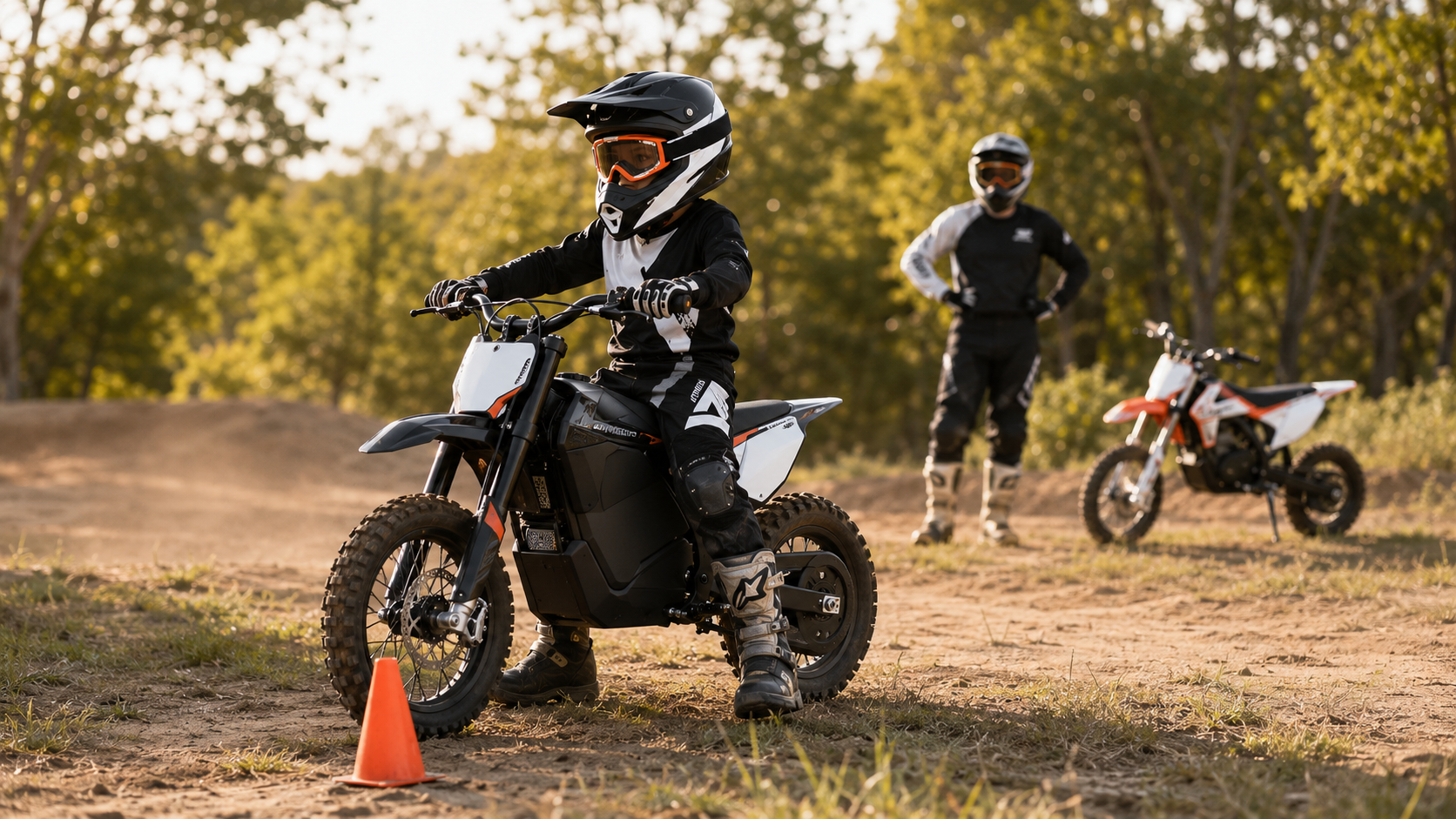
Moving from a balance bike or a small electric dirt bike to a Yamaha PW50 can feel like a major milestone. For many families, it is the child's first step into a traditional gasoline motorcycle. But the right time to upgrade is not determined by a birthday, the highest speed a child has reached, or how excited they are about the sound of a gas engine.

What Changes When a Child Moves to a PW50?
The Yamaha PW50 is designed as an entry-level gasoline dirt bike. Its 49cc two-stroke engine uses a fully automatic, single-speed transmission, so the rider does not need to operate a clutch or shift gears. An adjustable throttle stop lets a parent limit how far the throttle can open. The shaft final drive avoids exposed-chain maintenance, and the oil-injection system eliminates the need to premix gasoline and oil.
Those features make the PW50 easier to approach than a race-oriented motocross bike, but it is still different from a small electric dirt bike. According to Yamaha's current specifications, it has an 18.7-inch seat height and weighs about 90 pounds ready to ride. That low seat can help a child touch the ground, yet the total mass may be much greater than the electric bike the child is leaving.
A gas engine also changes the ownership routine. There is fuel to store and transport, an engine and exhaust that become hot, oil and service items to monitor, and more noise than a typical electric model. The bike cannot simply be switched on for a quiet practice session in every backyard. The family needs a suitable off-road riding location and adults who are prepared to manage the motorcycle as well as coach the rider.
The Best Upgrade Signal Is Automatic Control
Parents often ask, “My child uses the highest mode on the electric bike. Does that mean they are ready?” Not necessarily. Speed familiarity is only one small part of riding ability. A child can be comfortable traveling fast in a straight line and still lack the habits needed to control a heavier motorcycle when something unexpected happens.
The strongest upgrade signal is that correct actions happen without a parent calling them out. The rider sees a turn and slows before entering it. They look toward the exit rather than staring at the front wheel. If the bike moves unexpectedly, their first reaction is to close the throttle rather than grip harder. When the parent gives the agreed stop signal, the child responds immediately.
These habits matter more than how old the rider is or how long they have owned the current bike.
Eight Signs Your Child May Be Ready for a PW50
1. Starting and stopping are consistent
The child can start smoothly without a sudden surge and stop at a chosen marker repeatedly. Test this over several sessions, not just once. A ready rider can coordinate throttle-off and braking even when excited, tired or approaching from a slightly different angle.
2. Rolling off the throttle is automatic
This is one of the most important habits for preventing “whiskey throttle,” where a frightened rider hangs on and accidentally twists the throttle farther. Ask the child what to do when confused, then observe the real reaction during low-speed drills. The correct response should be to close the throttle, straighten the bike when possible and brake progressively.
3. The child can ride slowly, not only fast
Low-speed control reveals more than top speed. The rider should be able to follow a wide figure eight, weave around widely spaced cones and maintain balance without constantly putting a foot down. A child who can only stay stable while going fast may need more time on the current bike.
4. Turns are planned rather than rescued
Look for early braking, eyes up and a smooth line through the corner. The rider should not charge into every turn, panic, drag both feet and rely on an adult to redirect the bike. Perfect technique is not required, but basic judgment should be repeatable.
5. The rider follows boundaries every time
A PW50 should not be the reward for ignoring instructions on a smaller bike. The child should remain inside the practice area, stop when signaled, avoid people and parked vehicles, and understand that riding ends when safety rules are ignored. Emotional maturity is part of readiness.
6. Minor mistakes do not cause panic
Every young rider stalls, tips over or misses a line. A ready child can pause, listen and try again without becoming reckless or shutting down completely. Confidence should mean calm problem-solving—not a lack of caution.
7. The PW50 fits in the real riding position
The child should reach the handlebars without locking the elbows or leaning forward excessively. Their hands must operate the controls comfortably, and their feet should stay secure on the pegs. Ground contact should provide useful support at a stop, not just a toe touching while the motorcycle leans heavily to one side.
8. The family wants the gasoline-bike pathway
The PW50 makes the most sense when the family wants traditional motorcycle ownership, riding areas suited to gas bikes, or a future path toward trail riding or organized motocross. If the goal is convenient neighborhood practice, low noise and simple maintenance, a well-fitted electric dirt bike may continue to serve the child better.
A Simple PW50 Fit and Strength Test
Do this test with the engine off and an adult holding the motorcycle securely. Protective footwear is useful even during a stationary check.
- Seat position: Have the child sit in the normal riding position with hips centered rather than sliding far forward to reach the ground.
- Ground support: Confirm that the rider can support the motorcycle at a stop without the bike immediately falling into the adult's hands.
- Handlebar reach: The child should turn the bars from side to side without pulling the torso off-center.
- Brake reach: Small hands must reach and operate the levers without releasing the grip completely.
- Static lean recovery: With the adult in control, allow a very small lean and see whether the child can recognize and resist it.
- Walking control: Let the child walk the bike forward and stop it using the brakes, still with the engine off and close adult support.
Touching both feet down is reassuring, but it does not prove that a child can manage a 90-pound motorcycle. If the PW50 repeatedly overwhelms the child's legs or upper body during these stationary drills, do not assume engine power reduction will solve the problem. The throttle limiter can reduce speed; it cannot reduce weight.
Signs It Is Better to Stay Electric Longer
Continuing with the current bike is the better choice when the rider still needs frequent verbal reminders for basic control. Specific reasons to wait include:
- The child freezes or holds the throttle open when surprised.
- Braking begins only after a parent shouts a reminder.
- The rider cannot complete slow turns without repeated falls or adult catches.
- The PW50 is physically difficult to support even though the seat is low.
- Noise or engine vibration makes the child tense and distracted.
- The family does not yet have a legal, practical place to ride a gas motorcycle.
- The child enjoys the current bike and is still learning meaningful skills on it.
There is no prize for reaching a PW50 early. A lighter or more controllable electric dirt bike can give a child more repetitions because setup is quick and noise is lower. More good practice often develops stronger fundamentals than fewer sessions on a bike that feels intimidating.
K1, K2 and PW50: Different Steps, Not a Simple Ranking
The Ecoleap K1, Ecoleap K2 and Yamaha PW50 should not be treated as three levels in which every child automatically progresses from one to the next. They support different riders and different family goals.
A child does not need to “graduate” from electric merely because they have become competent. The Ecoleap K1 can remain useful while a young rider builds balance and braking. The K2 can provide a more capable electric step for a confident rider who still benefits from quiet practice and progressive speed modes. The PW50 is the better next step only when the rider fits it and the family deliberately wants gasoline-bike ownership or a motocross pathway.
How to Make the First PW50 Sessions Safer and More Familiar
When the child passes the readiness checks, avoid changing the bike, terrain and training rules all at once. Use a familiar, flat, open practice area with a clear boundary. Keep the first sessions short and finish before fatigue causes mistakes.
- Engine off: Learn the controls, hot areas, mounting, walking and braking.
- Sound and throttle: Become comfortable with vibration, then rehearse “roll off and brake” at a conservative throttle setting.
- Straight drills: Practice smooth starts and stops inside a marked box.
- Wide turns: Add circles and an easy figure eight while keeping eyes up and hands relaxed.
- Mild terrain: Introduce small surface changes only after control is repeatable. Avoid deep sand, steep hills and crowded tracks at first.
Are the Parents Ready for the Upgrade?
Child readiness is only half of the decision. Before buying or moving to a PW50, the adults should be able to answer yes to the following:
- We have a permitted off-road area where a gasoline motorcycle can be used.
- We can transport and store the bike and fuel safely.
- We will follow the owner's manual for inspection, fluids and service.
- We understand which parts become hot and can supervise around them.
- We have properly fitting helmet, eye protection, gloves, long clothing and over-the-ankle boots.
- An attentive adult will supervise every session.
- We are willing to keep the throttle setting conservative while the child adapts.
If the family's riding access is rare or complicated, the PW50 may result in less practice than the current electric bike. That practical issue matters. The best progression tool is the one the child can ride safely and consistently.
Frequently Asked Questions
What age should a child upgrade to a PW50?
There is no single correct age. Yamaha designs the PW50 for young beginners, but fit, strength, control habits, judgment and supervision matter more than age alone. Two children of the same age can be at very different stages.
Does reaching 20 mph on an electric dirt bike mean the rider is ready?
No. Maximum speed does not test low-speed balance, emergency throttle-off response, precise stopping or the ability to manage a heavier motorcycle. Evaluate the complete skill set.
Is the PW50 difficult because it has a gas engine?
The fully automatic transmission removes clutch and shifting tasks, while the adjustable throttle stop helps parents limit speed. The challenge is the complete package: weight, engine procedures, heat, noise, fuel and riding-location requirements.
Is an 18.7-inch seat height low enough for every child?
No. Seat height is only one measurement. Leg length, boot thickness, hip position, handlebar reach and the rider's ability to support the bike all affect real fit.
Should we sell the electric bike immediately?
If budget and storage allow, keeping it briefly can reduce pressure. The child can return to a familiar platform for balance drills while learning the PW50's new procedures. Once the rider consistently chooses the PW50 and no longer needs the old bike for practice, selling it may make sense.
When is staying on a K2 the better choice?
Stay electric when the child is still developing control, the family values quiet and frequent practice, or the available riding areas do not suit a gasoline motorcycle. A rider who continues learning on a K2 is not falling behind.
Final Upgrade Checklist
- The child fits the PW50 and can support it while stopped.
- Handlebars and brake levers are comfortably within reach.
- Throttle-off is the automatic response to uncertainty.
- Starts, turns and marked stops are consistent.
- The rider can follow boundaries and adult stop signals.
- Minor mistakes do not trigger panic or reckless behavior.
- The child wants the gasoline-bike experience rather than feeling pressured into it.
- The family has safe riding access, protective equipment and a maintenance plan.
- The throttle limiter will begin at a conservative setting.
- The first sessions will use familiar, flat terrain.
The Bottom Line
It is time to upgrade to a PW50 when the move adds a useful new layer of learning without taking away the child's basic control. The ideal rider already manages balance, throttle, braking and boundaries on the current bike. The PW50 then introduces a traditional gasoline motorcycle, a heavier chassis and new ownership procedures while keeping operation approachable through its automatic transmission and adjustable throttle stop.
If the child still depends on speed limits, verbal reminders or adult catches, keep building skills on the current electric bike. A few additional months of confident practice can make the eventual PW50 transition smoother, safer and more enjoyable.
Choose the bike the child can master now, not the bike you hope they will grow into. See the Ecoleap K1, see the Ecoleap K2, or read our PW50 readiness guide for a more detailed pre-purchase assessment.
Safety note: Rider readiness varies. Always follow the motorcycle owner's manual and warning labels, use properly fitting protective equipment, supervise children closely and ride only in permitted off-road areas. Speed and range claims for electric bikes can vary with rider weight, terrain, temperature and riding mode.
New: A four-stage K2-to-PW50 transition plan
If the child is using an Ecoleap K2, treat its three modes as preparation levels rather than speed rewards.
- 10 mph foundation: ten smooth starts, five precision stops, wide turns in both directions and immediate response to the family stop signal.
- 15 mph terrain control: brake before turns, stand lightly over small bumps, stop and restart on a mild slope and choose a safe line without constant prompting.
- 20 mph advanced control: use only in an appropriate open off-road area after technique remains calm at higher speed. Maximum mode is not required for PW50 readiness.
- PW50 familiarization: return to low-speed drills. Learn the engine-off controls, heat zones, starting routine, sound and different throttle feel before adding turns.
Do not confuse a low seat with a light bike
A PW50’s low seat can look welcoming, but complete motorcycle weight still affects stops, tight turns and tip-over recovery. Test the child’s ability to support and walk the powered-off motorcycle. A throttle stop can limit engine response; it cannot reduce mass.
When staying on K2 is the stronger choice
Continue on K2 if throttle-off is not automatic, the rider still needs frequent adult catches, gas-bike noise creates tension or the family lacks a practical permitted place to ride. K2’s brushless motor, lithium battery and chainless drive can make frequent short practice easier for many households. More successful repetitions often matter more than an early change of platform.
See also Why K2 Works as a Pre-PW50 Training Bike and Razor Dirt Bike to Yamaha PW50: Skills That Transfer.


Share:
Is My Child Ready for a PW50?
STACYC 12eDRIVE vs Ecoleap K2: Is Your Child Ready to Upgrade?