

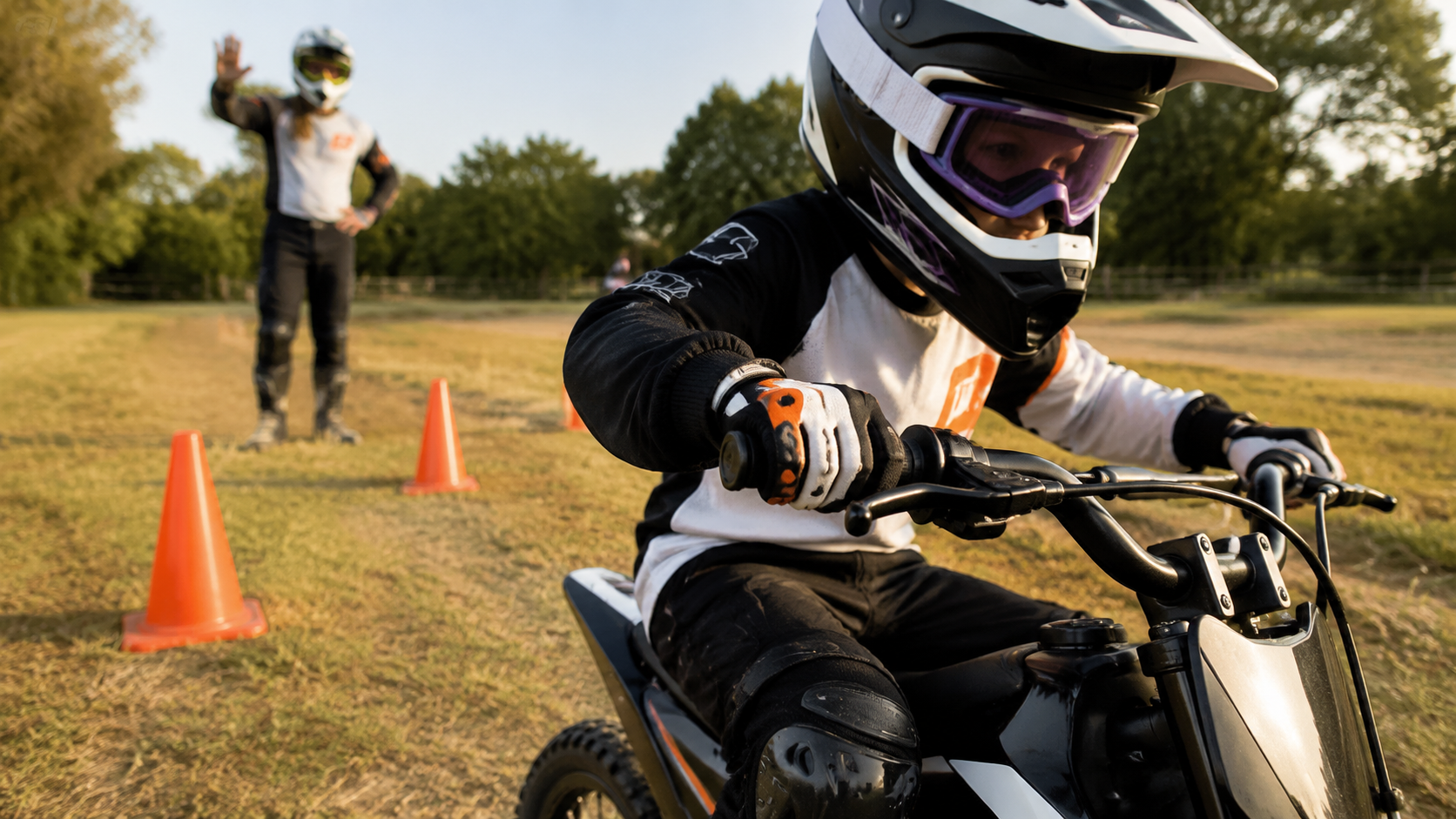
Teach throttle control in three stages: wrist movement with power off, straight-line starts in the lowest mode, then controlled roll-off and braking at a marked stop.

Set the hand position
The wrist should begin in a neutral position, not cocked high over the grip. Explain that relaxing and rolling forward reduces power. Make sure the child can reach the brake without changing their whole grip.
Practice with power off
Ask the rider to roll the throttle a few millimeters and return it smoothly. Say “power” and “off” while they match the movement. Repeat until roll-off is automatic.
Use a short start lane
Select the lowest mode. The adult stabilizes only as recommended by the manufacturer, then the rider applies minimal throttle for a few yards and rolls off before braking.
Teach the surprise response
The safest response to uncertainty is eyes up, throttle off and smooth brake pressure. Practice the verbal cue at low speed before adding turns.
Progress gradually
Add wide circles, then figure eights. Do not raise the speed setting until starts are smooth and the child stops inside the box repeatedly.
Parent checklist
- Choose by fit and control, not age alone.
- Start in the lowest available speed mode.
- Use a certified helmet, gloves, knee pads and elbow pads.
- Practice on flat, open private property with adult supervision.
- Check local rules before riding.
Frequently asked questions
What causes accidental surges?
A high wrist position, gripping too tightly, turning the bars while tense or trying to hold on with the throttle hand can all add input.
Should I run beside the bike?
That can place the adult in the bike’s path. Use a controlled area and the teaching method specified for the model.
Next step
Compare the Ecoleap K1 and K2 before choosing the right first bike. See the Ecoleap K1, see the Ecoleap K2, or read our kids’ electric dirt bike buyer’s guide.
Safety note: Rider readiness varies. Product speed and range can change with rider weight, terrain, temperature and riding mode. Kids should ride off-road only in permitted areas under responsible adult supervision.
Why “whiskey throttle” happens
When a beginner becomes frightened, the body often stiffens. The child pulls on the handlebar for support and may rotate the throttle farther instead of closing it. The solution is not simply telling the rider to be careful. Parents need to teach a physical escape response until it becomes automatic: relax the grip, rotate the wrist forward to zero power, straighten the bike when possible and apply the brake progressively.
Five drills that build real throttle control
- Millimeter drill, power off: open the grip only a few millimeters, pause and close it completely.
- Walk beside, power off: mount, dismount, turn the bars and reach the brake without using the throttle hand as a support handle.
- Start box: launch with minimum input and roll off before crossing a nearby line.
- Steady-speed lane: hold one moderate pace instead of alternating between full power and coasting.
- Random stop signal: the adult gives the agreed cue at safe moments; the child must roll off first and stop in control.
How K2’s three modes should be used
The Ecoleap K2 provides 10, 15 and 20 mph modes. Keep the learner at 10 mph until every drill above is consistent over multiple sessions. Move to 15 mph only if higher response does not change hand position, braking order or judgment. The 20 mph setting is for a capable rider in an appropriate area; it is not part of a beginner’s first-week curriculum.
What parent communities warn about
In a Reddit parent discussion, some riders described budget mini-bike throttles as feeling close to on/off and worried that children could learn a full-grip habit. That is subjective owner experience, not a measured comparison, but it highlights why steady partial-throttle drills should come before more speed.
Stop the session before fatigue teaches bad habits
Short sessions are more productive than one long session that ends with tight hands and delayed reactions. Finish after a successful drill, record what the child can repeat and continue another day. A frightened or tired rider should never be pressured to “get back on” immediately.
Related reading: Training Wheels vs. a Pre-PW50 Electric Dirt Bike and Why Kids Lose Confidence on an Oversized First Dirt Bike.


Share:
7 Common First Dirt Bike Mistakes Parents Can Avoid
Backyard Dirt Bike Riding Guide for Kids